
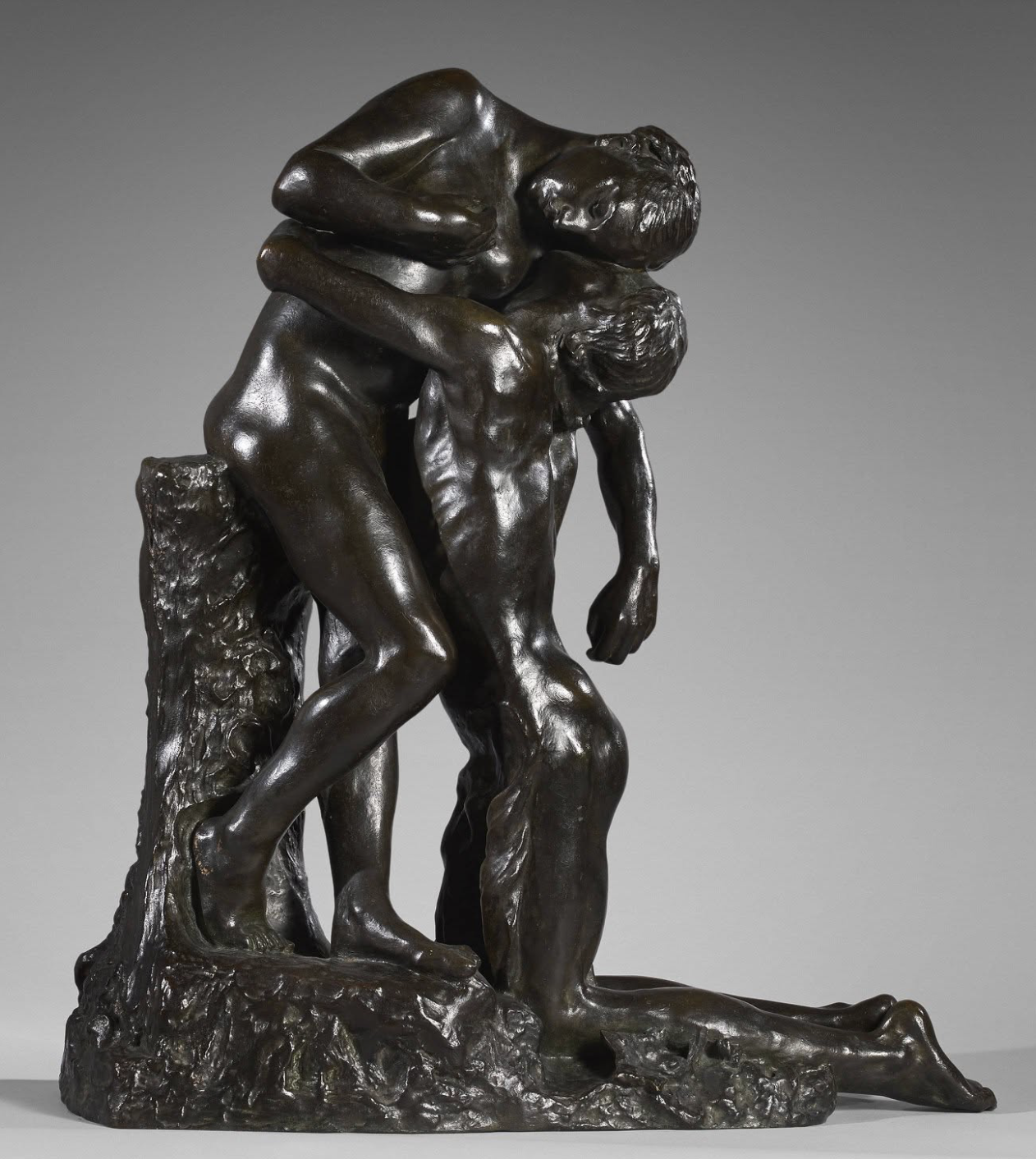
Camille Claudel
The Abandonment
Bronze
1886
Musée Camille Claudel in Nogent-sur-Seine
S13E4.
Anne-Louise Mikkelsen
I chose The Abandonment by Camille Claudel, also called Shakuntala, which is after a Sanskrit play, where King Dushyanta lost his memory of his beloved Shakuntala, and now has refound her, and this sculpture we're seeing is actually their reunion. Shakuntala is standing, embracing her king. He's kneeling in front of her, and she's holding his head. She's shadowing her breast, protecting herself. There's so much emotion, there's so much sensibility, and a bit also fragile. The artist's story is fascinating. She was not particularly supported by her family — her dad, to some extent, but her mother, not. And she was a woman working a bit in the shadow of men, actually, despite her being an absolute genius. She went all in 100% doing what she wanted to do. It was her passion that was the driving factor here, and for me, the driving factor is passion, or else I would never have done what I've done. I was just 16 when I saw it the first time, and it's kept with me. I've never forgotten about this.
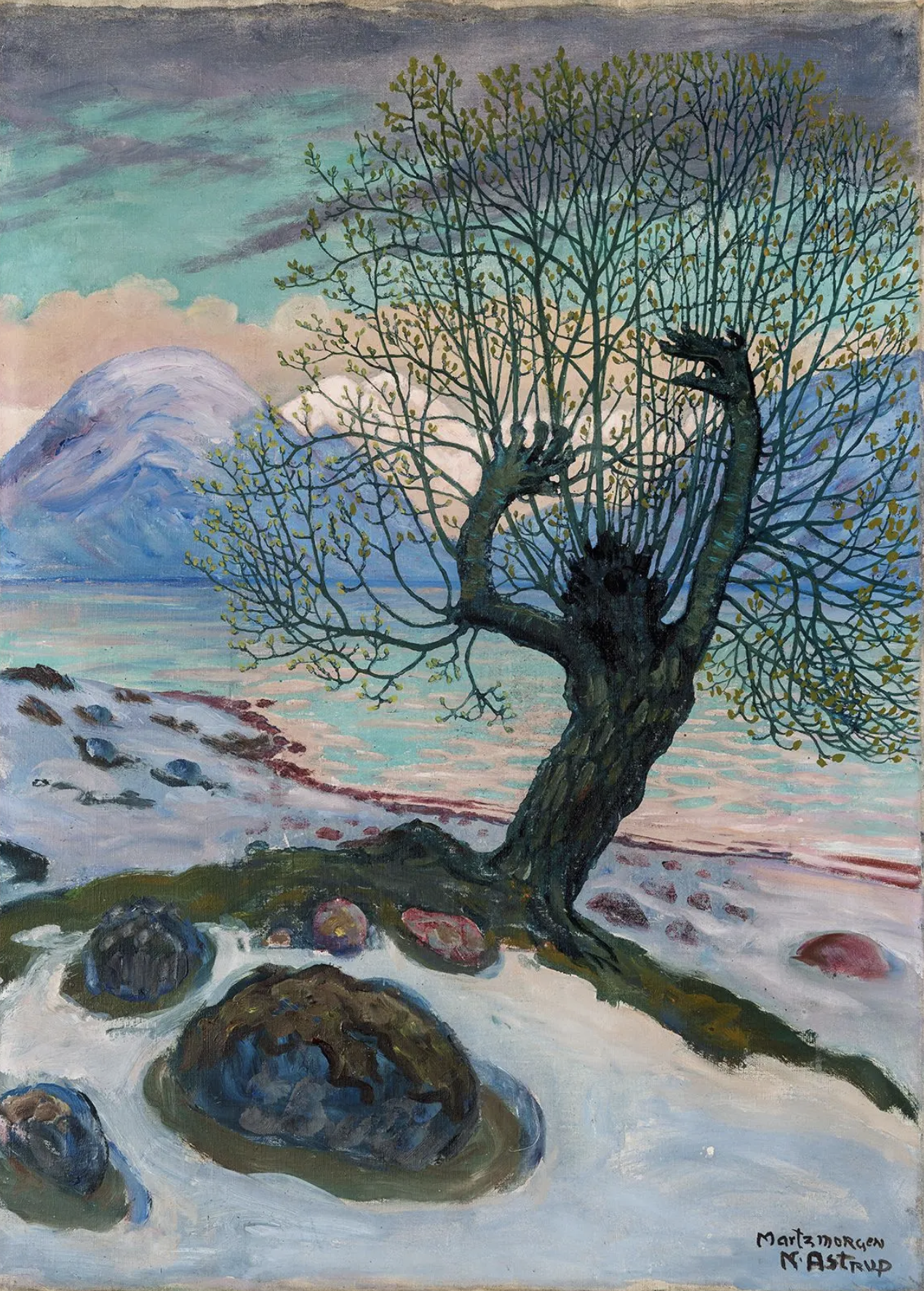
Nikolai Astrup
A Morning in March
Oil on canvas
1920
Kode Art Museums, Bergen
S13E3.
Thure Lindhart
I've chosen Marsmorgen or A Morning in March by Nikolai Astrup. A tree is rising up with mountains in the background. In the tree, you also see hands and arms, and you see branches that could be hair, and you see a face. So the tree becomes a living being, but it also becomes a troll or something in a fairy tale, something deeply rooted in culture and nature. I portrayed the Norwegian painter in a film about him called Flammen over Jølster. He left Jølster to study in Paris. And when he came back, his father was so disappointed with him that he didn't want to become a minister like himself, so he wouldn't lend his son money to build a house on the sunny side of the lake. Nikolai had to move to the shady side where there was never sun, and he spent the next many years growing, farming, and building. He painted his home, the mountains, the lakes, the people, the nature, and he turned this little shadow land into a paradise. And I think it's a beautiful image of this man turning shadow into life and art.
Emil Westman Hertz
Nine of Wands
Installation
2016
Statens Museum for Kunst, Copenhagen
© Emil Westman Hertz / VISDA
The rights-restricted image is purposely blurred.
S13E2.
Kira Skov
I've chosen Emil Westman Hertz' Nine of Wands, which contains lots of different pieces. He works with organic materials: wax, cones, wood. Very raw, very spiritual. There's something very haunting about it. There's also something about the cycles of life and something very ancient in the expression of it. You couldn't pinpoint a time period that it was created within. It transcends time. It could be hundreds of years old, and it could also be very modern. Emil passed on half a year before Nicolai, my husband. They grew up together. My whole house is full of pieces by Emil. He left a great body of work behind considering he was only 38 years old when he passed. I have a personal connection to Emil's work. We both went through a great illness and I think the both of us used that as a creative tool. There's something about death being very present, close by. In that sense, I've always been very drawn to his work.
François Schuiten
"The Theory of the Grain of Sand"
from the series Cities of the Fantastic
Colored pencil, black ink, Indian ink, acrylic on paper
1992–2009
King Baudouin Foundation, Brussels
© Peeters-Schulten-Casterman, Ph. de Formanoir
The rights-restricted image is purposely blurred.
S13E1.
Jesper Kyd
I chose this image from François Schuiten's series Cities of the Fantastic, which has been recently brought to English under the Obscure Cities name. What I see is an impossible situation. There's no way your house is going to be in the water like that, and he's just sitting there completely calm, like everything is fine. Of course it speaks about the environmental damage that we've been doing to Earth and the way the water rise is becoming a problem here in the US and the world, of course. But it also is very much Schuiten's style of mixing two things together that don't really go together. Basically, in my head, the inventors of the comic books Tintin and Asterix and Smurfs invented all of that stuff that took years to break through in America. There's so many risks being taken in comic book art. It doesn't try to conform to anything. I find it very liberating to read certain comic books. They're just so much out of the box, which is what I try to do with my music as well. It inspires me to push things harder and to keep reminding myself that we haven't reached a place where, oh, everything has been done. So that's what I get out of his artwork. I love when he combines two impossible situations together and it makes you think.