
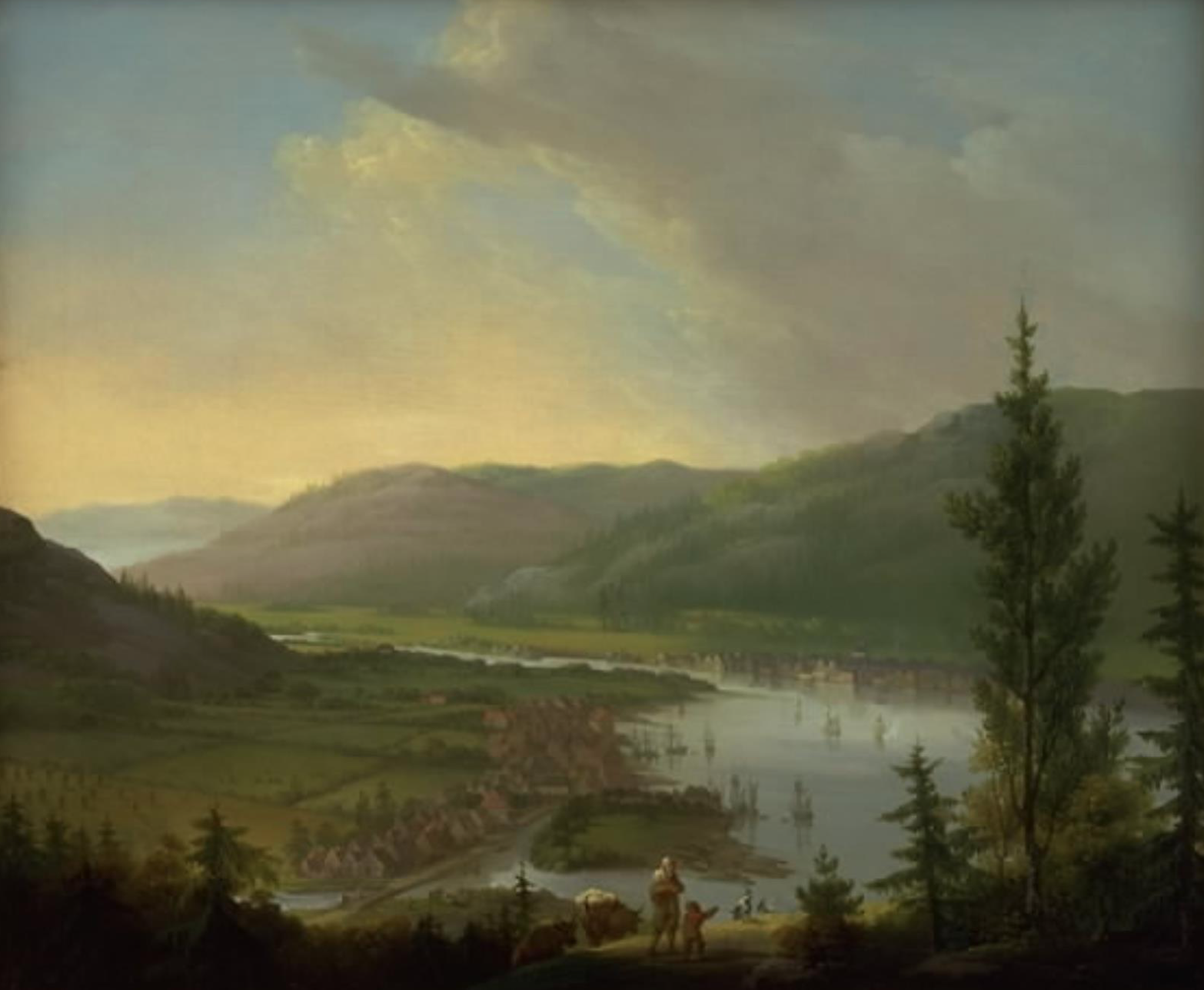
C.A. Lorentzen (1746–1828)
View towards Drammen, Norway
Oil on canvas
1790–1799
Statens Museum for Kunst, Copenhagen
S5E10.
Barbara Topsøe-Rothenborg
I chose Lorentzen's View towards Drammen, Norway. This painting really spoke to me because of Lorentzen's really masterful composition, nuanced use of light, and very detailed execution. And it just makes a really beautiful work of art where he offers this aesthetic pleasure and he directs the viewer's eye through the serene beauty of this landscape. And it has just a very poetic and romantic quality that I really adore. I'm a very visual director and always have been. I'm super particular about composition and lighting. I'm also prepping a feature that's shooting partly in the Norwegian countryside, something I've always loved to travel in. So I'm drawn to that right now, looking at options for shooting. This quiet, almost meditative mood of the painting expresses my own longing for peace and reflection in nature. It inspires me to enjoy life.

Superflex (1993–)
FOREIGNERS, PLEASE DON'T LEAVE US ALONE WITH THE DANES!
Installation
2002
Statens Museum for Kunst, Copenhagen
© Superflex / VISDA
The rights-restricted image is purposely blurred.
S5E9.
Jamil GS
I chose the art piece, "FOREIGNERS PLEASE DON'T LEAVE US ALONE WITH THE DANES" created by SUPERFLEX in 2002. The bold graphic font against neon orange reads like an alarming newspaper banner. When I returned to Denmark for a long stay after 20 years in New York, I could see banners pop up at kiosks around Copenhagen with manipulating headlines about immigrants or second-generation Danes. It's both brilliant and tragic. Brilliant because it's a really bold statement that flips the nationalist and racist rhetoric on his head, prompting questions and dialogue. Tragic because it's a topic that is still relevant today in Denmark as well as other countries of the West. It resonates with me because those drew parallels to this destructive racism that I'd seen in America. It could easily as well read, "Foreigners, Please Don't Leave Us Alone with the Americans or Germans or French or British." It is something that didn't exist in the Denmark that I was born in and grew up in.

Loui Michael (1933–2022)
Imaginary Scenery. Nocturne
Oil on fibre board
1981
Statens Museum for Kunst, Copenhagen
© Loui Michael / VISDA
The rights-restricted image is purposely blurred.
S5E8.
Signe Byrge Sørensen
I chose Imaginary Scenery. Nocturne from 1981 by the painter Loui Michael. It's a bright, colourful picture with a yellow fence. It could be any fence in the town I grew up in. Growing out of this orange chaos on the ground, it's birds and weird characters and so on. This painting, it's full of generosity and love of the craziness of everything. It's like looking right into his very creative brain. I think painting as art is such a singular experience. It comes out of this one person's creative mind and then it's shared with all of us. And it's so different from film because film is such a collaborative art. Every little element in a film is discussed a million times and planned, shot, edited, redone, mixed, and so on. I don't think it's easy to paint at all. I think that must be incredibly hard. And in that sharing moment, we can take out of it whatever we feel at that particular time or any time. And I think that's really interesting.
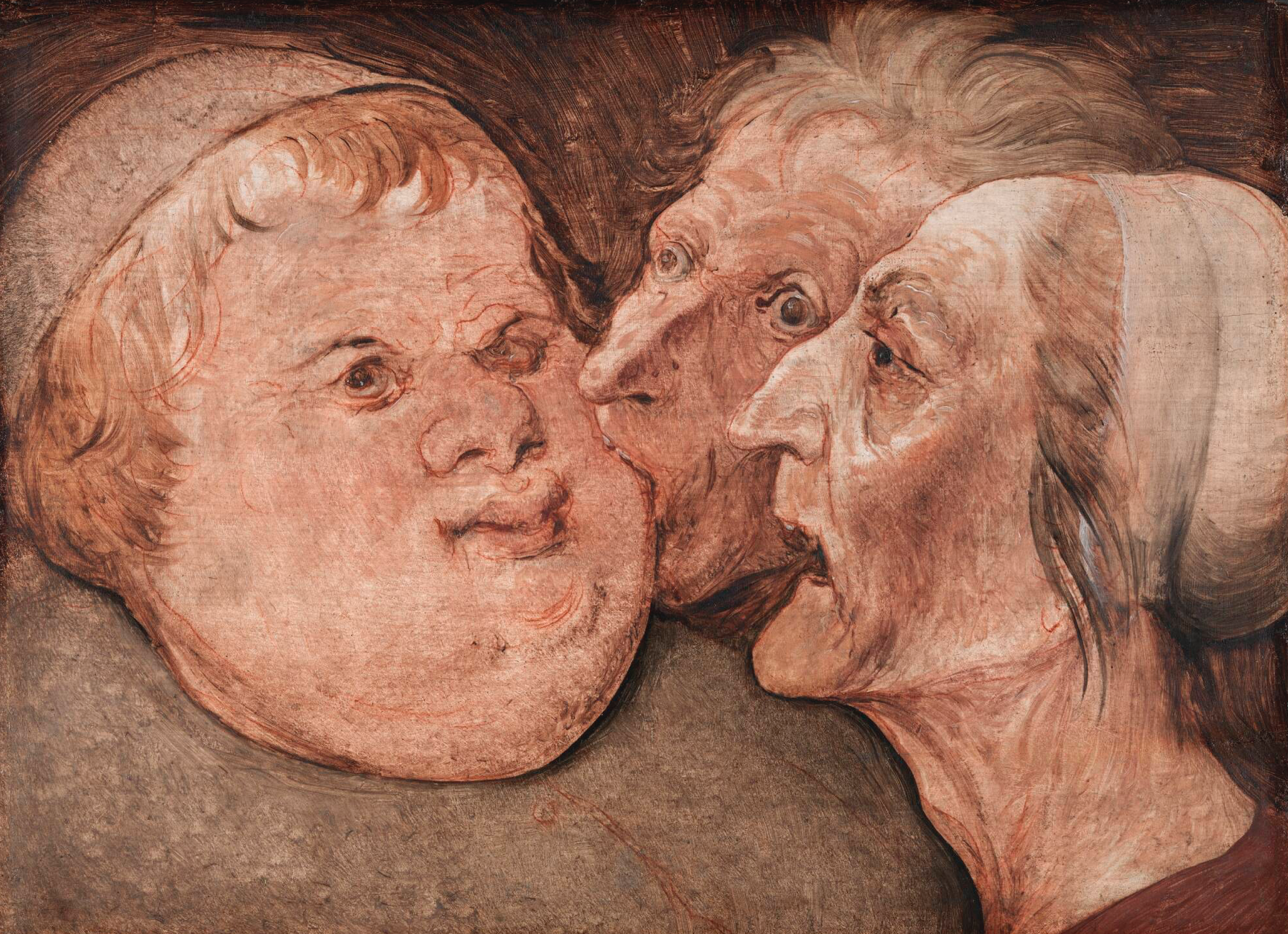
Pieter Bruegel (I) (1526–1569)
The Strife between Carnival and Lent
Oil on panel
1562
Statens Museum for Kunst, Copenhagen
S5E7.
Joshua Oppenheimer
I chose The Strife Between Carnival and Lent by Pieter Bruegel the Elder. It's a tiny little painting. You have a fat man representing Carnival being bit by what I think is an emaciated woman representing Lent, who has her eyes fixed on the distance, but also seems startled by what she's just done, like it was a starving impulse. The woman in the foreground is already in a daze, but is gnawing at the cheek of the skinny Lent efigure. The fat man's eyes representing Carnival are watering with pain, and there might be a wince, but he too is distracted, and what could it be? I sense an ancient mythical conflict, really, humans attacking each other, and being undone, literally, by what they're doing. They become someone else. It's as if I woke up from a dream and could feel and visualize every detail. It just took my breath away. What motivates me in all my work are the ways that we really have no idea who we are and what we're doing until we find ourselves doing it. And all our attempts to sort of impose control through the stories we tell about ourselves are illusory the moment those stories fall apart.
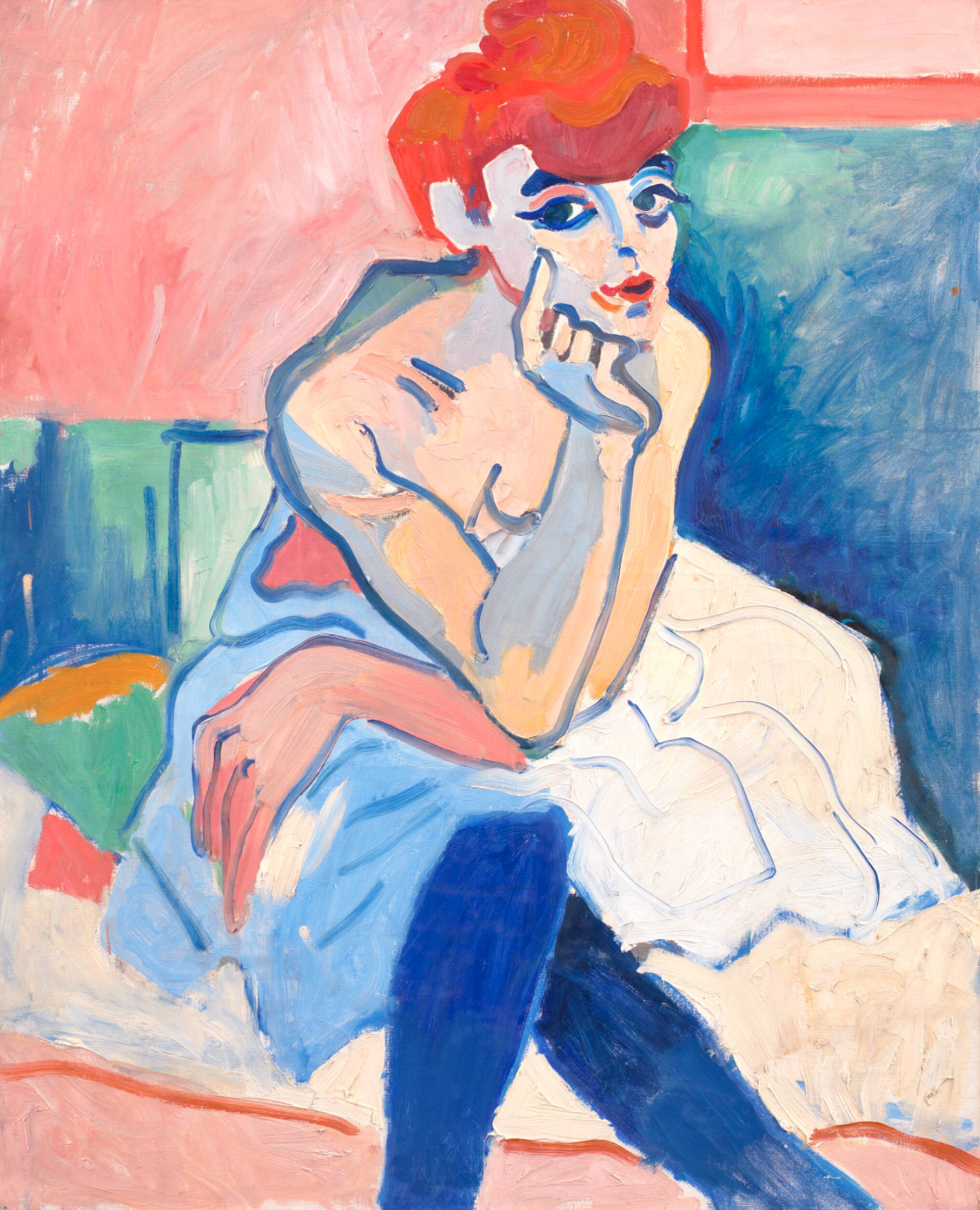
André Derain (1880–1954)
Woman in a Chemise
Oil on canvas
1906
Statens Museum for Kunst, Copenhagen
S5E6.
Tonny Sørensen
I chose André Derain, Woman in a Chemise. My uncle was an artist. And it was one of those stories that he lived in Mallorca in the '70s. I met him twice in my life. I got a painting from him when my dad passed away. My dad passed away very young. He was 49, of lung cancer. And he had this little painting of this girl looking out the window that I still have to this day. And this image is very close to that painting. That's why I chose this. It reminds me of the mystique I thought, or the enigma, of my uncle living in Mallorca and what that was like. This is what I long for, living in a beautiful place and just wake up in the morning and paint. This painting, it's simple, a little abstract, it gives you exactly the feeling of what she's thinking. And that's what I like. It's a little loose. I like the way she's looking at you. It looks like photographs back in the day. I love that just being able to get an expression and you get it. You don't have to go close and see how it's done. You just look at it and go, this is exactly who this woman is.
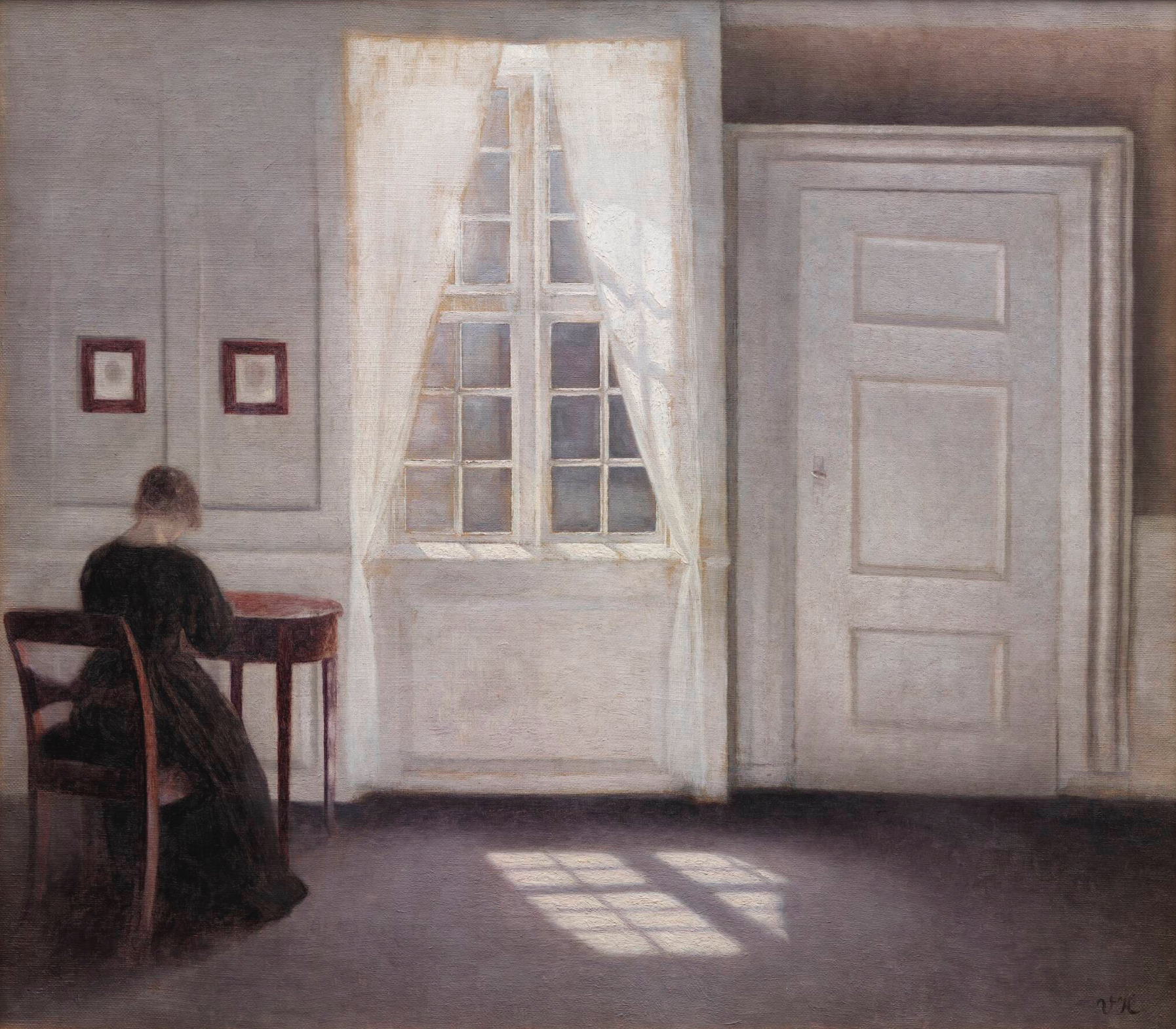
Vilhelm Hammershøi (1864–1916)
Interior in Strandgade, Sunlight on the Floor
Oil on canvas
1901
Statens Museum for Kunst, Copenhagen
S5E5.
Lasse Elkjær
I picked the picture by Vilhelm Hammershøi, Interior in Strandgade, Sunlight on the Floor. I like the simplicity of it, the minimalism, and the calmness of it. The lady sitting at the desk in her own thoughts, we don't know what she's doing. I can put myself in her shoes. I spend most of my time in front of a desk, sitting in a chair in deep thoughts, creating my music. I would write a classical-based score with a smaller chamber ensemble, a lyrical, nostalgic tone to it, and instrumentation to be not grand, so it's almost like the instruments sit in that room. A picture like this is a calming focus to me. I'm an old soul. It's like I've been living another life, maybe from that time period with no electronic gadgets. Something in there lures me in, makes me want to be there.

J.F. Willumsen (1863–1958)
A Mountain Climber
Oil on canvas
1942
Statens Museum for Kunst, Copenhagen
© J.F. Willumsen / VISDA
The rights-restricted image is purposely blurred.
S5E4.
Sharin Foo
I chose the painting A Mountain Climber by J.F. Willumsen, of a woman standing on the top of a mountain looking out. Something about the color palette: expressive, surreal, psychedelic, strong. Coming from a flat little country of Denmark, living here in Los Angeles, I connect with the desert and the mountain ranges and the Pacific Ocean and that kind of hugeness in nature. I look out and I see three-dimensional mountain ranges and I suddenly have this perspective. This adventurer that she represents, I kind of have a feeling of that wanderlust that I've had in my life. I see that in that painting as well.
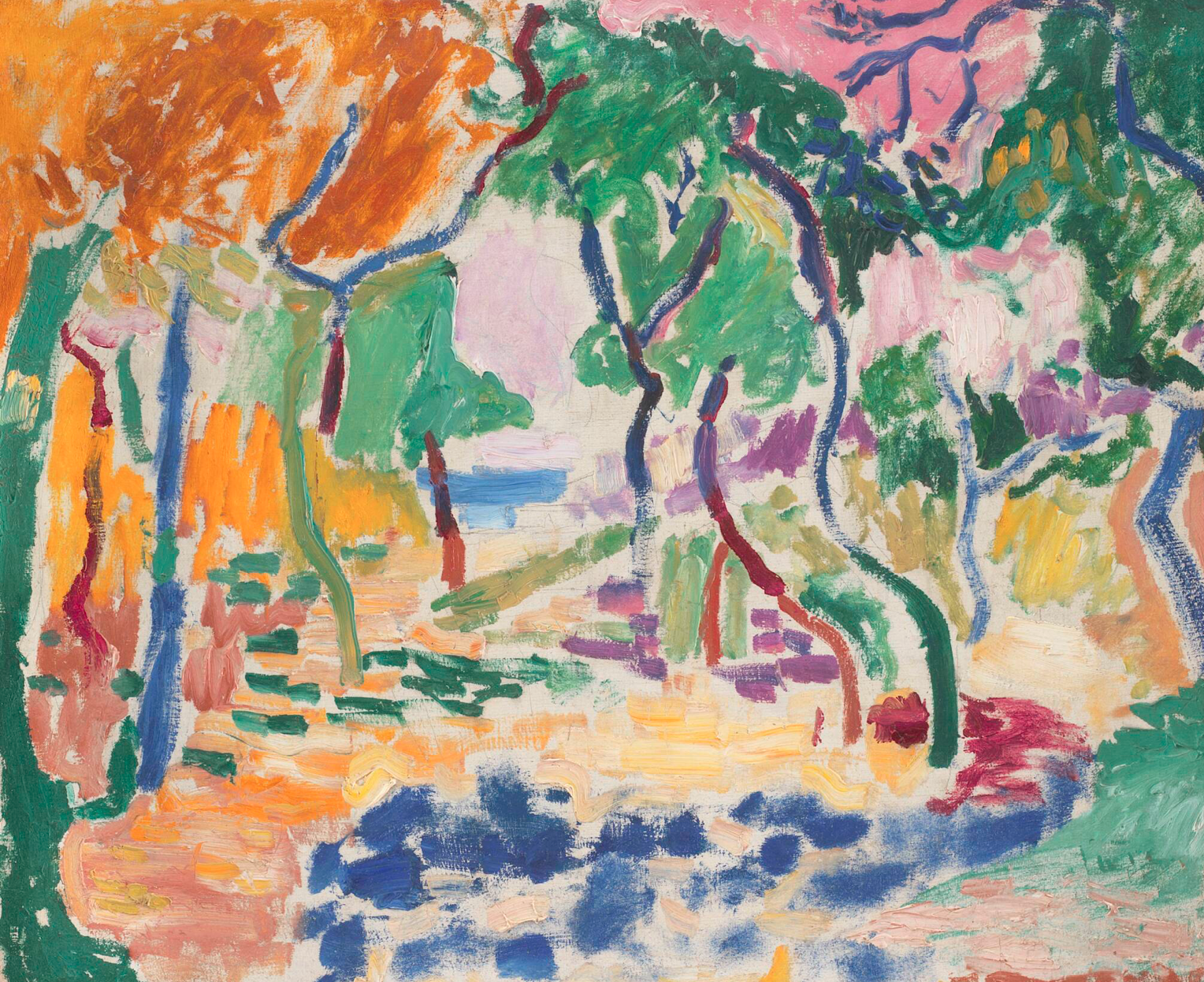
Henri Matisse (1869–1954).
Landscape near Collioure. Study for "The Joy of Life"
Oil on canvas
1905
Statens Museum for Kunst, Copenhagen
S5E3.
Eva Jensen
I've chosen Landscape near Collioure by Henri Matisse. It's a study for The Joy of Life from 1905. It's a landscape, a forest glade, a clearing in the woods, painted in beautiful vibrant colors. I am drawn in by the undulating lines, the tree trunks, the narrowed perspective view of the horizon in the distance, the movement and the rhythms in the composition. I'm drawn to the luminous colors and the atmosphere, the silent music. These elements are all part of what creates great architecture when it's well-designed, well-composed and built, materialized. It's a study. It has more layers than a sketch. And as an architect, the development for an idea, the study of a vision from the invisible, the immeasurable, to the visible field, is an interesting open process. It's the beginning of a large artwork, and it carries a seed, the DNA, of a promise of something beautiful and exhilarating.
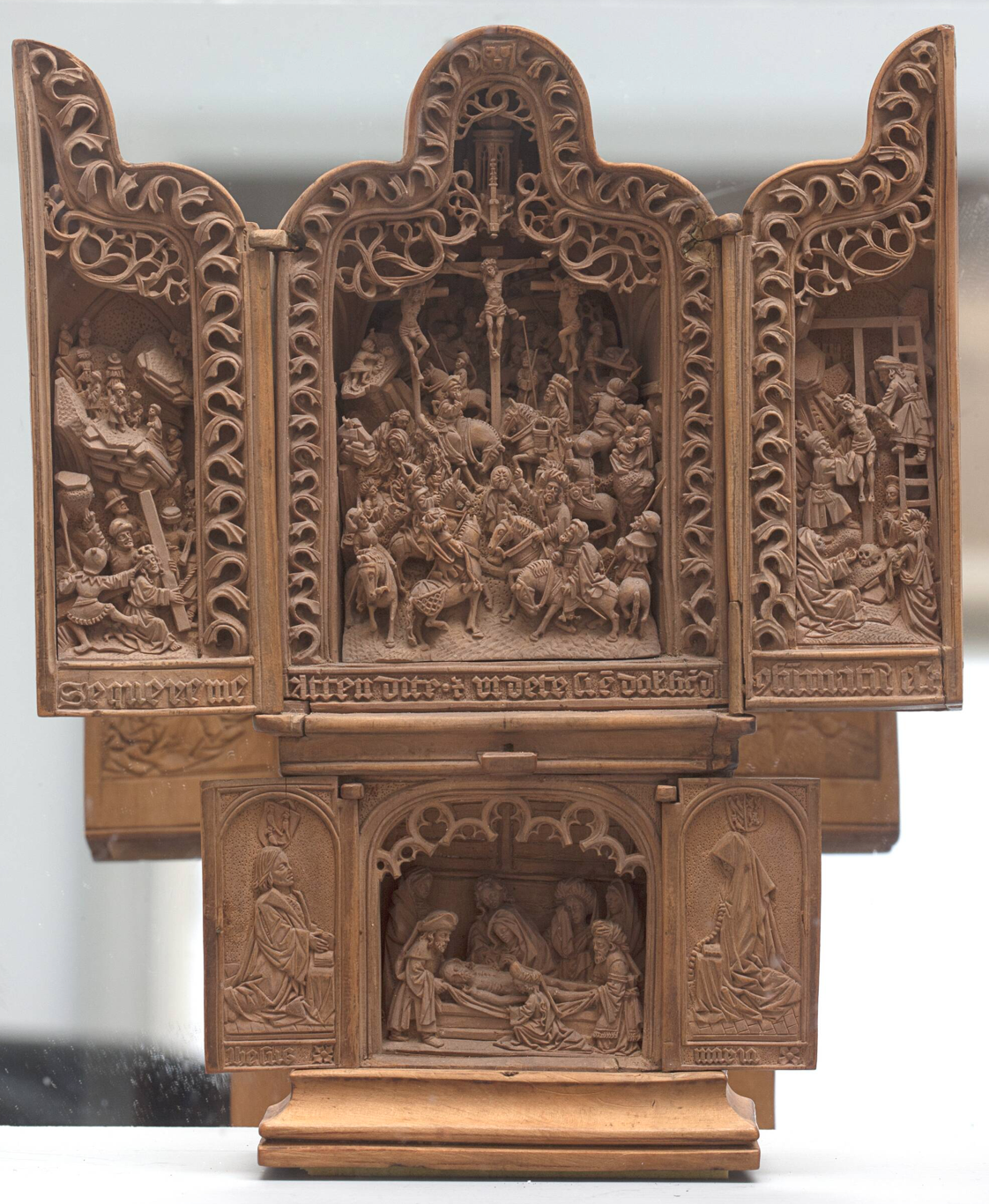
Adam Dircksz (1428–1528)
Miniature Altar. Triptych with the Passion of Christ
Boxwood
1502–1528
Statens Museum for Kunst, Copenhagen
S5E2.
Thomas Dambo
I picked a little woodcarving by a Dutch artist named Adam Dirksch. It's created in the 1500s in the Netherlands. It looks 8x8 feet from an altar in a church. And then when I look closer, I could see it was 6x4 inches. The carving, folding out in the middle, has two sides to it. One side is a religious depiction of the crucifixion, and the other side, the appreciation of magic. The carvings have multiple figures, really detailed, and then different ornamentations inside and outside. And it humbles me as an artist to see somebody put so much love and technique and craftsmanship into such a tiny, tiny little object. It's just amazing how you can carve something that small, and carve such an intricate story into it. It's definitely made by an expert with a technology that mostly is forgotten. I remember from my own childhood how a physical object could hold a big value. I think with the whole fast production and consumption of everything, much of that appreciation has been forgotten. Back when an object took such a long time to produce, it holds such a significance so that you really cared about it. Now, you take it, and you throw it away, and you don't use it anymore.
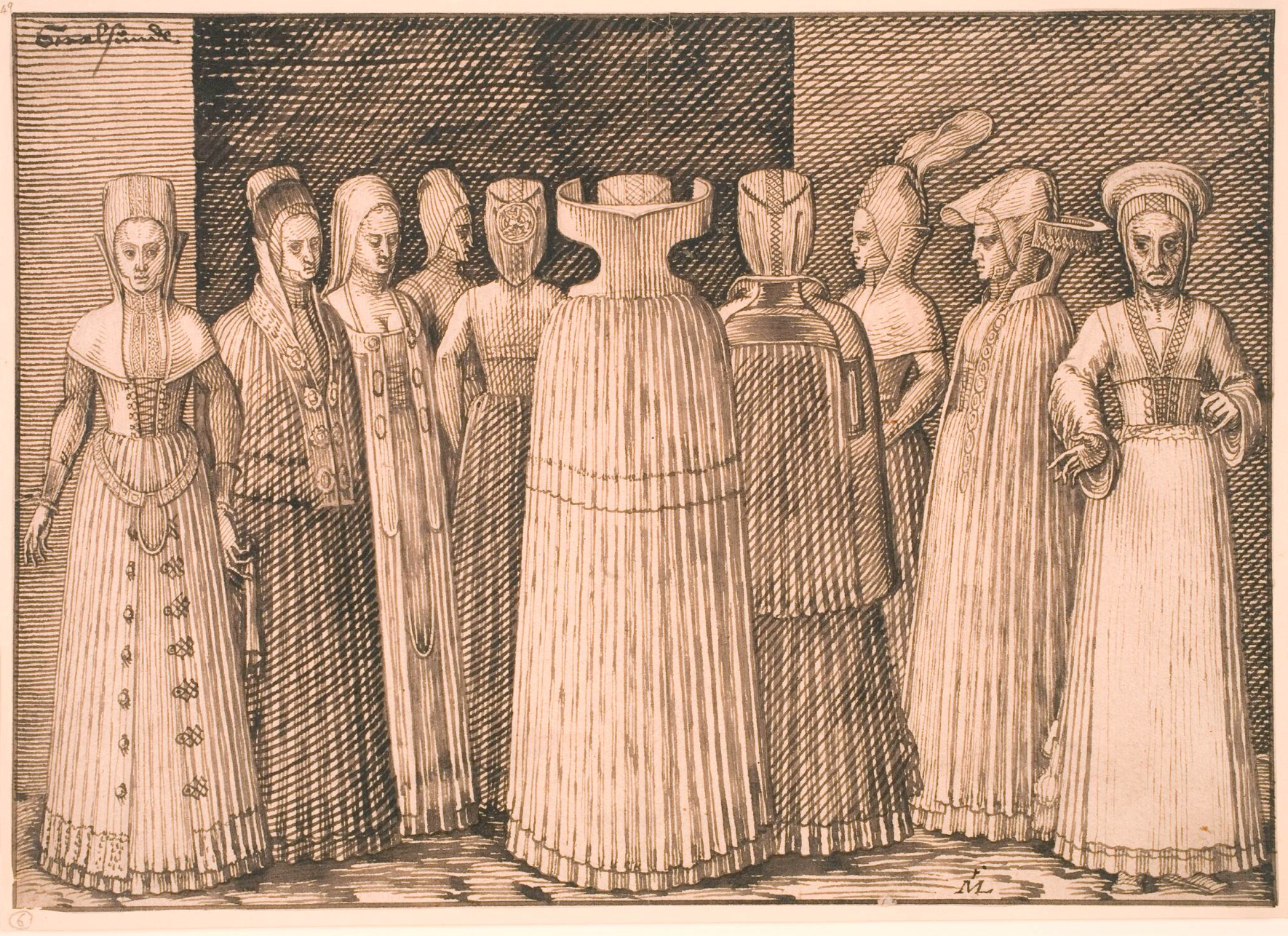
Melchior Lorck (1526–1583)
Ten Women from Stralsund
Pen and brown ink
1571–1573
Statens Museum for Kunst, Copenhagen
S5E1.
Kirsten Justesen
I picked Melchior Lorck. He lived in the middle of the 1500s in Flensburg, a part of Denmark at that time. And it's Ten Women from Stralsund, just 22 by 31 centimeters. He's organizing his gaze. So, he's drawing these women in costumes. In the front, there are three women you only see from the back, with exceptional headgear, almost sculptures. There are three on one side, two on the other side, drawn in profile. First you think they're nuns. No, they're not, because you see the cleavage. Right and left side, there are two drawn from the front. But I couldn't explain to you their expressions either in their heads or in their hands. I don't know why they are, I don't know who they are, I don't know what they are. I'm fascinated. I'm not interested in psychology. But those women, I'd like to know, or make a story.