
Nina Sten-Knudsen (1957–)
Museum
Oil on canvas
2002
Statens Museum for Kunst, Copenhagen
© Nina Sten-Knudsen / VISDA
The rights-restricted image is purposely blurred.
S2E10.
Maria Sten
I picked the painting Museum from 2002, by Nina Sten-Knudsen, who happens to be my mother. The canvas is so big. The spice jars, the alleys. The way that the light comes up from the top, the way that the light falls into these buildings, you really feel like you are walking into a world. You want to know what's behind this beam, what's behind this wall. I get Aladdin vibes randomly, Akbar, you can smell it, you can see the dust hanging in the air. I feel like an explorer, like an anthropologist or archaeologist diving into a pyramid or something and looking through these collections of things of old. So it's like you're, yeah, going into a world. As an artist myself, and telling stories and building worlds, that is something that I really respond to.
Exhibition
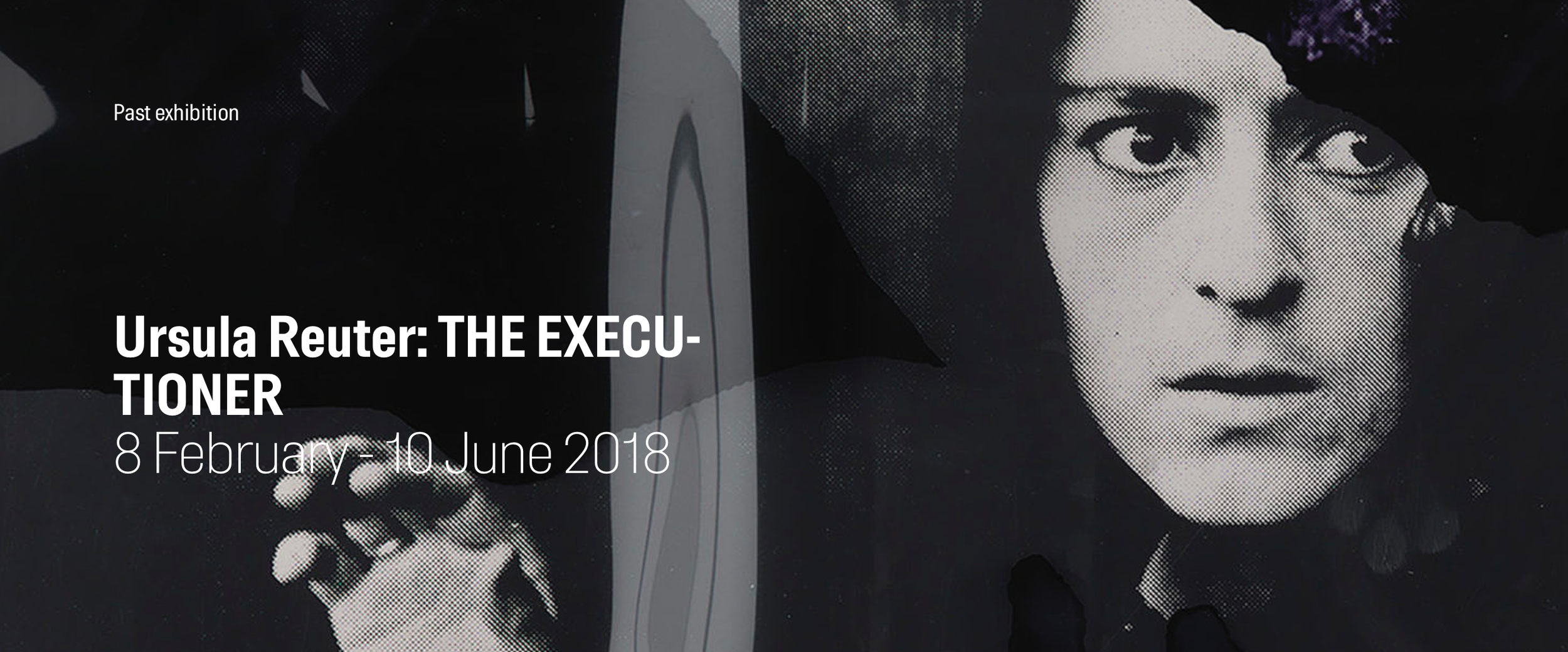
Ursula Reuter: THE EXECUTIONER
8 February–10 June 2018
Statens Museum for Kunst, Copenhagen
S2E9.
Bjørnstjerne Christiansen
I have chosen the film Skarpretteren. It's from '71. And it portrays a woman who dedicates her life and gives up her own identity and so on throughout the film, for the man, for the family, for society. Then at the end she accepts to be executed. But the last sentence she says, "The next great moment belongs to us." She accepts her role as a mother, but she wants something else. It's by my mother, Ursula Reuter Christiansen. My father made the music. My father died 10 years ago. This music, it's a soundtrack of my own early beginnings. My mother's pregnant in the film with my sister and it's in their farmhouse they had just bought half a year before. So this is also my home now when I'm there at the countryside. It's timeless. Women don't have the free voice in many, many, many parts of the world, and other ones are suffering. But yet there is always this courage, the next big moment might belong to you, that I cherish a lot. I also use that in my own thinking and practice and daily life, I would say. Things go against you, and so you find a way to alter it, and move with it, accept, but you move forward with that knowledge that you have gained. And then you reflect upon each situation you're in, and that changes you.
Henri Matisse (1869–1954)
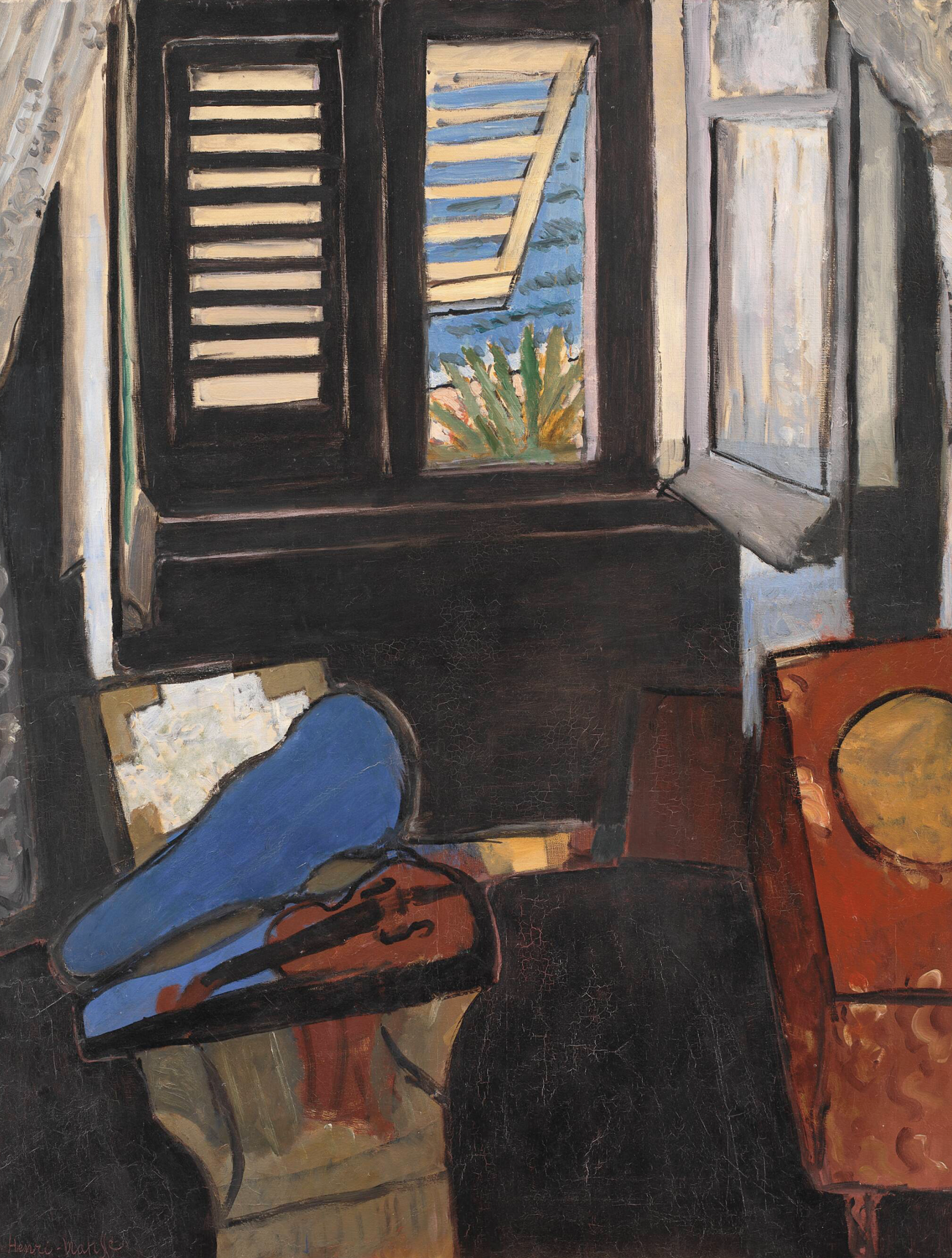
Interior with a Violin
Oil on canvas
1918
Statens Museum for Kunst, Copenhagen
S2E8.
Jørgen Klubien
I have a 21-year old son who is wanting to be an artist. And we spend a lot of time together sketching, painting, and talking about art. I have a particular love for a painting by Henri Matisse, called Interior with a Violin. It's a little room with the open window and it looks out onto the sea. There's palm trees. And the sea outside and the palms remind me of California and the sea breeze and the lovely sleep you can have close to the ocean, and it's just the best. I like his colors. They're fun. They're almost cartoony, and loose, which is how I like to draw myself. I like to do loose styles. And the violin represents music, so it has that little footnote for me.
C.W. Eckersberg (1783–1853)
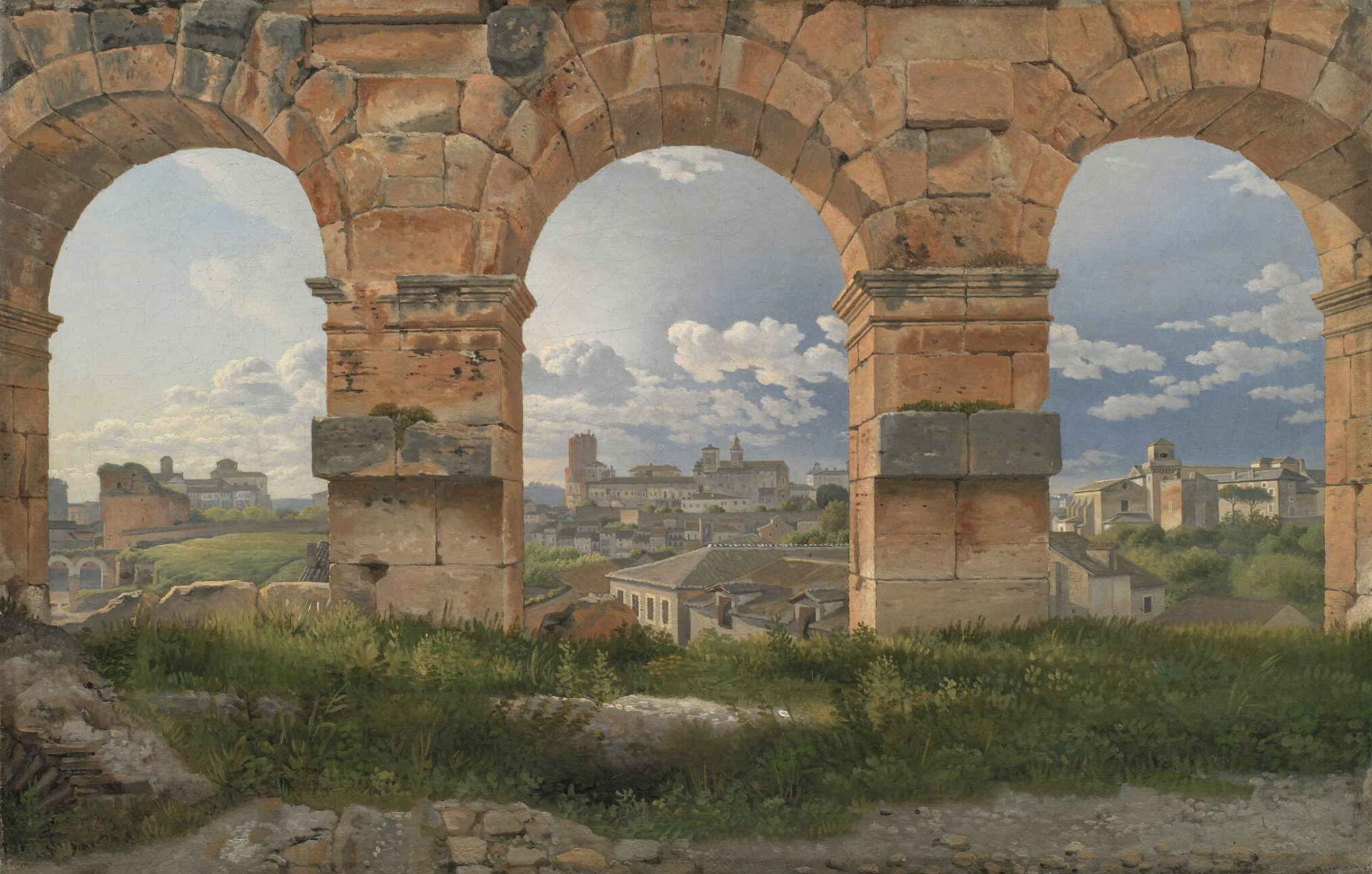
A View through Three Arches of the Third Storey of the Colosseum
Oil on canvas
1815
Statens Museum for Kunst, Copenhagen
S2E7.
Finn-Olaf Jones
Eckersberg's painting of the three arches in the Colosseum — it's kind of unusual because it is three different views and he basically changed the perspective on all three of them. The sun is behind one of the walls there and it's actually the same kind of light you'd get if you put your hand in front of your eyes, and blocked out the sun on a very sunny day. There is this glare, and it's very modern. I don't know, he took a sort of psychological view to light. It's very much an impressionistic psychological reaction to seeing the sun like that. This is exactly what it's like growing up on a midsummer night in Denmark. You have this blue, blue, blue light and then suddenly goes dark for a few seconds and then it all comes back. Eckersberg was afterall the teacher of the generation that taught the generation of Northern Lights painters. It's almost like you fall in love with the shy girl in the class and nobody else knows that she's really cool. There's a certain genius there that this reawakened for me.
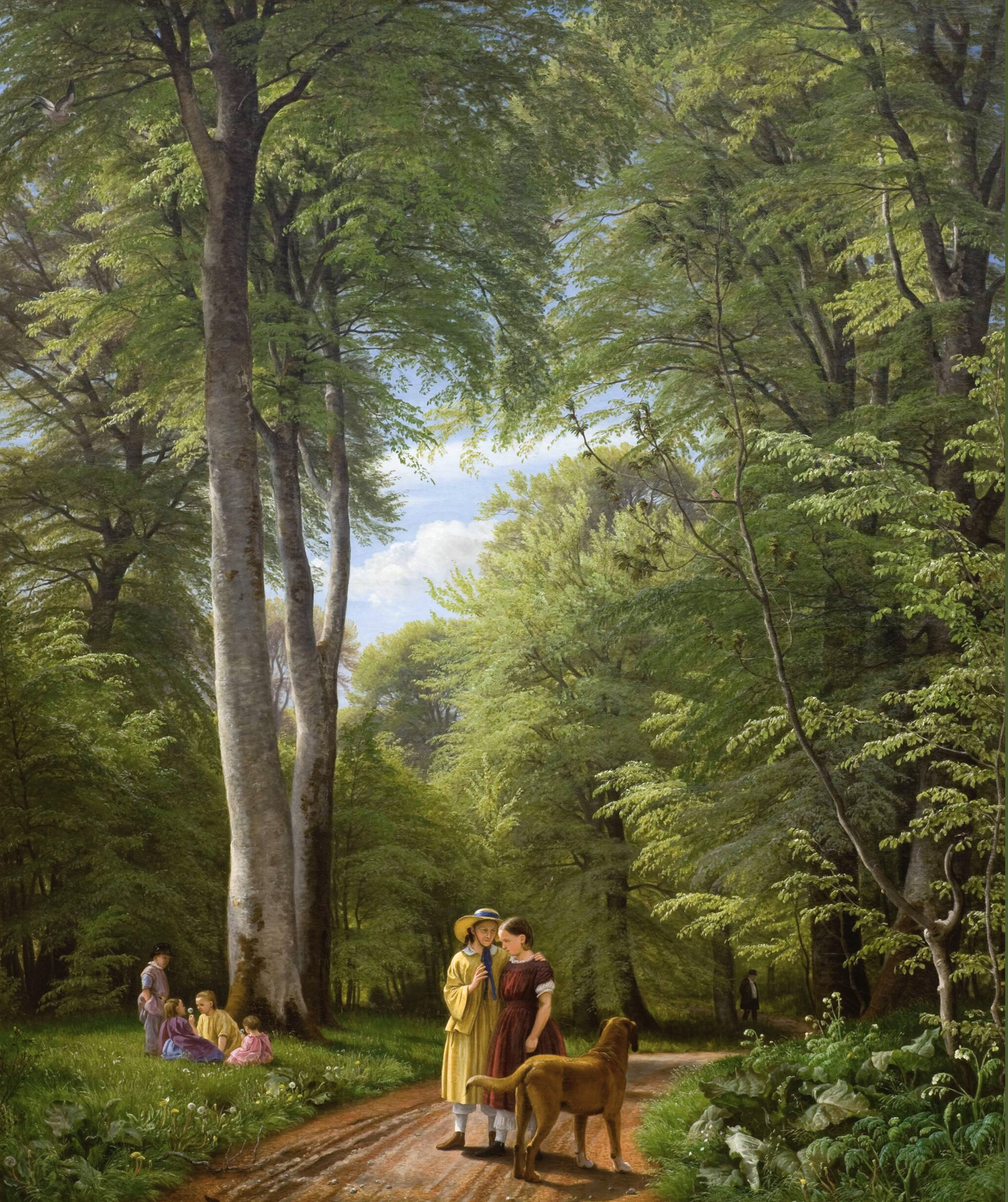
P.C. Skovgaard (1817–1875)
A Beech Wood in May near Iselingen Manor, Zealand
Oil on canvas
1857
Statens Museum for Kunst, Copenhagen
S2E6.
Mette Lisby
I chose a painting by P.C. Skovgaard from 1857. It's called Beech Wood in May. Everything in that painting says Denmark to me. There's a family, the forest, the light coming down. My mom lives by a forest. I've never been a forest person like that, but having been away for so many years, we came back a couple of years in a row in that early May-June period to see my mom. And just seeing that vivid green color, to me became the essence of Denmark. And then the light of the Scandinavian nights. I didn't really know how much I loved it and how special it is. You only understand that when you've been everywhere else. Even in LA, it's not that at all. He must have just thought, how am I gonna say Denmark in one painting? And I think he did with this.

Poul Gernes (1925–1996)
Untitled
Silver paint and alkyd on fibre board
1968–1969
Statens Museum for Kunst, Copenhagen
© Poul Gernes / VISDA
The rights-restricted image is purposely blurred.
S2E5.
Benni Korzen
Poul Gernes — he never gave his paintings titles. Nor do I. He played around with things that I play around with, circles of different main colors — red, blue, green, yellow. He creates shapes that don't seem to be painted. There is no texture. He stays away from painting anything other than the shape and the color. And the combination of colors and the placement of the colors — round circles inside of a square box that quite often he did on pieces of wood — fascinates me because I'm playing around with the same things. Not necessarily just circles, but shapes that dance around and that when they move around, they relate to each other and to the background in ways that other things do not. He has concretized nine circles onto a square piece. I'm envious of his ability to do this without having lines. That to me, is brilliant.
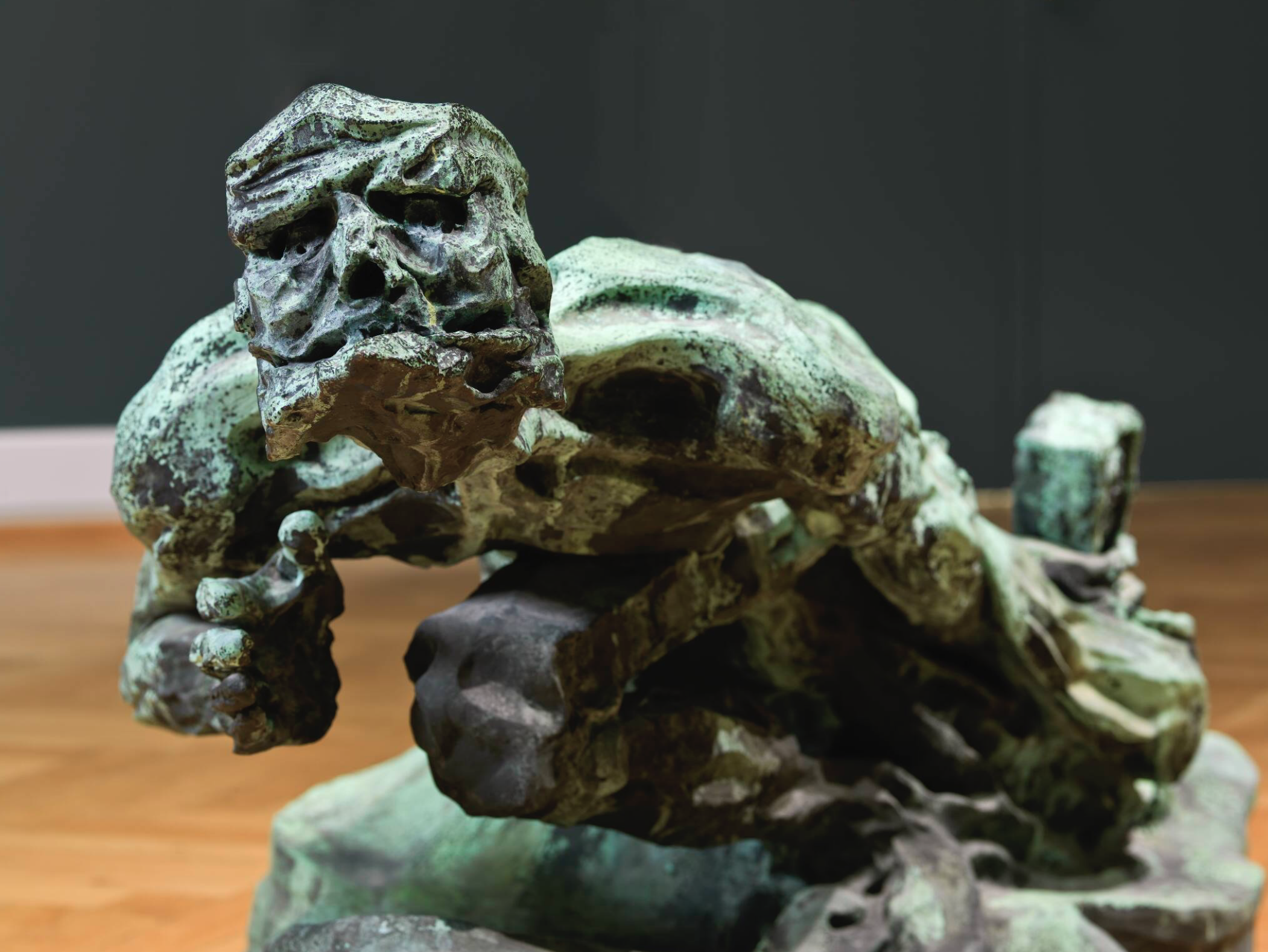
Niels Hansen Jacobsen (1861–1941)
The Shadow
Bronze cast
1897–1898
Statens Museum for Kunst, Copenhagen
S2E4.
Lilibeth Cuenca Rasmussen
Niels Hansen Jacobsen, I chose his work, a sculpture, very traditional, called Skyggen, which means shadow. It's from 1897 to 98, an older artwork. I'm also in this process of making works about the shadows. When you're attracted to a piece, it's because there's something in it for you. I could really see myself in this work. It's a very contemporary expression. It really looks like it is a 3D-printed sculpture in some angles, and not modeled in clay and then made to bronze. I could imagine that he was inspired by this story of Hans Christian Andersen. He made a story about the shadow, which is a very scary story about the shadow taking over his master's life and body. The sculpture has so many different angles, it looks like it could have been made today. Very abstract, very concrete. I can rotate around the sculpture forever because it's just giving me different perspectives continuously. It's beautiful.

Poul Anker Bech (1942–2009)
Asphalt Serenade
Oil on canvas
2002
Statens Museum for Kunst, Copenhagen
© Poul Anker Bech / VISDA
The rights-restricted image is purposely blurred.
S2E3.
Mads Refslund
I've chosen Poul Anker Bech, and the piece is called Asphalt Serenade. You can see on the left side of the picture, it's people working on construction with asphalt. And on the other side, it's a field with a sky in the back and a tower. His way of seeing the scenery, it's like something of contrast. Almost fantasy, it's just beautiful colors and it's very emotional, almost unknown what is happening in the background. You could be anywhere in the world. And it's inspiration, in a way, of looking for something that's bigger than yourself, I think. The same as my kitchen, you have a big contrast between a field and asphalt. You're sitting on the edge of something and something can happen. I had a girlfriend, one of my mentors in life. We were together for nine years, she's a beautiful soul. And Poul Anker Bech was one of her favorite artists. And we went and saw his show at some point. So I think that maybe it has something to do with where I was in that time of life. I was in my twenties at that time. And maybe it reminded me a little bit of her. I like that. And this piece is really beautiful.
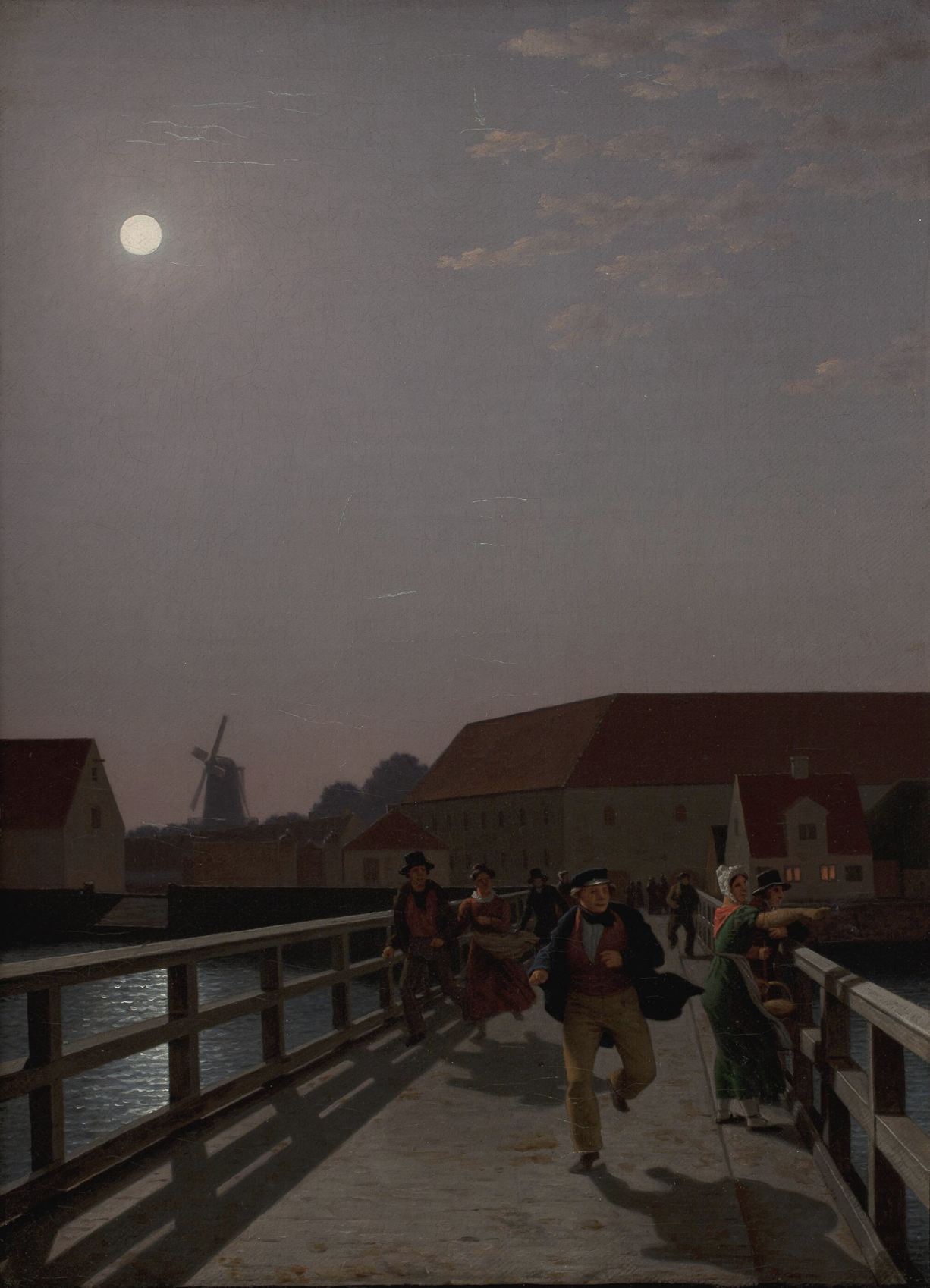
C.W. Eckersberg (1783–1853)
Langebro, Copenhagen, in the Moonlight with Running Figures
Oil on canvas
1836
Statens Museum for Kunst, Copenhagen
S2E2.
Josefine Lindegaard
I chose Langebro i måneskin med løbende figurer af C.W. Eckersberg. It's an incredible painting that's set in moonlight in Copenhagen over a bridge by Kastellet. I absolutely love this bridge. I don't know why I gravitate towards moons in paintings. This has two small windows that are lit up in the background, and it always makes me think of what's happening in this little house. There are people on the bridge. Some people are standing pointing, and a man is running. Where are all these people going? I can give each one of them individual stories and change them over time depending on what mood I see this painting. The old Copenhagen buildings make me nostalgic. It makes me feel at home and it makes me wonder where these people are from, where they are going, who they are, who their ancestors are. The way that the moon reflects in the water, and the sky's turning from day to night with the pink colors and the clouds, it's just so beautiful.
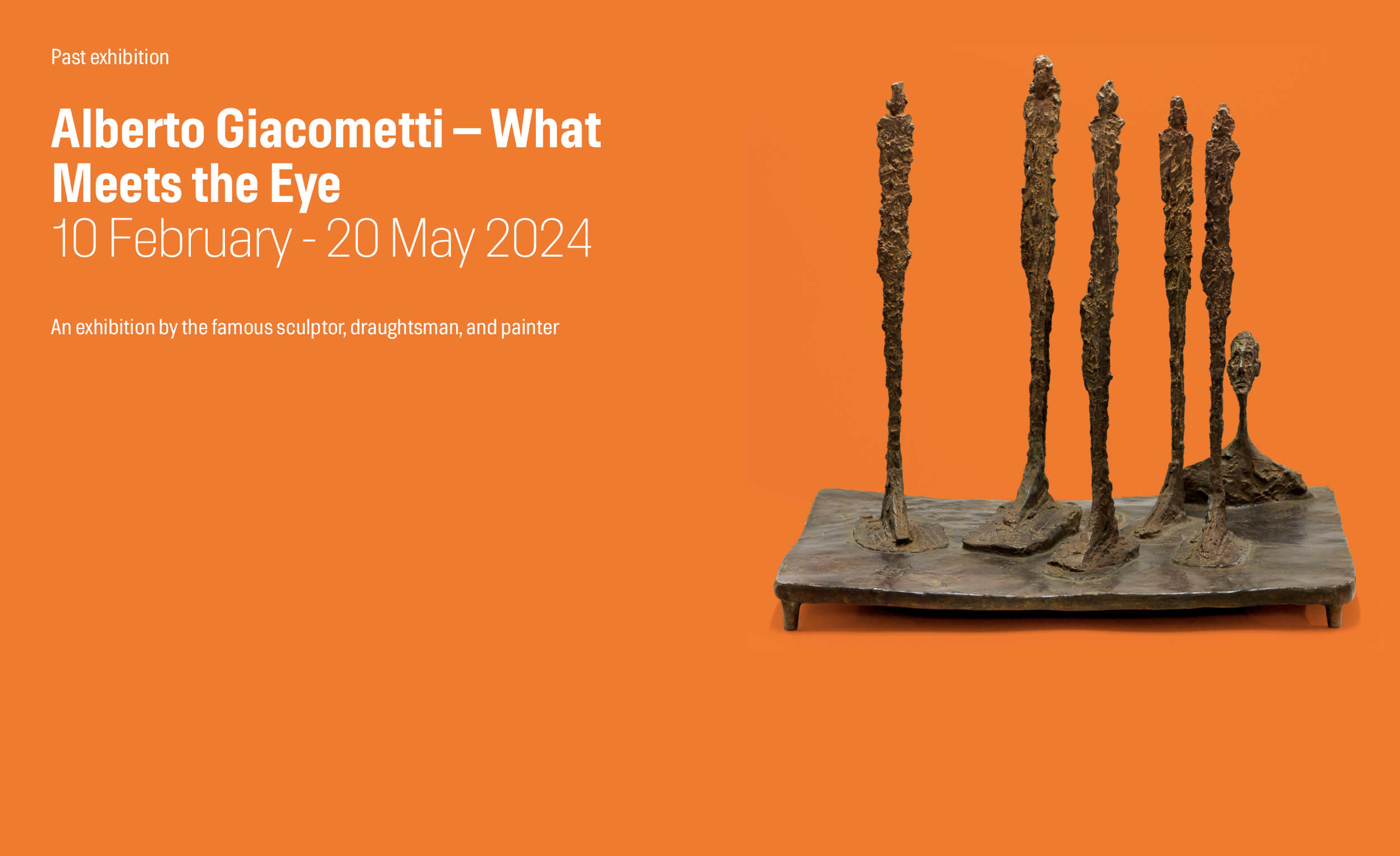
Exhibition
Alberto Giacometti — What Meets the Eye
10 February–20 May 2024
Statens Museum for Kunst, Copenhagen
S2E1.
Claes Bang
There's a quite massive Giacometti exhibition on at SMK at the moment. Giacometti is sort of how I got interested in going to museums and art, because my mum, she took me to museums when I was quite young, and I thought it was actually super boring and I didn't understand. Until all of a sudden there was this Giacometti in front of me, and that sort of was something I could understand at the age of seven. That spoke to me somehow. I think, to me, there's a lot of humor in it. It's almost like it has a cartoonish kind of feel to it. There was something that absolutely, all of a sudden, I was like, oh, going to museums is actually kind of cool. And I would always ask after that, so is there going to be one of those Giacomettis there? And I was super disappointed when I went to the museum shop and found out that I couldn't buy a miniature sort of Giacometti, because I really wanted to take one home. I'm really into museums and art and all that, and that sort of started with him.