
From his home in Århus after a performance of Ludwig Holberg's theater play Jeppe på Bjerget, Roskilde-born Danish actor and director THURE LINDHARDT talks about the craft of acting, the necessity of collaboration and letting go of one's ego, and other nuanced differences between working in theater and in film. He talks about the high-budget Ron Howard film Angels & Demons, revisits directors who made a lasting impact on him, and describes finding safety in taking artistic risks.
Photographer: Private Photograph
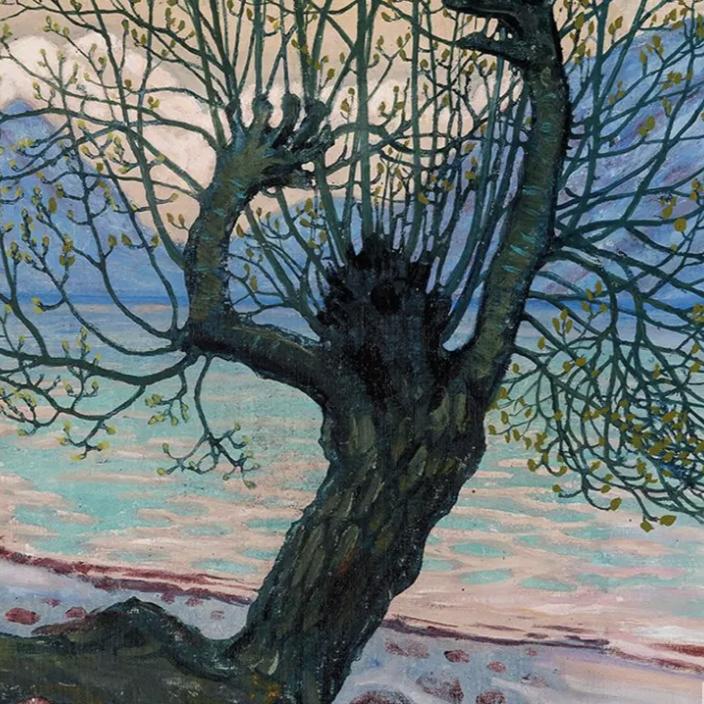
For today's episode, Thure Lindhardt chose Nikolai Astrup's Marsmorgen or A Morning in March, from 1920, from the collection of Kode Art Museums in Bergen.
“It’s about the intention of the scene. It’s the craft. It’s the work. And then when you’re on set and you’re there, there’s only one thing that will work, and it is totally letting go of everything you’ve prepared and just hoping for the best. It’s really scary sometimes. But it’s a good feeling of scariness.”
“I think maybe also that’s one of the reasons I keep going back to theater and I keep going back to teaching and writing. I know I have to go where the craft is, and I easily get so full of myself if I go the other way. So I have to keep going back to those places where my ego maybe doesn’t wanna go.”
“When you meet someone where you know that for this person, art is the most important thing in the world, and artists are important, and acting, you feel blessed working with people like that. The art becomes more important than the fear. And we know as artists, fear is a very big part of the business.”
Powered by RedCircle
This conversation with Asger Hussain occurred on September 2, 2026.
00:01
Thure Lindhardt
When you meet someone where you know that for this person, art is the most important thing in the world, and artists are important, and acting, you feel blessed working with people like that. The art becomes more important than the fear. And we know as artists, fear is a very big part of the business. It's what drives you, but it's also what stops your creativity, right?
00:32
Asger Hussain
My name is Asger Hussain. I'm a film producer and guest host of Danish Originals, where we celebrate Danish creatives who have made a significant mark in the US.
00:44
Asger Hussain
Today's guest is actor, writer, and director Thure Lindhardt. From Flammen & Citronen and Keep the Lights On to Ron Howard's Angels & Demons and the acclaimed series The Bridge, Thure's career spans Danish and international film, television, and theater. He's currently starring in Christian Lollike's reinterpretation of Holberg's Jeppe på Bjerget at Aarhus Teater. Thure, welcome to Danish Originals.
01:12
Thure Lindhardt
Thank you very much, Asger.
01:13
Asger Hussain
It is so great to have you. I've been looking forward to this.
01:17
Thure Lindhardt
Me too.
01:18
Asger Hussain
And thank you for joining us, because you are actually in the middle of a theater play right now.
01:23
Thure Lindhardt
I am. I was on stage one hour ago. I was in front of 700 people in the audience.
01:29
Asger Hussain
I see a little blush.
01:31
Thure Lindhardt
There is a little blush. The adrenaline is still up, so it's a good time to talk.
01:36
Asger Hussain
That's actually what I wanted to ask you about. How is it coming down from that and then just home in general, or having a conversation such as now, that switch?
01:47
Thure Lindhardt
Well, it's interesting because I'm on stage for two hours and 45 minutes, constantly talking, screaming, shouting, crying, laughing. And afterwards, it's a mix of being extremely exhausted and then also being high. The adrenaline is going "drrrr-drrrr-drrrr." It's this weird mix of exhaustion and high.
02:10
Asger Hussain
You know that it's make-believe, but your body doesn't really know it. And I guess you need that energy, but then how do you just shut it off afterwards? It's very interesting. A lot of performers say the same thing, I think.
02:23
Thure Lindhardt
Well, I go for a walk. Walking is the best thing I can do. My apartment is 20 minutes away from the theater. And you can walk everywhere here in Århus. It's not LA. So I walk, and that really relaxes my body and my system. And I try to spend some time just by myself, just walking, because then I slowly calm down, and then I go home and I eat. And after a good meal, I land again.
02:53
Asger Hussain
I'm gonna start very easy because I want to know a little bit more about you and the early days, which I feel I haven't read much about over the years. So tell me a little bit about where you were born, where did you grow up?
03:08
Thure Lindhardt
Well, I grew up in a fairly small town called Roskilde, which is 30 kilometers outside of Copenhagen. I grew up in a very good family, academic family. My father is a Lutheran minister, but more like a theologist. He was working in university, he was teaching. And my mother is a psychiatrist. So I grew up with parents who talked a lot about faith and emotions and the mind.
03:38
Thure Lindhardt
The first three, four years of my life, I actually lived in Sct. Hans where my mother was a doctor, which was this hospital for people with mental illnesses and diseases. And to me, that was a very beautiful and safe space to grow up.
03:56
Asger Hussain
I haven't heard about that place in, well, 40 years now that you mention it, but it used to be something that was actually part of the cultural awareness or just societal awareness growing up in Denmark, I think.
04:10
Thure Lindhardt
It was.
04:11
Asger Hussain
So you would just go there after school or just be adjacent to it?
04:15
Thure Lindhardt
No, we lived there.
04:16
Asger Hussain
Oh, you lived there. Okay.
04:18
Thure Lindhardt
That was our home, that was our home. So there were houses for doctors, where they would live at the actual hospital. It was this whole idea that started in the end of the 1800s where you started to think that for people with mental illnesses, fresh air would be good for them, a green environment, water, so you built these hospitals in nature and planted a lot of trees. It was a very beautiful thought.
04:49
Asger Hussain
That has not made it to Los Angeles.
04:52
Thure Lindhardt
No. Well, it hasn't made it to Denmark. It's gone now. It doesn't exist anymore.
04:56
Asger Hussain
It doesn't exist. And when did your initial interest in performing start? I'm saying performance because I don't know if it was acting or music or something else.
05:18
Thure Lindhardt
Well, it started in school, when I was five or six. We did school theater, and I just remember standing in front of parents and grandparents and adults, and I was doing some sort of sketch, whatever you do when you're five years old, and they giggle. And I was like, oh, wow, they laughed. I could make them laugh. It's a very clear image for me, people laughing. And then I just never stopped.
05:37
Asger Hussain
And at that point, I think it's very, as you say, audience-driven. So would you first yourself, once you were outside of the perimeter of the school, was it impersonations or was it trying to take things that had already been done and put your own spin on it? What really got you into, "Well, there's actually cause and effect here between what I'm doing and how people are reacting"?
06:01
Thure Lindhardt
I think it was playful. It was a game. My parents had a lot of clothes from my grandparents, and so there were old hats and old jackets from my grandfather, and a fur that my grandmother had. And me and my friends would just put them on, and we would just make fun with it, like children play. We didn't call it anything, but I remember how much fun it was to put on some kind of weird costume. And it was really — I loved it, I really loved it.
06:38
Asger Hussain
And did that continue? Did you have a break from it, or did it continue into becoming a profession?
06:46
Thure Lindhardt
Well, I went to a class in a normal school, and everyone, all the boys, were playing football. But we were two boys who wanted to do theater. So me and my best friend René, there was an amateur theater in Roskilde. And when we were ten, we started out there. And it became very serious.
07:11
Thure Lindhardt
I think we were there three, four times a week. And we got a key to the place so we could go in when there was no one there, and we would just play around. And it was so much fun, but it was also very serious. So I had this partner in crime, and we were just playing.
07:33
Asger Hussain
And you were each other's audience to begin with?
07:35
Thure Lindhardt
We were each other's audience. We started writing plays as well. When we were 12, we wrote our first play and we performed it. It was amateur theater, but we were very serious.
07:50
Asger Hussain
I bet. And that's actually something that I wanted to talk about because in the public eye, you have moved between theater, movies, television, but it's clearly theater where it started. And this I didn't know, that you've always been writing as well, because I think that opens up a completely different world of seeing things and experiencing things, and also the way that you relay them in a way.
08:18
Asger Hussain
I wanted to ask, do you remember, vividly, I'd like to ask, if you remember the first performance where you felt that something is different now or there is definitely, whether it was the scope or whether it was the audience or just maybe something inside of you that clicked and said, "I knew that I loved this, but this is something more now"?
08:44
Thure Lindhardt
When I was ten, I got a small part in the movie Pelle the Conqueror by Bille August, and I played a boy in Pelle's class. And being on set, I mean the film was shot for months and months and months, and I think even though I had a small part, I was there for at least a month.
09:08
Thure Lindhardt
And it was a very big film and I remember being on set seeing how they built the whole school out of wood and made it look like it was in the 1800s. And seeing how they built a boat and seeing how they transformed everything and put costumes on, I remember that feeling of, this is magic, this is where I belong, this is something very special. And seeing the old actors, I mean, to me they were old —
09:42
Asger Hussain
Of course.
09:43
Thure Lindhardt
I don't know how old they were, but —
09:45
Asger Hussain
Max von Sydow, he was always old. He was when he was young!
09:49
Thure Lindhardt
Yes, he was always old. And he was... I don't know what you call it in English, the thing that Emil does, cutting wood. You know, Astrid Lindgren's Emil from Lönneberga. He's cutting wood and making it and turning it into small figures, and Max von Sydow did that in the breaks. And I remember sitting next to him and him sitting there cutting wood with his little knife, just being calm and then going on set, and perform. And I was like, wow, is that how you do it?
10:28
Asger Hussain
I know. This makes the hair on my arms rise a little bit because I think it's moments like this that are actually pure magic, both in terms of being on set, but also just seeing how I think artists perform when they switch it on and off, and which is something I actually wanted to talk to you about now, if we jump a little bit.
10:48
Thure Lindhardt
That's okay.
10:49
Asger Hussain
Moving between these mediums, do you find your preparation to be different between theater and film and television?
10:58
Thure Lindhardt
I do. I do, definitely. I think the biggest difference is that at least here in Denmark, rehearsing for theater plays, we have eight weeks together in a room with a director, five, ten actors trying things again and again and again and again and again. And so you feel you're much more, as an actor at least, you're much more part of that collaboration that eventually will become a play.
11:32
Thure Lindhardt
As an actor in a film, it depends on the project, but often, obviously you don't have so many rehearsals, and often a lot of the things are being created when you're not there, 'cause that's how it is, and that's how you have to do it.
11:52
Asger Hussain
And I guess in theater you're editing before you actually start, and in film you edit after you're done, right? But I was also thinking about this, you just said, you don't have as much rehearsal on some movies. And I've worked with directors that have barely had any rehearsals because they don't like that.
12:11
Asger Hussain
And then there are other directors that will both rehearse, but then they'll also stick to the page, and you have to say the word almost the way that it's written and not improvise too much.
12:24
Asger Hussain
So I guess it's also that you have to adapt to actors that have different ways of preparing and working, and you have to adapt to directors that have different ways of working as well. And it must require a lot of you, 'cause it's not always that you can be in sync from the beginning.
12:41
Thure Lindhardt
I think it requires, what you say, the ability to adapt, which is not a bad thing. It requires that you put yourself in different situations and understand, okay, I'm not gonna get further with this person unless I do it differently. And since you have so little time, you gotta act and react fast.
13:12
Asger Hussain
And let me ask you this, and I'm asking for film here specifically and also as a producer. We get to read things and we get to watch the final product. But I've also sat on set maybe two meters away from a scene that is very intense and it's being shot out of sequence, that means that we don't always shoot what comes right after the way that it's written.
13:37
Asger Hussain
But we'll do something before lunch and something after lunch and it'll all be put together. But what looks to me like a magic trick every single time, and especially with your great colleagues, great actors, how do you articulate a point of view that's so precise every single time, even if you're shifting the performance a little bit, if you make it louder, if you make it more subdued.
14:10
Asger Hussain
When you're sitting there and watching, and you get the exact same feeling you did when you were reading it, how do you convey that so precisely? For me, that's the magic trick, and it never ceases to amaze me how you do that.
14:26
Thure Lindhardt
Well, I think a lot of it is preparation, how you prepare for the actual scenes. It's about the intention of the scene. It's the craft. It's the work. And then when you're on set and you're there, there's only one thing that will work, and it is totally letting go of everything you've prepared and just hoping for the best. It's really scary sometimes. But it's a good feeling of scariness.
15:05
Asger Hussain
I know. And it's different from theater, right? Because, especially in confined movie sets, and I'm thinking of a couple of experiences that I've had where there's the boom operator with the sound, and the camera is in your face, and spit is flying in the head of your co-star, and it's just such intensity.
15:26
Asger Hussain
And you think this is the fifth or sixth time you're doing it. How in the world can you get into that? Again, the performance is one thing, but then it's what it's actually conveying in that moment. And for me, that is just a joy to watch, and you can't really even begin to fathom what it does to you being the one that does it, right?
15:47
Asger Hussain
You just said you came from a show, you have adrenaline. How do you get out of that moment and then go straight onto the next moment, which can be 20 minutes later, and then you have to do something completely different?
15:59
Thure Lindhardt
Yeah, well, especially if you look at kids, they do it all the time. They're crying and they're unhappy, and they want a toy, and they don't wanna go to school. And then the next second they're laughing and making jokes. And then they're the most egoistic little bastards in the world. And one second after they love you till death, and you're like, "Uh, what?"
16:18
Asger Hussain
Happens every day around here.
16:20
Thure Lindhardt
It happens here as well. And we're just big kids. I think, to me, understanding, and I understood it late, how quickly we are able to shift. As I understood that, then it became much more fun to act. And there's something magical about going into a state of mind where you, for example, have to cry, and you go into that state of mind, and as the director says, "Cut," then you're just like, "Okay, that's it."
17:02
Thure Lindhardt
Do you know what I mean? It's like you wash it off, and you're like, "Okay, what else? Let's have lunch. Let's talk about the weather." I think you somehow you also need to be able to let it go. Does that make sense?
17:16
Asger Hussain
It makes a lot of sense. I think not knowing the technique behind how you do it, it's very impressive, and it's still, after all these years. To me, it seems like a magic trick. And I'd rather that you not reveal all the tricks behind it, but it's just fascinating to watch, that you were able to do it.
17:34
Asger Hussain
But you know from your colleagues that some are very different. Some carry the role in a very different way, and it's not always that fun to be around as colleagues. But it's their process, and you have to respect that as well.
17:49
Thure Lindhardt
I worked with an actor for six months. We did a show, and his character hated my character. So this actor, he decided not to talk to me for six months. That was a bit intense. He would not say hello when we met in the hall or in the morning. He would not go with the same car as me because our characters hated each other. And you just have to accept, okay, that's his way of working. What can I do? It was a bit hard, but you just... what can I do? And he was good!
18:27
Asger Hussain
I bet. I think this has been discussed way too much to be interesting anymore, the whole method acting. But I do think that part of what you're mentioning is craft, and part of it is also personality. Some people are not able to compartmentalize in that way.
18:43
Asger Hussain
I've seen it on set. Even with two very positive experiences side by side, with two actors, you can still see that one is much more relaxed in a completely different way that isn't just related to skill. It's also related to their personality of just being, "Well, this is supposed to be fun, and I'm here, and I'm lucky to be here, and I'm going to have the best time." It helps that you're a veteran actor as well, I think, but I've seen personality is also a big part of it.
19:14
Thure Lindhardt
I totally agree. Do you know the movies where I've been laughing the most are?
19:21
Asger Hussain
The most serious ones.
19:23
Thure Lindhardt
The most serious ones. After a take that's really serious, you just need to crack jokes, say something absurd, make people laugh. You have to laugh.
19:36
Asger Hussain
You do.
19:37
Thure Lindhardt
You just have to laugh. And it's so liberating.
19:43
Asger Hussain
I've seen crew, grown men and women actually be very affected. And they needed to let out some steam as well after some intense days. Again, if you're in close quarters and you do something for 12 hours, I think it's very, very important that you have those moments.
20:01
Thure Lindhardt
It's like a good fight with our partners, right? And then we crack up and we laugh afterwards, then everything's just a little easier, right?
20:09
Asger Hussain
I know, I know. You said something interesting about how as you got a little older, you realized certain things that made it easier. I was thinking, for many people that work in film and theater, with all of its ups and downs and just how things do commercially and how you're perceived, I do think there's a luxury in working with something where you're a part of a collective in this way.
20:47
Asger Hussain
It's not you, Thure Lindhardt, who is so linked to the zeitgeist like a designer or a singer would be, where the art becomes inseparable from the artist. And I think you being someone else's instrument, almost, of a vision really helps where obviously I love seeing a good performance and I love seeing Thure Lindhardt going from actor to star and all the things that you can imagine.
21:07
Asger Hussain
But there is something very satisfying about progressing as a craftsman until the very end, I think. And that gets me high in a way and also I feel very lucky that this is the place we landed.
21:22
Thure Lindhardt
I totally agree. I became an artist because I wanted to collaborate with other people. And the best performances I have done have been because it's been a collaboration between a director and a photographer and other actors. And the worst performances I've done have been the ones where I felt it was only about me, also inside of me.
21:57
Thure Lindhardt
Do you know what I mean? 'Cause it's often the thing that's inside of you, where I had to prove something or I had to be special, or I had to be recognized, or where I felt, oh, I have to be a star or something. And I always failed whenever I went down that road. And trust me, I've tried it.
22:21
Asger Hussain
And that's a skill set too.
22:23
Thure Lindhardt
Oh my God, it is.
22:25
Asger Hussain
Some things require it, right? Because it becomes so much of a centerpiece, or you become the centerpiece. Again, the art and the artist, they become inseparable, in a way, with certain types of movies. You can't separate whoever plays James Bond from the allure and what comes with it, the 50 years of history.
22:46
Thure Lindhardt
I think, Asger, to me, I think maybe also that's one of the reasons I keep going back to theater and I keep going back to teaching and writing. And I'm not saying this to be pretentious, but honestly, I know I have to go where the craft is, and I easily get so full of myself if I go the other way. So I have to keep going back to those places where my ego maybe doesn't wanna go. Does that make sense?
23:18
Asger Hussain
No, it makes a lot of sense.
23:20
Thure Lindhardt
Places that are far away from the red carpet and from where all the money is, but where the art is. And I know that there's some amazing artists who can work with billion-dollar budgets and it's gonna be great. I don't know. I've tried it as well, and it's not that I wouldn't do it again, but I always feel safe in the places where it's not about me, but it's about the craft or the character or the project.
23:50
Asger Hussain
Yeah. And by definition, sometimes, I guess especially in theater, sometimes those are risky endeavors for other reasons. So it's interesting that you find safety in some sort of almost artistic risk in a way, 'cause that is probably where you can be most free, without, you know, putting words into your mouth.
24:12
Thure Lindhardt
No, it is. It's definitely where I can be most free, most definitely.
24:16
Asger Hussain
I do wanna ask about some of your early experiences or recent experiences on any type of thing where you felt, probably on the early side, that this was so good and it was so interesting, or it was so promising just from a craft's perspective that you would love to go back and work with that filmmaker again?
24:40
Asger Hussain
And usually I don't like to single out any sort of projects or directors or coworkers, but is there something where you felt the journey that I've been on from then to now, it would be really interesting to go back and work with this person again?
24:56
Thure Lindhardt
There are several directors. One is Kaspar Rostrup, who's a Danish director. I did my first film with him where I played a young man with autism, and I also did Hamlet with him in the theater. And he was an amazing director. I would say he was one of those artists who made me better than I was. I remember I worked with him when I graduated from theater school, and he asked me to do this role as a young man with autism.
25:33
Thure Lindhardt
And he said to me, "Thure, you have to know one thing, that actors..." He was also an actor himself, and he said, "Actors don't play a diagnosis. Actors play humans, and humans can have diagnoses. Humans can drink too much. Humans can have sexuality. Humans can commit crimes. We are playing human beings. So I want you to play a human being with autism."
26:08
Thure Lindhardt
And I remember him saying that, and somehow the words came to me, words of humbleness, where I answered, "Kaspar, I don't know how to do that. I don't know how to play a human being. Maybe I will know in a few years." I was very young back then. I said, "Maybe I will know in a few years, but I don't even know what a human being is."
26:30
Thure Lindhardt
And then he looked at me, and he said, "I think you know, and I think you can do this." And then I could do it. So that feeling of somebody believing in you was very defining for me as an artist. And I would work with him any time. He passed away last year as an old man. He had a very good life and he was my mentor.
26:55
Thure Lindhardt
And then there's one more I wanna mention, if that's okay. And that's Ira Sachs.
27:00
Asger Hussain
Of course.
27:03
Thure Lindhardt
An absolutely wonderful filmmaker. We did a film, or he did a film that I was in, Keep the Lights On, based on a true story, based on his own life. And that was the first time I really felt that total collaboration with the director and with the DOP and with everyone on set. It was like everyone on the set was just one organism working together. Everyone knew exactly why they were there. We didn't even have to say so much 'cause everyone was just doing their job. And that was a very, very, very good experience.
27:48
Asger Hussain
I bet. And I've heard that about Ira. I've known a few people that have worked with him in producing capacities, and I think even within the independent space in the US and internationally, he has carved out his own space of doing things, and I think he'll keep doing interesting things for a long time, I hope.
28:12
Thure Lindhardt
When you meet someone where you know that for this person, art is the most important thing in the world, and artists are important, and acting, you feel blessed working with people like that. The art becomes more important than the fear. And we know as artists, fear is a very big part of the business.
28:40
Asger Hussain
For good and bad.
28:42
Thure Lindhardt
For good and bad. It's what drives you, but it's also what stops your creativity, right?
28:47
Asger Hussain
It does. It does. And with that, I don't want it to be such an obvious layup, but if we talk about filmmaking as a spectacle, the biggest Hollywood machinery that you could possibly imagine, you've tried that as well. You were in Ron Howard's Angels & Demons.
29:07
Asger Hussain
And Ron Howard has had an epic, long career with all sorts of films really, and it now spans from features to documentaries back to features, and it's literally everything, and he's had his take on it. But I think around that time when you were in that, that was a classic big for the purpose of being big, machinery for the purpose of just moving.
29:34
Asger Hussain
And I wonder if you could give us a little bit of, of insight on that, both as a fan but also just for our listeners who might be wondering what is it like to step onto a set like that, where I bet it's not just one organism, it is multiple organisms at the same time and sometimes competing. It's like red and white blood cells. It's every analogy you can imagine when it comes to organisms that might apply.
30:01
Thure Lindhardt
Honestly, it was just so much fun.
30:06
Asger Hussain
Yes. Okay!
30:07
Thure Lindhardt
It really was. I had been up for the part of the albino monk in the first of those films, The Da Vinci Code. And I actually got the part. I auditioned and I got the part. But since I had just played a role in a Danish film called Nordkraft, I had lost eight kilos and I was very thin.
30:28
Thure Lindhardt
And so when we had to do the screen tests and I had to stand there with a naked torso, and I was very, very thin, and I was standing there next to Tom Hanks and Ian McKellen, who are big, big men, I remember the producer was whispering to Ron Howard. And they were a bit nervous, and he came up to me and said, "Can you work out a little bit?"
30:53
Thure Lindhardt
And I was like, "Yeah, sure, but we start shooting in two weeks. I don't know how much I can work out, but I'll try." And then I flew home, and the same night my agents called me and said, "They have to take you off the part." And that of course was strange and sad and so on.
31:15
Asger Hussain
Yeah. That is also Hollywood.
31:17
Thure Lindhardt
That's also Hollywood. But Ron Howard called me personally, and we had a conversation, he explained to me why, and he apologized. And I remember I said to him, "Look, of course it's a punch in the face, but in the last month, I also have to admit that I felt so happy and so free, and having one of the biggest directors in the world seeing my talent and recognizing it, I must say that's kind of something. So thank you for that, and I'm looking forward till next time."
31:55
Asger Hussain
How very Danish of you too.
31:59
Thure Lindhardt
But he didn't forget it. He didn't forget that Danishness. He didn't. So two years after, I was in Los Angeles, and my agent said, "Ron Howard wants to talk to you since you're here." So I came to his office and he said, "I never forgot that conversation we had." And I said, "Neither did I."
32:25
Thure Lindhardt
He said, "I'm sorry I had to take you off the part, but I really want you to be in my next film, Angels & Demons. And you don't need to audition. It's not a big part, but I just want you to be there. Would you be there?" And I was like, "Hmm, let me have a look at my calendar. Okay, I will."
32:46
Thure Lindhardt
So I was on it for five, six months, and I had a lot of screening — I had a lot of shooting days. And to answer your question, it was amazing. It was Hollywood at its best. They rebuilt the Sistine Chapel. They rebuilt four churches. They rebuilt St. Peter's Square on a huge parking lot. And it was so much fun.
33:16
Thure Lindhardt
I remember the first day of shooting we were in Rome, and we were on Piazza del Popolo, and I was playing the Swiss Guard in a Dolce & Gabbana suit or Armani or whatever, something very cool. And I was sitting in an Alfa Romeo and there were eight Alpha Romeos driving over Piazza del Popolo.
33:38
Thure Lindhardt
And we had to get out of the car, and there were four cameras and Tom Hanks was there. And I just remember, okay, this is really cool! It was so much fun.
33:49
Asger Hussain
That sounds fun. And I'm glad to hear that you had that experience as well.
33:54
Thure Lindhardt
That was... We have an expression in Danish called "drengerøvsstrømpe."
33:59
Asger Hussain
Yes.
33:59
Thure Lindhardt
t was just like that, "drengerøvsstrømpe!" It was like being a little boy who got 40 toys — guns and cars — and "Oh, wow!" It was really fun. It was really fun.
34:12
Asger Hussain
I'm glad. And did you feel that in moments? Because, as I recall, you did play directly opposite Tom Hanks in it. I can't remember all the scenes exactly, but once you're in that moment between you, him, the director, do you feel that it's a day at the office once you're in the moment and you're in the zone similar to being in Denmark or is it still a little bit different?
34:36
Thure Lindhardt
It's really interesting, Asger, because once you meet these big stars, first you're like, oh, wow, I know this person from films and stuff. But then once you get into the room with a director and you're two actors who have to solve a scene with a director and with a DP, you're just artists working together.
35:08
Thure Lindhardt
And I'm not saying this to be smart or anything, but that never, ever becomes another day at the office for me. And that doesn't matter whether I'm in Århus at a theater or on a big film set. And I really mean that from the bottom of my heart.
35:27
Asger Hussain
That's a good way of saying it, yeah. And also, I think I've experienced the same thing, that once you get these people in the room, they're actually there to work. It's everything that surrounds that machinery that's very loud and can be very unnecessary from a producer's point of view in a way.
35:47
Asger Hussain
But I don't think I've ever met someone who wasn't there to work with maybe the exception of one. And I'm just saying one because I have an idea of who I'm thinking of. But still everyone else has been there to work, which has been a great experience.
36:03
Thure Lindhardt
That's also my experience. The only issues I've had have been... Okay, I'm being very honest now. When I was young, I could be extremely difficult, but that had something to do with fear. So when I see that in young colleagues, I try to remember that particular fear that you can have coming to a set, having to prove yourself, maybe not feeling good enough, maybe feeling judged, and so on.
36:46
Asger Hussain
But there's always someone who's older, more experienced, or if you thought of any other industry, it doesn't really matter what it is, if you're the new person coming in, people will look at you in a different way. And I think you become self-conscious in a way. And for some people, I think that translates into arrogance or being difficult.
37:08
Asger Hussain
But it doesn't mean that their heart is not in the right place or they don't know how to do the work, right? They just don't have the body of work or the experience of meeting that moment necessarily. But then that's also where you want a mix of people together in the room, so it's not just a bunch of hotheads in a way.
37:28
Thure Lindhardt
But don't you feel that's also one of the good things about becoming a little more mature, that you start seeing that?
37:39
Asger Hussain
I think you have more patience, definitely, in most instances. And in some instances you have less because... and this is not just directed towards a day on set or the director. There are also just people that are assholes, and I think you can see that if the cameras are off or in the way that people treat other people.
38:05
Asger Hussain
Life's simply too short for a certain segment of this industry, I feel. But for the most part, I've only had positive experiences. Even in the most difficult situations, I've had positive experiences. I think with that comes some patience and if you just stick it out and you just try to get the best out of people, you'll get there.
38:26
Asger Hussain
But for film, for me, always, and again, I'm a producer, so I'm not in the scene the way that you are. But I think the job is to get everyone to do their best version of themselves and to function like that organism. I've tried it once. Once in 23 years, I've had that experience of just everyone waking up, going to work, coming back home, eating together, and rinse, repeat, and do it the next day again. And it's not easy, but when it clicks, it's a high. It's such a great, great experience, and a privilege, really.
39:05
Thure Lindhardt
I agree. I think one of the reasons we do it is for those moments where it clicks, right?
39:13
Asger Hussain
Yeah, although I think people around us might not think it's a privilege. I could be wrong. Listen, I want to talk a little bit about what you're doing now because it has a couple of different layers to it. You have moved into theater, but you've also taken on a couple of things, specifically in Denmark that have a lot of cultural significance in the way that it's been portrayed.
39:39
Asger Hussain
Historical significance, not just cultural. You've had AMDI and you are now doing Jeppe på bjerget, which is a Danish classic, an absolute classic that every kid grows up with or used to grow up with. I don't know how it is anymore. I always referred to it as the Danish version of Trading Places with Dan Aykroyd and Eddie Murphy.
40:04
Thure Lindhardt
It is! It is!
40:07
Asger Hussain
They take the Dukes and they flip it around.
40:09
Thure Lindhardt
Totally. Totally. It is that story. It totally is that story. I'm sure that Eddie Murphy got it from Holberg.
40:18
Asger Hussain
I'm sure he did. No, but if you really think about it, there are so many parallels to the way that cruelty works and where you take one person and drop them into something else. What I really wanted to talk about, is why this, why now? Because it's a modern interpretation of that play. It's a modern interpretation of that story. What is it about it where you felt this moved you? Because you didn't write it, so you're taking someone else's words and you're taking it to the stage.
40:48
Thure Lindhardt
So Holberg, who wrote this, we call him our Danish Molière. He wrote the play in 1723, and it is, as you say, a story about this farmer who wakes up in the bed of the court of the baron, and he's a king for a day. And he gets drunk, and he tries to rape people, and he tries to kill people. He falls asleep again, and he wakes up the next morning in the gutter.
41:17
Thure Lindhardt
It's written as a comedy, and it's always been played as a comedy. But then Christian Lollike, who is the director and who's also a playwright, he read the text, and there is this famous Danish quote that says, people say Jeppe drinks, but nobody says why he drinks. And he read in the actual texts that it says why Jeppe drinks, and it's because he's been to war.
41:48
Thure Lindhardt
He's been to war for ten years, and he comes back, and his wife is having an affair with a priest. And he's getting beaten up by his wife. He doesn't belong anywhere. And this play is written right after a big Nordic war that lasted 25 years. So Holberg knew this.
42:10
Thure Lindhardt
So what Christian Lollike claims is that this is a story about PTSD. It's a story about a soldier who comes back from war and suffers from PTSD, and he starts drinking. And that's the play we're doing. We're doing a play about some artist taking a real person, putting him into their artwork and seeing how he will react.
42:43
Thure Lindhardt
So it's a mix of reality TV, and you could also say The Truman Show, the film with Jim Carrey, right? And he finds out in the end, just like in The Truman Show, that it was all just a scam, and they just made fun of him. So it's a comedy, but it's also definitely very tragic. And that's what I'm doing right now.
43:09
Asger Hussain
And the reception has been great as far as I can see all the way from Los Angeles. What do you think resonates with people other than how the storyline progresses and what happens? There must be something deeper here that resonates as well.
43:26
Thure Lindhardt
And the reception has been overwhelming. It won the Danish Tonys as best play and so on. And I think it's a mix. It is a mix of this classic play that everyone in this country knows, and also in Norway. He was originally Norwegian, Holberg. So we all know this play. We all grew up with it.
43:50
Thure Lindhardt
And I think taking it to our contemporary time and still keeping the comedy, but also saying, "Guys, this is how it is right now. This is how we treat people. These are the consequences when we are playing with people's lives." Especially, we artists are looking for something that's authentic, right? Everything has to be authentic these days.
44:15
Thure Lindhardt
And in the search for that, working with real people, we sometimes forget that real people have real lives, real destinies, and real dreams. And we turn them into products. And I think that resonates in people.
44:44
Asger Hussain
I think it does, very much so. That was a fascinating and great insight, Thure. I've kept you for a while, and it's getting late, and you just came off stage and you're still wearing makeup, so I'll try to... There's something that occurred to me that I want to ask you, which is you have actually been part of the Danish, the international film industry, for a long time now.
45:16
Asger Hussain
And I wanted to ask you a little bit about the future as you see it, and in particular for Denmark, the Nordics, Scandinavia, however you want to define it. We had such a moment in the late '90s where a certain way, a certain stylistic way stripped everything bare and brought the craft out in a very particular and unapologetic way with Dogme.
45:44
Asger Hussain
I think you could look at furniture design and just see that sparseness and just see it was stripped down to its bare essentials of what a movie could be, and yet it had such a great impact. And later on, or maybe the following ten or 15 years, actually all the way up until today, somehow we realized that because the sun doesn't really shine a whole lot in Denmark, we'd be super good at creating crime stories and —
46:10
Thure Lindhardt
Nordic Noir.
46:12
Asger Hussain
Nordic noir, both in literature and in film and television. As a movement, this is a twofold question, what would get you excited about something in the future? And with that, a question as well, why aren't we seeing something like sci-fi out of Denmark? Is it just because it's culturally not there?
46:33
Asger Hussain
You look at a series like Severance. And it's grounded enough in its basic premise and idea that that could come out of Denmark in a way. Very crazy, different execution maybe, but the basic idea of it. Why are we not seeing those things? How can we pull new things out? I think we've had a quarter of a century with some very defining movements. What's the next thing?
47:02
Thure Lindhardt
Obviously, it's a very small country, and we have to somehow tell stories that start from our own soil. I remember a director telling me this a few years ago, many years ago, that finding the stories that belong to your culture, your tradition, or somehow are rooted in your own tradition or culture, you gotta have those roots with you when you create a film, then they can be seen all over the world.
47:40
Thure Lindhardt
For instance, if we just try to do science fiction films like everybody else, I don't think they would work. But finding that specific Danish or Nordic thing, do you know what I mean?
47:59
Asger Hussain
Yeah, it could be folklore, it could be anything really, just anything. Horror. Just something where you think, "Why isn't that part of the DNA, in a way?"
48:11
Thure Lindhardt
Yeah, I know you didn't mean just sci-fis.
48:14
Asger Hussain
I love sci-fi, so.
48:15
Thure Lindhardt
Me too. Totally, totally, there's so many good examples. But I think the Nordic countries will collaborate more and more together. What I also wish is that the European countries start collaborating even more together. I see so many possibilities in the Danish/German, Danish/French, Danish/Polish, all these traditions, that they're merging more. I could really wish that, but I don't know if I'm all by myself with that wish.
48:49
Asger Hussain
Well, hopefully, something will come in one genre or the other.
48:52
Thure Lindhardt
Yeah, I'm sure it will.
48:55
Asger Hussain
Thure, it has been such a treat and an absolute pleasure to have you with us today. Thank you so much. This was wonderful.
49:04
Thure Lindhardt
It was. Likewise. Thank you very much.
49:07
Asger Hussain
Thank you.
49:11
Asger Hussain
For today's episode, Thure Lindhardt chose Nikolai Astrup's Marsmorgen or A Morning in March, from 1920, from the collection of Kode Art Museums in Bergen.
49:23
Thure Lindhardt
I've chosen Marsmorgen or A Morning in March by Nikolai Astrup.
49:28
Thure Lindhardt
A tree is rising up with mountains in the background. In the tree, you also see hands and arms, and you see branches that could be hair, and you see a face. So the tree becomes a living being, but it also becomes a troll or something in a fairy tale, something deeply rooted in culture and nature.
49:57
Thure Lindhardt
I portrayed the Norwegian painter in a film about him called Flammen over Jølster. He left Jølster to study in Paris. And when he came back, his father was so disappointed with him that he didn't want to become a minister like himself, so he wouldn't lend his son money to build a house on the sunny side of the lake.
50:19
Thure Lindhardt
Nikolai had to move to the shady side where there was never sun, and he spent the next many years growing, farming, and building. He painted his home, the mountains, the lakes, the people, the nature, and he turned this little shadow land into a paradise. And I think it's a beautiful image of this man turning shadow into life and art.