
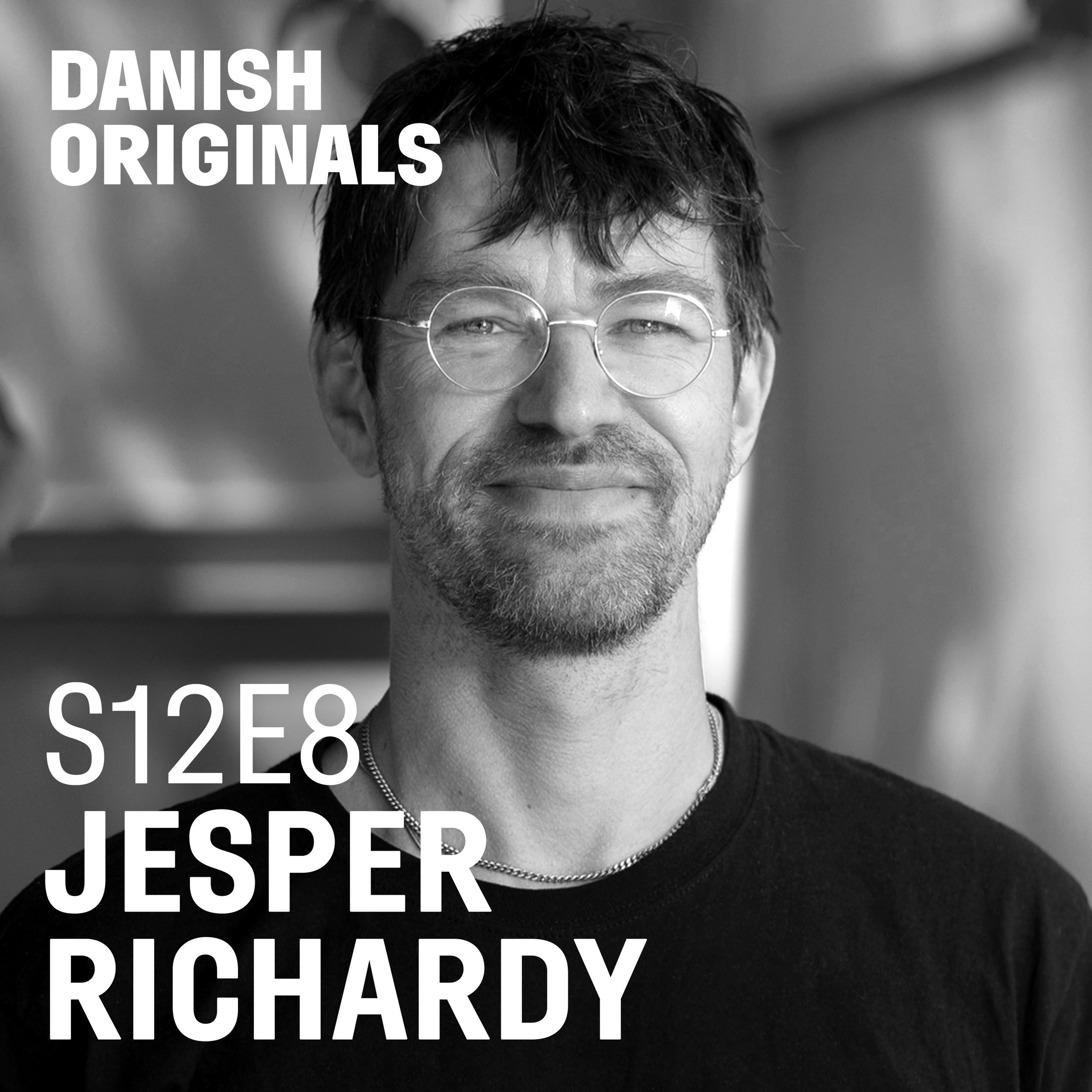
From his home, Copenhagen-born and based Danish vintage clothing store owner and PhD fellow JESPER RICHARDY talks about the life cycle of textiles. He shares his thoughts on quality, and on the systemic changes needed in the fashion industry as it concerns sustainability, circularity, waste, capitalism, and consumerism. Jesper talks about the evolution of his three different ventures, in Copenhagen and New York respectively, and how in 2017 Lady Gaga changed his trajectory.
Photographer: Nana Reimers

For today's episode, Jesper Richardy chose School of Goya's Portrait of Luis María de Cistué y Martínez (1788-1842), from 1791, from the collection of the Louvre Museum in Paris.
“My thoughts with my studies were really due to the fact that it was my experience that people who work with textiles see textiles as a piece of fabric or a design or print or color combinations. But very few see it as what it’s really made of, which is oftentimes, if it’s a natural fiber, an agricultural product.”
“We need to make sure that textiles and fashion are not made of toxic, harmful substances, not only to us but also to the environment and to the climate. We need to stop producing things that are only made to be used once or twice. We need to educate and educate ourselves about what quality is.”
“How we talk about clothes is really our thoughts about how we’re going to use it. And I would want it to be part of the vocabulary, and talk about the material, the design, how we found it, the fact that it was secondhand, the fact that it was repaired. Nothing can get me going like a beautiful repair.”
Powered by RedCircle
This conversation with Frederikke Møller occurred on August 17, 2026.
00:00
Jesper Richardy
How we talk about clothes is really our thoughts about how we're going to use it. And I would want it to be part of the vocabulary, and talk about the material, the design, how we found it, the fact that it was secondhand, the fact that it was repaired. Nothing can get me going like a beautiful repair. So somehow I will manage to push that agenda a little bit forward, that it doesn't have to be new, and we can keep loving our clothes for a long time. And then if somehow I can put a nail in the coffin of fast fashion on the way, I would love to do that.
00:43
Frederikke Møller
My name is Frederikke Møller. I am an independent cultural advisor, and guest host of Danish Originals. Our goal is to celebrate Danish creatives who have made a significant mark in the US.
00:56
Frederikke Møller
Today, our guest is Jesper Richardy, and Jesper is the owner of the vintage boutique Time's Up in Copenhagen and P. Principal Vintage in New York. He's also a PhD fellow at the Royal Danish Academy in Copenhagen. Welcome, Jesper.
01:11
Jesper Richardy
Thank you.
01:12
Frederikke Møller
So I'm really excited to speak to you today. I'm in my home in Østerbro in Copenhagen. Can you tell our listeners where you are?
01:23
Jesper Richardy
Right now I'm in my home in the center of Copenhagen, and I'm off to New York tomorrow.
01:31
Frederikke Møller
Alright. Sounds exciting. So have you been enjoying summer in Copenhagen?
01:38
Jesper Richardy
I've been working most of the summer, to be honest. But I've spent most of my summer in New York, and I had two big weeks of vacation in Spain with my son, and then Copenhagen for a couple of weeks, and then back to New York again.
01:55
Frederikke Møller
Sounds like a great summer. I started by mentioning that you are the owner of Time's Up, which sells high-end vintage clothing. You're also a PhD fellow focusing on the life cycle of textiles. Can you tell us how the interest in vintage and textiles started?
02:12
Jesper Richardy
My interest started way, way, way back when I was a young child. My grandparents were in the textiles business and produced textiles in Sweden. So I grew up with textiles being a conversation topic over the dinner table.
02:30
Jesper Richardy
And then when they had to shut down their business in the mid-'80s, when practically all textile factories or producers closed down in Denmark because everything was being outsourced first to Eastern Europe and then to Asia, the conversation changed to a sort of a bitterness and a longing for the way things used to be when quality was still appreciated.
02:54
Jesper Richardy
And then in my family, we're all avid thrifters. We'd go to flea markets all the time, and this was maybe the late '80s or early '90s, we would observe how people were getting rid of all kinds of quality products, not only textiles, but also furniture and inherited objects that were really beautifully made.
03:15
Jesper Richardy
They got rid of it because basically, they just wanted to buy new stuff. In order to accommodate that, they needed to get rid of something. And that something was usually something that was made in a quality that far surpassed what they could get today. For instance, they would get rid of Danish classic modern furniture to buy IKEA or whatever.
03:37
Jesper Richardy
And already back then, I was sort of provoked by that and thought that was a very curious thing. Why would we get rid of something that was obviously a luxury object in the sense that other people had used a lot of time and talent and effort into making something that could withstand the test of time?
04:02
Jesper Richardy
That is the definition of luxury to me, at least other people's time and effort to be able to buy into that. I was sort of provoked by the fact that they got rid of that in order to exchange it with something that was made with a very short lifespan in mind. And so I started collecting, not only textiles but all kinds of things.
04:24
Jesper Richardy
And I think I had an eye for funny, quirky, interesting, well-made things from a very early age. But I never really considered it to be a career path until much later on.
04:39
Frederikke Møller
So how did that interest develop into starting your own business, one I think you've had for two decades, I believe.
04:46
Jesper Richardy
Yeah, I'm 46 now, and I started the first store when I was 23. So yeah, 23 years. So after a decade of dumpster diving, I finished high school, and then I went on to study sociology at university. I don't know, I think during the course of those years, I was starting to panic a little bit, thinking, oh no, what kind of life am I signing myself up for?, having a little bit of pressure from family and parents to take the safe route and get your degree and a job.
05:22
Jesper Richardy
I was struggling with those ideas, and I remember I was getting ready to hand in my thesis. And I knew once I handed that in, to me at the time, that felt like then the decision was made, I was going to be sitting in that cubicle for the rest of my life. So I decided to take a little break, took two weeks to figure out, okay, am I going to finish this or not?
05:47
Jesper Richardy
And I rented a car, and I just drove south through Germany, and further south. I crossed the Italian border. And I still remember very vividly driving in the mountains, and all of a sudden, I see this guy on the side of the road with a little table, and he was selling shoes. And me being used to seeing things on a table that may be of interest, I immediately knew this was gold.
06:15
Jesper Richardy
And I drove closer and closer, and I saw these towering platform shoes on the table getting bigger and bigger. And I got out, and he was selling them for close to nothing. And I remember asking him if he had more. He said, "Sure, sure. Come, come, come, come, come." And behind him was his father's old shoe factory that closed down in 1973, untouched.
06:43
Jesper Richardy
And somehow I ended up buying 25,000 pairs of platform shoes from this guy. And that's when the decision was really made for me that I was going to be doing something else. So I spent all my savings on platform shoes and stayed down there, packed them on pallets, and had them shipped home.
07:06
Jesper Richardy
And my dad helped me find an old barn somewhere in Northern Zealand where I could store all of them. And then I started selling platform shoes to pretty much anybody who would take them. All the vintage shops in Denmark. I started contacting people abroad and in other countries in Europe.
07:26
Jesper Richardy
And I was very lucky in the sense that at that time, in the early 2000s, all of a sudden, just when I bought all of these platform shoes, there was a resurgence in the whole '70s disco era. And I had, I think, more than 200 different styles, and we ended up selling them to all of the big fashion houses also, like Chanel and Dior, for samples.
07:50
Jesper Richardy
And I spent a year in my PJs in front of the computer just selling platform shoes, and it cost me a relationship as well. But once the last platform shoe was sold, I thought, okay, now I'm going to open my store. This is what I'm gonna do.
08:11
Frederikke Møller
Wow. So the platform shoes really led to a lot of things.
08:14
Jesper Richardy
Yeah.
08:16
Frederikke Møller
And you are of course Danish, but you have strong ties to the US. You opened a vintage boutique P. Principal around three years ago in New York City. Why did you decide to open in the US?
08:27
Jesper Richardy
I went to New York for the first time when I was 21 for an internship. When I decided to go, it was obviously because I already had an idea of what New York was going to be like, and it lived up to the hype, to me at least.
08:44
Jesper Richardy
New York represented so many things that had to do with being in a place that is truly cosmopolitan, a melting pot of cultures and identities. And for me, growing up in Denmark as a gay Jew, I was so tired of feeling like the odd one out. I know probably many people feel that way, but to me it was exhausting.
09:12
Jesper Richardy
So I went to find some kind of kinship with other people, not that necessarily they were like me in terms of having this same combination of minorities, but people who kind of could relate to my experience a little bit more. So that's why I went and it didn't take me very long to find a community.
09:35
Jesper Richardy
I found my best friends in the first couple of weeks, and they are still my best friends today, which is really incredible. And my friendships are really the reason why I kept returning over and over for so many years. And my best friends' friends became my friends, and so they are kind of my chosen family. And later on, when I went back to school, I also pursued some of my studies in the US, just to be close.
10:05
Frederikke Møller
Yeah. And I actually wanted to ask you about that. So you pursued an academic career. You have a master's degree in agricultural science, and you were at the University of California, Davis. Can you tell us about that time?
10:19
Jesper Richardy
It's sort of a long story, but I'll try to make it shorter. As I talked before about those ideas of quality and sustainability and consumerism, although I had started the store in Denmark already, those ideas just started taking up a bigger space in my brain.
10:42
Jesper Richardy
And I also started realizing that having maybe one of the best vintage stores in Copenhagen and it having somewhat of an impact, it was also sort of preaching to the choir in terms of, did I really change anything because the people who came into my store, they were already part of that agenda. Could I really do something wider?
11:11
Jesper Richardy
And then on top of that, I started thinking a lot about how my eye was developed. And I started thinking a lot about why a lot of gay people are very strong in the creative fields. Why are so many gays good at art and fashion and poetry and music? And I started thinking about what we all have in common.
11:35
Jesper Richardy
And to me, it was having to fit in at an early age and being very good at decoding any kind of deviance from the norm. I started thinking, okay, so this is why I'm so good at that, it's really something that was given to me by a society I had to fit into, but it's not so much an expression of myself.
11:58
Jesper Richardy
And I started thinking, "Okay, so what was I really interested in before all of this?" And to me, it was science, math, and nature. I could not get enough information about anything nature-related as a child. So I kind of wanted to explore that further, use another part of my brain.
12:20
Jesper Richardy
And then being a small business owner, it wasn't really in the cards that I could take time off to go back to university for a long time. And then the whole Lady Gaga thing happened.
12:32
Frederikke Møller
Can you tell the listeners about the Lady Gaga thing?
12:35
Jesper Richardy
Sure. So I believe this must have been back in 2017. I had already been having all of these thoughts about wanting to go back to school for so long, but I owned a small store, and there was no way I could hire somebody full-time to manage. And I was getting sort of depressed working in the store every day selling dresses.
13:01
Jesper Richardy
Although I was for it, I felt my life was reduced a little bit, and that I could do more. And then one day I was in the store eating a sandwich, and all of a sudden, I see a huge shadow pass by the front window, and the store just explodes in paparazzi. And in comes Lady Gaga, and she ends up spending a couple of hours in the store.
13:28
Jesper Richardy
And I've never been a Lady Gaga fan, although she's a nice person. But that visit enabled me, because she needed a truck to come and pick up all of her purchases, to hire a manager and go back to school.
13:47
Frederikke Møller
Yes. So Lady Gaga changed your trajectory?
13:51
Jesper Richardy
She really did, which is absurd. So, my thoughts with my studies were really due to the fact that it was my experience that people who work with textiles and the people I spoke to in the store throughout the years, they all see textiles, of course, as a piece of fabric or a design or print or color combinations. But very few see it as what it's really made of, which is oftentimes, if it's a natural fiber, an agricultural product.
14:26
Jesper Richardy
And I thought, now that we are increasingly using plastic to make clothes, I really wanted to explore how fiber production and plant fibers are made and how that connects with the finished product. And because in Denmark everything has been outsourced to the Global South, we still have big fashion companies, but really nobody knows how anything is made anymore.
14:53
Jesper Richardy
In the US they still have somewhat of a cotton and hemp and wool production. I pursued some of my studies there, because I started agricultural sciences here in Denmark, and I soon realized that it was really a lot about the big cash crops, as we call them, the industrial crops, and not so much associated with everything else.
15:13
Frederikke Møller
So if we can just move to the broader perspective of the fashion industry, what changes do you feel need to happen on the systemic level for the fashion industry to become less of a pollutant?
15:28
Jesper Richardy
That's a big, big question. I think the answer is a complex one. We obviously have tried in the last 15 years to change some things, right? And the changes that have been tried have been primarily through the market, and thinking, okay, if we inform consumers about the detrimental effects of their consumption, then they will make better choices.
16:00
Jesper Richardy
But sadly, now we see that capitalism and consumerism is such a big driver in us, also mentally. We seek to consume, and we seek that gratification, that rush we get when we buy something. It's sort of the perfect storm in combination with fashion, which is so trend-driven and cheap, and new styles coming all the time. So put that together with the urge to buy and there's just no end to it.
16:34
Jesper Richardy
So, we need to do many things. We need to make sure that textiles and fashion are not made of toxic, harmful substances, not only to us but also to the environment and to the climate. We need to stop producing things that are only made to be used once or twice. We need to educate and educate ourselves about what quality is.
17:05
Jesper Richardy
When I teach school children about textiles and sustainability, I try to develop a vocabulary with them, because unless we have the vocabulary to talk about something, then there is no discussion or we can't have an opinion about something if we don't have the words.
17:23
Jesper Richardy
I speak to teenagers all the time in the store, and I try to explain what to me is good quality, which very much has to do what we call the hand of the textile, what it feels like against the skin, how you can feel that it's a good quality, how you can feel that it's going to last for a long time.
17:41
Jesper Richardy
And I will say stuff like, "Feel that cotton and that T-shirt. Isn't this just the driest, nicest feeling?" And they will look at me, "But cotton, is that a plant?" So that's really where we are. We are so disconnected. Textiles is what I look at, but the same can be said for many, many things that we surround ourselves with that we really have no idea how they're made. So in order to make more informed decisions in our purchases, we need to have a vocabulary to talk about it in an informed way.
18:15
Jesper Richardy
And then there's the whole thing with durability, right? So legislators now think, okay, if we tell textile and fashion companies that they only can make things that are very durable, meaning that they don't break, then surely they must use them for a long, long time.
18:35
Jesper Richardy
Now, some of the research I have been involved with shows that that is really not the case at all. Just because it's durable doesn't mean that it's gonna be used more. In fact, most of the clothing that ends up in landfills today is perfectly wearable. It also has to do with figuring out, and you can probably relate to that, what creates that emotional attachment that we have with some of the things in our wardrobe?
19:06
Jesper Richardy
Why do we care for something? Why would we take care of some of the pieces? It has to do with when we bought them, how much we paid for them, the rarity of it, what occasion we wore it to. The fact that we changed the buttons because we lost one of them, the effort that we made and so much more.
19:25
Frederikke Møller
Yeah. You know, Jesper, I'm also an avid vintage, thrifter person. And then just like you say, it's about the history of the textile that you buy. When did you wear it? And just all the history behind it. And definitely there's a quality aspect as well to it.
19:45
Jesper Richardy
For sure.
19:46
Frederikke Møller
So I'm just thinking what needs to happen for us to actually move away from throwaway culture and fast fashion? Because also it is a mindset. And you've also said that sustainability means more than lab tests. It needs people. I know it's such a huge question. How do we change people's mindset? Because as you say, we crave that dopamine of buying, and fast fashion is definitely a part of that equation.
20:13
Jesper Richardy
For sure. And now we're also seeing, and as I'm sure you're aware, some of the resale platforms online are now some of the biggest retailers in Europe. And some research suggests that buying secondhand is actually accelerating consumption, and it's not necessarily a good thing. What really matters is that what we buy gets used over and over and over. So if we buy something in order to resell it immediately, it's just as bad.
20:43
Frederikke Møller
Yeah, it's true.
20:45
Jesper Richardy
Now in the EU, we are making this very complex fee structure in a lot of new regulations. One of them is called the extended producer responsibility, meaning that companies that put clothing into the market have to pay for the collection and the waste treatment and the recycling of them.
21:07
Jesper Richardy
That is going to increase the price. But it's a giant bureaucratic system that needs to be set in place in order to maintain that. One thought I had, wouldn't it be better to just tax the hell out of this entire sector and make it like cigarettes or dangerous agricultural pesticides?
21:30
Jesper Richardy
We don't necessarily need to ban them, but we can make them so expensive, so it actually reflects, what we call in academia, the negative externalities of a product, meaning the price of a product should reflect all the money that has to be used on saving the climate and the environment at the same time. That's a thought, which I don't think that's going to become reality.
21:53
Frederikke Møller
Yeah. To go back to your US experience, you were at the University of California, Davis. How is that experience of university in the US versus in Denmark? Is it a very different experience or is it very similar?
22:11
Jesper Richardy
I don't think they're similar at all. I think they're very fundamentally different. It's a good question. I don't know if it's because I also went back to university quite late and I definitely was a much better student than I was early on. I really felt the privilege and in the US because it's not a given that you get that opportunity because of the cost associated, you really feel the privilege of it.
22:35
Jesper Richardy
And people are not lazy. Everybody's there to get 100% out of it and do their very, very best, and that's a very inspiring environment to be in. And on top of that, you get all of the support from the system. And I was very lucky that I got an advisor, Amélie Gaudin, who was just incredible.
22:57
Jesper Richardy
My academic field is a very interdisciplinary one and not a lot of people, because it doesn't fit into the silo of design or material science or agriculture. So I pull on all sorts of traditions, and it's not been easy for me to find a home for that, but she got it. And she just pushed me to pursue it, and believe that there was something there.
23:24
Jesper Richardy
Also, Davis is a small town. It's a campus town two hours outside of San Francisco. There's not a lot happening there. And being away from my friends and family enabled me to just really focus on my studies. And being in my mid-30s, I had the time of my life just studying. I was that annoying student, front row of the class, well prepared, every day.
23:51
Frederikke Møller
That sounds like a nice experience. You have a men's vintage store in New York. Can you tell us a bit more about being a shop owner in New York City, and how it is to have a business there?
24:05
Jesper Richardy
We started almost four years ago in a Chinatown mall under the Manhattan Bridge, and then we moved two years ago to a location on the Lower East Side. We are on the corner of Ludlow and Stanton.
24:17
Frederikke Møller
Oh, nice.
24:18
Jesper Richardy
And now we're also doing women's wear.
24:20
Frederikke Møller
Oh, nice.
24:21
Jesper Richardy
My idea was really to add a dimension to the vintage clothing landscape in New York, which is already kind of packed. What I saw was that there was a lot of very high-end designer vintage. There was a lot of Americana in terms of workwear and sportswear, and they're great at that.
24:45
Jesper Richardy
But for me, being a textile nerd, I saw an opportunity for something that was a little bit more focused around the quality of the textile. So we opened four years ago, and it's been really great. New Yorkers love fashion, and they love vintage. And just being on the Lower East Side and part of that whole history of that area and getting to talk to the amazing characters who've lived in that neighborhood for decades.
25:18
Jesper Richardy
And for me, being in New York is also about that melting pot, and I still feel it does have, to me at least, the best street life in the world. I cannot express enough how important that is to me visually in terms of keeping inspired, because fashion is circular and I think that's great because there's a lot of nostalgia and history and self-exploration associated with it.
25:46
Jesper Richardy
And so when I talk about long-lived and durable, I'm definitely not advocating for the fact that we shouldn't be part of a fashion landscape, because we all need to evolve as human beings. So New York helps me feel inspired and looking for where we are moving culturally.
26:10
Frederikke Møller
I totally agree. It's so inspiring, and the street style there is just amazing. So can you reveal the thought behind the name for the store P. Principle?
26:21
Jesper Richardy
So I actually love the name for the store here in Copenhagen, Time's Up, because to me it encapsulates a lot of the thoughts around living in the moment and where we are in the sustainability crisis, and it reminds me a little bit of Vivienne Westwood's first store, Worlds End. It's got a little bit of that same cachet.
26:45
Jesper Richardy
But then when I wanted to open the store and registered the name in New York, we sadly got a letter that we couldn't use the name, although we had already had a store here in Denmark for 20 years. There was a hashtag called #TimesUp that was associated with the MeToo movement, and we were politely told to not use the name. And I guess you don't wanna fight a good cause.
27:07
Jesper Richardy
And so I thought a lot about alternatives. And so P. Principle is based on Freud's pleasure principle. And Freud, he describes how a lot of depression in people basically stems from this conflict between instant gratification on one side and the search for meaning on the other. And the pleasure principle is the instant gratification, which I spoke about before, the instant gratification that fits perfectly into the capitalist production machinery, in that we all have to buy all the time.
27:48
Jesper Richardy
So it's kind of a semi-ironic play on that, in wanting to create a space that is not only about that, but it is about finding something that resonates somewhere else in your brain or in your body, and that evokes a different kind of sensation and meaning than buying something random that you don't really care about.
28:12
Frederikke Møller
Okay, so there's thought behind that name. I can just say that it's also the title of a Janet Jackson song.
28:19
Jesper Richardy
I know, and that's funky.
28:22
Frederikke Møller
It is. So how is that experience opening a business in New York City versus in Copenhagen?
28:28
Jesper Richardy
When it comes to starting a business and being in New York, it's just completely different from my experience in Denmark. In Denmark, of course, I was met with somewhat support, but also a lot of skepticism. "Are you sure you wanna do that? Ooh, it sounds like a lot of work. What's your plan B?"
28:52
Frederikke Møller
The safety net.
28:54
Jesper Richardy
The safety net. "How are you ever gonna get a mortgage?" Whereas in New York, there are so many entrepreneurs and small business owners, and I found it so inspiring to be around people who talk shop and network and okay, so how do you build a business? In Denmark, I had nobody besides my family to talk about these things.
29:20
Frederikke Møller
Sounds like an inspiring New York environment.
29:24
Jesper Richardy
Yes, and plus in Denmark, when I went back to university at 35, I was also met with a lot of raised eyebrows being the oldest of the cohort, and I encountered none of that in the US. So yeah, this entrepreneurial spirit also translates a little bit into academia as just like, "Go for it. If you believe it, go for it." To me, that was super inspiring.
29:51
Frederikke Møller
I totally get that. What you say about New York, that resonates, I think, with me and with a lot of our listeners as well. What do you hope your research on textiles and sustainability can help change?
30:06
Jesper Richardy
Now with my new project, we're working exclusively with textile waste. So I have the vintage clothing stores, which are very high-end, but now we're starting to work a lot with municipal textile waste, both here and in the States. So whatever is thrown away to go to landfill or in Denmark where it's getting burned, we go through the textile waste, and we take everything out that we feel has value, in material and in design, in order to resell it and save it from going into landfill.
30:39
Jesper Richardy
Somehow I would love to create more of an idea about what makes us love our clothes, as we talked about. How we talk about clothes is really our thoughts about how we're going to use it. And I would want it to be part of the vocabulary, and talk about the material, the design, how we found it, the fact that it was secondhand, the fact that it was repaired. Nothing can get me going like a beautiful repair.
31:10
Jesper Richardy
So somehow I will manage to push that agenda a little bit forward, that it doesn't have to be new, and we can keep loving our clothes for a long time. And then if somehow I can put a nail in the coffin of fast fashion on the way, I would love to do that.
31:29
Frederikke Møller
Are there more vintage shops in the future?
31:34
Jesper Richardy
So I am heavily invested in the whole textile sustainability and circularity agenda. I don't know about more vintage stores, but I'm definitely gonna stay in the field either academically or with my work with municipal textile waste and trying to find a second life for that and in education.
32:08
Jesper Richardy
But I don't know. I'm in a co-parenting situation. I have a small boy with my best friend, and she works in film. And since she has very kindly allowed me to pursue this PhD in Denmark while the jobs were lining up in Hollywood, it's her time to take the lead. So we're going to relocate to LA next year.
32:31
Jesper Richardy
And then, of course, California is also a super interesting place for me because textiles is very high up on the agenda. They have adopted a lot of the same legislations that we have in Europe in terms of mandatory textile collection and extended producer responsibility. I will be working on some of the same projects that I've helped kickstart here in Denmark in California.
32:56
Frederikke Møller
All right. So you'll continue your research into textiles in California, and you will be LA-based then?
33:04
Jesper Richardy
Correct.
33:05
Frederikke Møller
That is very exciting.
33:07
Jesper Richardy
At least for two years is the plan until our child is starting school.
33:14
Frederikke Møller
Yes. All right. That sounds so exciting. And so will you continue working on your PhD while there?
33:21
Jesper Richardy
So I'm done with my PhD in three months, and I will be Dr. Richardy.
33:25
Frederikke Møller
Fantastic. Dr. Richardy, I love that.
33:29
Jesper Richardy
Which is a huge milestone for me. My God, having three businesses and a small child and living between two continents has been a lot of fun, but also very busy. So I'm looking forward to having a little bit more time on my hands. We'll see.
33:47
Frederikke Møller
I totally get that. Wow. Well, I'll just say congratulations. I think I can say that already now. Thank you so much, Jesper. You're already on your way with a lot of these things that you're dreaming of, I believe. You're doing a great job already. So thank you for being part of Danish Originals. I really enjoyed talking to you.
34:12
Jesper Richardy
Thank you so much. Thank you as well.
34:17
Frederikke Møller
For today's episode, Jesper Richardy chose School of Goya's Portrait of Luis María de Cistué y Martínez (1788-1842), from 1791, from the collection of the Louvre Museum in Paris.
34:32
Jesper Richardy
I chose the School of Goya's Portrait of Luis María de Cistué y Martínez.
34:39
Jesper Richardy
So you will see a picture of a prince in regalia. With his fine lace and black velvet clothing, it represents a lot of wealth, but it also expresses a knowledge about materials and quality and luxury and also symbolic value of things. It’s sophistication.
35:01
Jesper Richardy
This painting used to be owned by Yves Saint Laurent. When he passed away, his entire art collection was auctioned off by Christie's. Before that, it was moved to the Grand Palais in Paris, and it was a spectacle. Everybody in Paris or in the art world globally was talking about it. But behind all of the buzz and the fashion was really something quite astounding to me.
35:29
Jesper Richardy
I have a pretty big collection of his work, especially from the '70s and early '80s. So I managed, by pulling all the strings I had, to get a pass to go and see the collection on view for two days before the auction. And it was the biggest art experience of my life.
35:48
Jesper Richardy
Not only this portrait, but to see that level of sophistication and eye for colors and textures and meaning from all kinds of periods, it wasn't so much about each individual object, it was about how it was put together. I felt so high from that experience, it was so beautiful.
36:08
Jesper Richardy
The billionaire class from all over the world had traveled to Paris to see and to bid on the sale. Everything sold for minimum three times the valuation, most of it much more. The prices weren't based on previous prices. Everybody just wanted to be part of this story of Saint Laurent and the legend that he was.
36:29
Jesper Richardy
It started all of these very complex thoughts in my mind about taste and value and luxury and what it really is. And it was something that I still think about today because the whole experience was just so absurd and unlike anything I will ever see again. That's why I chose this portrait.