

From her San Francisco office, American journalist and author JEANNE CARSTENSEN discusses her new non-fiction book A Greek Tragedy: One Day, A Deadly Shipwreck, and the Human Cost of the Refugee Crisis, that portrays, through firsthand accounts, the largest single-day loss of life during the modern European refugee crisis on October 28, 2015. Jeanne shares thoughts on the timelessness of this very human story, and comments on historical patterns of migration as a global survivor's game.
Photographer: Marissa Leshnov
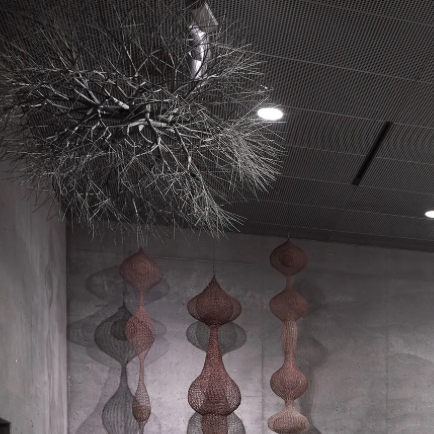
For today's episode, Jeanne Carstensen chose Ruth Asawa's installation of 15 Untitled, from 1955–1969, from the collection of Fine Arts Museums of San Francisco.
“I needed to spend a lot of time and really, really listen. And sometimes the pacing of the interview, I know what I’m going for in my head, I’m hoping that they will, I don’t know, describe something that I need them to describe, and they’ll go in a different direction.”
“People who speak with authors and journalists like myself, they really are doing work, and they are really sharing with the world something that they have no reason to share. These people have gotten nothing back from this book. They live far away. Some of them haven’t even seen it. Some have seen it. There is no immediate payback.”
“There was a time when all the countries in Europe were exporting people. And now we think and act in the media like it’s only the other way around. But the US is filled with people who came from Europe. What a massively common experience this is over many centuries, this moving around.”
Powered by RedCircle
This conversation with Finn-Olaf Jones occurred on August 10, 2026.
00:01
Jeanne Carstensen
People who speak with authors and journalists like myself, they really are doing work, and they are really sharing with the world something they have no reason to share. These people have gotten nothing back from this book. They live far away. Some of them haven't even seen it. Some have seen it. There is no immediate payback except telling the story and maybe feeling listened to and feeling, "Well, my story will go down in history sometime."
00:39
Finn-Olaf Jones
My name is Finn-Olaf Jones, and I'm a journalist, businessman, and mountaineer, and guest host of Danish Originals. Our goal is to celebrate Danish creatives who have made a significant mark in the US.
00:50
Finn-Olaf Jones
Today's guest is Jeanne Carstensen, a journalist who has written for The Nation, The New York Times, and other publications. She's also the writer of the acclaimed book, A Greek Tragedy: One Day, a Deadly Shipwreck, and the Human Cost of the Refugee Crisis.
01:06
Finn-Olaf Jones
The book deals with the disaster off of the island of Lesvos in October 2015, when a boat carrying refugees overturned off the island and some 80 people drowned. Welcome, Jeanne. I'm sitting in my house overlooking LA, the valley here, and where have we reached you today?
01:28
Jeanne Carstensen
I'm in my office in San Francisco.
01:30
Finn-Olaf Jones
And San Francisco's your base, isn't it?
01:33
Jeanne Carstensen
Yes, I'm based here. I often-times travel for my work, but this is my home base.
01:39
Finn-Olaf Jones
Yeah. 'Cause you've been all over the world covering the refugee crises in all the various spots that's been going on, and it's such an apropos subject. And this book has really brought all this alive to so many of us. Most of us see the refugee crisis, especially what's happening in the Mideast, as sort of this anonymous wave of people coming over, and you've really put names and faces and stories behind the tragedy.
02:05
Finn-Olaf Jones
You had a psychiatrist, you had a bank manager, you had people from all walks of life, and I couldn't help but to see that "there but for the grace of God go I." It's a very, very human story. And I'm wondering, you were there when this happened originally, in Lesvos, weren't you?
02:24
Jeanne Carstensen
Yes, I was there on October 28, 2015. That's the day that the shipwreck happened, and the book focuses on all the events around that day.
02:36
Finn-Olaf Jones
Yeah, and let's just start with the broad picture. What happened that day?
02:40
Jeanne Carstensen
Well, that day was a very bad day in a season of bad days. If you go back to 2015 and remember from wherever people were watching, we were seeing images of the rubber rafts filled with people in orange life jackets arriving to the Greek islands.
03:00
Jeanne Carstensen
And this kind of thing is happening all the time, but it often doesn't break through to the news. But this wave of migration was so huge that on the island of Lesvos alone, which is right across from Turkey, just about five to eight miles, depending on the exact topography, in October, the month of the shipwreck, 130,000 people arrived to that island alone.
03:29
Jeanne Carstensen
So the thing that is the context of the book that's always hard, you read the book and you learn about this shipwreck and all of the agony around it, both for the people on the boat and then for the local people and the whole system, the hospital system, was overwhelmed with so many dead, and you think, "Oh, wow, that's awful." But then I have to try and explain that even that incident that day was only one incident on a day when around 7,000 people arrived on this island.
04:06
Jeanne Carstensen
So every day in October, it was an average of 7,000–8,000 people arriving. And what was known as the Syrian refugee crisis, and that's because we were about four years into the Syrian civil war, and millions of people had left Syria, but as is very common in refugee situations, people don't wanna really leave their home, and they certainly don't wanna have to travel to another continent. So most people had been taken in by Turkey, Lebanon, and Jordan, and people were waiting, thinking, "Okay, this war will resolve. We'll be able to go back."
04:50
Jeanne Carstensen
But they weren't able to go back, and then they weren't able to educate their kids, and pressure was building up in the region. And so it all spilled over in 2015, and people tried to make it to Europe to start a better life.
05:09
Finn-Olaf Jones
Yeah. I noticed you do very little finger-pointing here. You let these people's stories speak for themselves. And you talk a lot about the background that some of the islanders had with their own refugee crises, a generation, two generations ago. And I noticed you start out with this quote from the Holocaust, from World War II, and I realized that maybe you deliberately made a timeless story here.
05:33
Finn-Olaf Jones
This is really a refugee story that really in certain variations could have happened any time in history, and it will probably be going on for the foreseeable future. But it's an amazing story, for me at least, because it just seemed timeless and you have simply avoided putting any political context to it. These are just tragedies for each of these people.
05:59
Finn-Olaf Jones
We walk with each of them from Afghanistan, from Syria, and all that to that gangplank in Turkey, almost as if we're going to an execution. And it's horrifying 'cause you see all the bad decisions, all the pressures, all the fraud that occurred to get these people there to their deaths or to their tragedy. And I was wondering, right from the start, was it your intention to make a timeless story?
06:27
Jeanne Carstensen
It was my intention. But the only way something becomes timeless is through being very, very specific. So this is a very specific story with as much detail as I could get about four people out of the close to 400 that were on this boat that day. And then also, as you mentioned, the locals who had been dealing with this for months after months, and then all these international volunteers who had come.
07:01
Jeanne Carstensen
And so something becomes timeless or universal through its specificity, and that's why it took me so long to write the book. It took me seven years and five international reporting trips because it was a detail of what color was the coat of somebody's son on the boat when it crashed and when it sank. These kinds of details are what can make something universal.
07:33
Jeanne Carstensen
And the other thing that I was aware of while writing the book, if you think of the geography of the Eastern Aegean, you have the Turkish coastline, and then you have the Greek islands of Lesvos, Chios, Samos, and they're all quite close to the shoreline of Turkey. And out in the middle of this, you have the international boundary, which is in the water, but you don't see it.
08:04
Jeanne Carstensen
The other thing that is very notable, is you mentioned that there was a refugee history on Lesvos. So in 1922–23, after the First World War and the decay of the Ottoman Empire, as that all fell apart, there was a lot of conflict in Turkey. And Greece was thinking that this was its moment to retake this area of land that has historically been Greek-speaking for centuries. And so the Greek army was going towards Ankara.
08:39
Jeanne Carstensen
Meanwhile, the Ottoman Empire was falling apart, and Atatürk was coming up, and there was a brutal war at this time. And Atatürk set fire to Smyrna, which is now known as Izmir, and all up and down the coast and all into the Black Sea, this conflict was unfolding. And so some million Greeks who were living in what was known as Asia Minor at the time, were forced to flee to these same Greek islands.
09:11
Jeanne Carstensen
And so if fast-forward to today, at least half the population of the island of Lesvos descends from these refugees. And they came in even worse conditions than today's, because there were no cell phones, and the boats were even worse, and it was a very horrible time. So you have that.
09:32
Jeanne Carstensen
But then all you have to do is go back over the centuries. You've got Ancient Troy, it's right across from Lesvos and a little bit to the north, up there on the Dardanelles. And so as a reporter, when I was there in 2015 and watching, it was hard to know how to describe it. Sometimes we would say, "Oh, it's biblical. It's epic to see so many people coming every day."
09:58
Jeanne Carstensen
It's a kind of thing you think doesn't happen in modern times, that tens of thousands of people will risk their lives in the water. But this has been going on, armies and migrations back and forth through this very body of water. And we have ancient Troy sitting there to remind us. And we have epics like The Odyssey, which is now in the theaters. And that was something a lot of us were aware of.
10:28
Jeanne Carstensen
You can think of each individual refugee, like Odysseus, trying to get home. So you're right. It's of the human experience, is what I'd say. And I wanted to bring that to readers — it could happen to any of us. I really felt that as a reporter, Finn, when I was there.
10:51
Jeanne Carstensen
And when I was there in 2015, I was filing stories every other day. I was on the radio. I was writing pieces. It wasn't like writing a book. It was much shorter pieces, but inside myself, I was really being changed. I thought, "This could happen to any of us. This could happen to me. This is not so much this other experience that we can pretend that we can ignore."
11:17
Finn-Olaf Jones
That's what's interesting to me. Despite all that traffic and the terrible history, and you put this so well in your book, you have an island of very reluctant heroes, it seems. You see these transitions, and certainly a lot of people were not heroes. But I was touched by how many people rose from the stupor despite maybe being numbed by the sheer volume of refugees.
11:40
Finn-Olaf Jones
I was especially taken by the story of the mayor across the island there who did not want to cooperate, but in the end decided to make a cemetery for these refugees. And the story of the cafe owners who became these island heroes and welcomed these people in and got their neighbors to help out.
11:59
Finn-Olaf Jones
It was really very, very touching, that gradual thing, which I guess you witnessed. But I guess my big question is, at what point did this become a book rather than a magazine story? At what point did you say, "Well, I'm gonna spend my next seven years following up on this one terrible tragedy of all the tragedies that have been witnessed there"?
12:19
Jeanne Carstensen
It took a while for me to figure it out. I reported on this for three years. So in 2015, for a few months, I was on the island of Lesvos, and spending so much time there, I really got a deep sense of that period and those mass arrivals. Then if we remember, I think it was November 13, 2015, we had the terrorist attacks in Paris, and so the whole dynamic started to change.
12:51
Jeanne Carstensen
For a number of months, the borders were open and people were arriving on Lesvos and they were able to get through into Europe. And then due to the terrorist attack and many other things, the borders started closing. So in 2016, instead of being able to move easily northward and apply for asylum in different countries, a lot of people were stuck in Greece.
13:16
Jeanne Carstensen
And I was there for six months in 2016 visiting camps all over the country and it was really hard what I saw. And 2017 I continued. So in 2018, I'm back in San Francisco. I have piles and piles of reporters' notebooks and so many stories in my heart, in my mind, endless. And I just started writing and writing.
13:43
Jeanne Carstensen
But I couldn't really figure out what the book was. I didn't want to do a policy book. I didn't wanna do something that was trying to tell the big picture. I thought maybe that had already been told in different ways. And so finally, I remembered back to October 28, 2015 and this shipwreck. And the thing is, it was the biggest shipwreck of that entire period and it was the crisis point on the island.
14:14
Jeanne Carstensen
And I suddenly realized if I could tell very deeply about one incident, it could be a way of telling this larger story that I wanted to tell. So it took me a while and before I decided, "Okay, this is it, I'm gonna write this book," I went back to Lesvos and I did a lot of interviews with locals who had been there that day and people from different non-governmental organizations and asked them about it.
14:44
Jeanne Carstensen
And it really confirmed that my idea was a good one because everyone said, "Oh yeah, we'll never forget that day. That was the worst day in a season of days." And I realized it was really legitimate. It wasn't just me as an outside reporter choosing a shipwreck. It really lined up.
15:05
Jeanne Carstensen
October 28 is also Ohi Day, which in Greece means "no" and it's a holiday that commemorates that Greece was able to turn back the Nazis at the beginning of World War II. Later they were invaded. But also for the Greeks, it's a mix. They remember that holiday, they remember that season, and then on Lesvos, that shipwreck, which overwhelmed the island.
15:31
Jeanne Carstensen
The island had been overwhelmed for months, but this incident was so terrible because they had many bodies washing up on beaches. They had dying children in their villages. And I remember that night, people just screaming, "Stop, stop, we can't take this!" This one man who was captured on, I can't remember which television network, he said, "Stop this, stop these wars! We can't take this anymore!" And really, the local people were pushed to the brink.
16:06
Finn-Olaf Jones
You found four people or four families that told the story so beautifully, and you really got in depth with them. And yet, from what I understood, you had to track these folks down long after the tragedy. How did you go about doing that, and how did you get their trust, and how did you select these four?
16:27
Jeanne Carstensen
It was one of the biggest reporting challenges of the book. So after I decided to write about the shipwreck, then the question is, how can I find people who survived that particular incident? Because the smugglers do not have any passenger lists, and there's no records of who was on the boat or where they went. If they survived, they moved on.
16:52
Jeanne Carstensen
So when I was back on Lesvos, that was one of my major goals, to ask people, "Do you remember that day? And are you still in touch with any of the people from that shipwreck?" And everyone remembered the day, and most people didn't have any specific connections to those people.
17:15
Jeanne Carstensen
But I would get a lot of stories. People would think and then they would say, "Oh yeah, there was this one really fat guy, this really huge guy." And I kept hearing about him, and then I was able to find photos of him because he stood out, because he was so big. Whereas other people who are more average size, they don't stand out.
17:42
Jeanne Carstensen
And so I eventually found a photojournalist who had written down his name and nationality, and I kept asking around all these journalists, everybody I could think of, "Do you know where this man is?" And nobody did. So finally I wrote a short article and had it translated into Arabic, and then had a Syrian friend of mine post it on Arabic language Facebook all over Europe, but with a focus on Germany and Sweden and Austria.
18:18
Jeanne Carstensen
I think those were some of the big countries accepting arrivals at the time. And maybe a month later, I heard from my Syrian friend, "We found him." And he was in a small town in Germany. He had received asylum, and I had my Syrian friend call him and ask him in Arabic whether he was even interested in speaking to a journalist, because I didn't want him to feel pressured or get some kind of call out of the blue.
18:49
Jeanne Carstensen
And he did wanna tell his story. So that's Okba Bader, and he was 37 at the time of the incident and weighed 470 pounds. And he studied psychology in Syria, and at the time of the civil war when it broke out in 2011, he was in the process of trying to apply to open a kindergarten, 'cause he wanted to teach. And his dreams were dashed like so many by the civil war, and he left.
19:23
Jeanne Carstensen
The second person I found was Hedayat Habibyar, and I got to him. He's an Afghan bank manager and loan officer from Kabul. And a nurse who's a source of mine, who I interviewed many times and she gave me a lot of insights when I was reporting there, I asked her if she was in contact with anybody.
19:49
Jeanne Carstensen
She did not want to share his contact with me, and she waited three or four months. I don't know what she was looking for, but maybe she saw how tenacious I was that I was moving ahead on this book, and eventually she shared his cell phone number with me. And same thing, I got a Farsi-speaking journalist to call him, tell him about me and the book, and ask, did he wanna tell his story, and he did. And that's how it all began.
20:21
Jeanne Carstensen
A little later, I found Rezwana, who was 14 at the time, and I also found Amel, who was from Syria, a 27-year-old artist. Those two had been reported on by some other people. They hadn't been able to go as in-depth about their stories, but I was able to find them through some other journalists, and they were both willing to talk to me as well.
20:51
Jeanne Carstensen
A lot of people ask me how did I choose these four, and in a way it just came together. Each person was interested in speaking to me, and they were so interesting themselves. I got very lucky that they were articulate people who were able to speak about their inner lives, and that was really a gift to me as a journalist, because some people, they might be too traumatized or some people just move on and they don't wanna go back and tell a story like this.
21:27
Jeanne Carstensen
So people were quite amazing, but it did take me flying around the world and going to where they were on several occasions. I needed to spend a lot of time and really, really listen. And sometimes the pacing of the interview, I know what I'm going for in my head, I'm hoping that they will, I don't know, describe something that I need them to describe, and they'll go in a different direction.
22:00
Jeanne Carstensen
And I found I just had to follow them in a lot of ways, and then I would find a way to do my follow-up questions at the right moment when they were open to that. One of the hardest things when interviewing somebody, I mean, these people survived unthinkable traumas, especially Hedayat, the bank manager.
22:27
Jeanne Carstensen
He gets on the boat with his pregnant wife. He's 23, she's 23, and their two sons are with them, and they are three and two. And what he goes through in this is just unthinkable, and it was very hard. He broke down in tears, but I never forced him. I felt that he really wanted to share his story, and I also realized it was the first time he had shared the entire story with as much depth as he did with me.
23:02
Jeanne Carstensen
People who speak with authors and journalists like myself, they really are doing work, and they are really sharing with the world something that they have no reason to share. These people have gotten nothing back from this book. They live far away. Some of them haven't even seen it. Some have seen it. There is no immediate payback except telling the story and maybe feeling listened to and feeling, "Well, my story will go down in history sometime."
23:40
Finn-Olaf Jones
Yeah. Was there anything specific you did to get these people to open up? Because it's an amazingly granular story. And they tell them in great detail, minute by minute. You have this 24-hour period when they're all in the water and there's rescuing going on, that is told with such incredible detail.
23:56
Finn-Olaf Jones
This is the worst time, probably, of everyone's lives, and they see loved ones die. I'm not quite giving anything away, but they see things that are indescribable, and yet you are able to get them to talk about this quite openly. I can't imagine how that would've worked, how you could have gotten them to speak so frankly, and the guilt some of them had too.
24:14
Jeanne Carstensen
Yes. Yes. You get to it over time, and I think part of it is they must have felt respected. They knew I was there. They could see what kind of a person I was, that I was really deeply listening to them. The first, I don't know, six or seven chapters of the book, they all begin in Syria and in Afghanistan when you meet these people, and it's not a full biography of them.
24:44
Jeanne Carstensen
It's just a portrait, so you can get a sense of some qualities that they had and some incidents in their childhood that sort of defined something about them. And it was incredibly important to me to have that kind of material, because what I wanted was that you would remember after you read the book, not the refugee characters, but you would remember maybe Okba, the big guy, and Hedayat, the loan officer, maybe by name, because you got to know them.
25:19
Jeanne Carstensen
So I would say that the shipwreck incident itself, that period, it was hard for them to talk about. The terrible moments of fear and loss and falling into the water and what they saw. But it's not as if I went only to that in my conversations with them. These conversations, especially with Okba and Hedayat, were over many days. And in both cases, they wanted to tell me the whole story chronologically.
25:51
Jeanne Carstensen
So the first time, they just told it. And I record everything. Everything. I could never do it just with my notebooks, but I'm also, with my reporter's notebooks, making notes about things I want to follow up on. And so for instance, there's a moment in the book, Okba, the large guy, the Syrian, is one of the last people in the water because they can't get him out of the water.
26:18
Jeanne Carstensen
So he told me, and he was very open about how it felt to him, that he was praying to God at moments, that he would feel hope and then he would feel, "This is it. I'm going down. I have to just hope I was a good enough person and pray to God, and my time is over." He would tell me all of this.
26:41
Jeanne Carstensen
But I also interviewed a lot of other people who saw him in the water. I found fishermen who tried to rescue him. I had Spanish lifeguards who were on two jet skis. I also went to Barcelona and interviewed them in depth. And so they saw him in the water. And so all of these things started to build up, and I had a more nuanced sense.
27:06
Jeanne Carstensen
And so when I went back to Okba for the second series of interviews, I would say, "So, this fisherman told me that when they were trying to pull you up, you were crying," and that would open him up to say something else. So it was a layering with a lot of care, of gathering information.
27:30
Jeanne Carstensen
I did learn that people who live through a traumatic moment, they're not thinking about how they dressed their children that morning. They're not thinking that their oldest son was wearing a black puffy jacket, and their youngest son was wearing a red puffy jacket because red was his favorite color.
27:54
Jeanne Carstensen
But as a writer, to make a story come alive, these details really, really matter. So I would find a time when I felt that there was an opening, and I would say, "If you could tell me, do you remember what they were wearing that day? Do you remember the color of your wife's headscarf that day?" And so it's very delicate, but you find a moment, and if you have a good rapport… and sometimes people would just not remember or not wanna talk about certain things.
28:34
Finn-Olaf Jones
Oh. Those two lifeguards are — Oscar and Gerard, right? For me, their story's the most tragic in many ways 'cause they are out there on their jet skis and they have to make the choice of gods and they have to do triage out there with 200 people floating around and they have to decide which dozen are we gonna save.
28:52
Finn-Olaf Jones
And that is just so heartbreaking. Did they ever get over that? I remember you writing about their recovery afterwards and that they were crying and that this was incredibly traumatic for them to have to do this. Did they ever get over that? I know you saw them in Barcelona afterwards.
29:08
Jeanne Carstensen
Well, they did get over it. You can see in the book what feisty human beings these guys are. Oscar, who is the head of this lifeguard company in Barcelona, he had become obsessed with what was going on in the Eastern Aegean in 2015, and Gerard as well. Oscar had some background, I think, with NGOs, but mostly we're talking about beach lifeguards, as they explained to me.
29:40
Jeanne Carstensen
They're like, "Hey, we just needed a job in the summer." Now, Gerard had become a professional lifeguard, but they had never, Finn, done anything like this. They had just rescued people in big wave surfing or patrolling the beaches off of Catalonia in the summer and hopefully nobody drowns, this kind of work.
30:01
Jeanne Carstensen
When they went to Lesvos, they thought, "Oh, we'll stay a week or two. We'll see if we're needed." But 7,000 people were arriving every day and there were no lifeguards, and the officials, the Greek Coast Guard and Frontex, which your European listeners will know is the border patrol for Europe, had not really put in place a rescue operation.
30:24
Jeanne Carstensen
It was all about border control. And so their ships were not configured for rescue, and their training was not really focused on rescue. Now, they did have to rescue people, and they did their best, but it was shameful the lack of preparation for life-saving.
30:43
Jeanne Carstensen
So enter these lifeguards, and that day two jet skis, two guys on each jet ski. They go out with very stormy weather that day, these famous winds from the northwest, they are actually mentioned in The Iliad. These are known winds in that area, and it's why the armies were held back from reaching Troy for months.
31:06
Jeanne Carstensen
And it's just horrible. The smugglers knew how bad. Sunny skies, but high winds. So that adds to the atmosphere of the tragedy. And the smugglers in Turkey, the shore there was protected from the wind, but they knew very well that out in the center of the channel it was dangerous conditions, and so dangerous, small craft warnings on Lesvos fishermen were not supposed to go out.
31:32
Jeanne Carstensen
So these lifeguards, they hear about this incident out in the middle of the channel. There's some huge shipwreck, but they had no idea how extensive it was, and they arrive on their jet skis. It took them half an hour in very rough seas, banging up and down, and it looked to them like a plane had gone down.
31:55
Jeanne Carstensen
They see out in the water, this rough, rough water, going up and down an oil slick of orange and blue with the life jackets. But what we have to remember about that orange and blue, probably half of the people had no life jackets at all. And most of these life jackets were fake life jackets that were manufactured cheaply by horrifying, unethical people in Turkey that were part of the smuggling thing.
32:26
Jeanne Carstensen
So for these lifeguards to face 350–400 people in the water, and there were also two Coast Guard patrol boats and one Frontex boat, but these all were very high up, it's called a high freeboard, they couldn't reach the surface. These were not good vessels for getting down and getting at the people.
32:52
Jeanne Carstensen
And so a lot of the pressure was on the lifeguards and then the volunteer fishermen who came out from the Turkish side and the Greek side. And I call it a mini Dunkirk, very mini compared to the scale, but it had some of that quality of civilians going out and fishermen, especially.
33:13
Jeanne Carstensen
And the lifeguards, what they saw was just beyond what they could take. All these faces in the water clinging to wreckage, calling out to them, "Help, help, help! Save my child! Save my child!" And so the lifeguards, they couldn't go towards large groups of people because the people were so desperate, they would actually pull the jet ski into the water. They would just tip it over.
33:47
Jeanne Carstensen
They were faced, as you say, with a triage situation. It's not like they could get together and prepare and discuss. They all knew about triage. They had to decide that if anybody's face was down in the water, they had to be assumed dead. Normally a lifeguard would grab everybody and immediately do advanced CPR, and they can perhaps bring them back to life, but they didn't have a chance to do that.
34:16
Jeanne Carstensen
At one point, he saw this little girl who was face down, and he thought, "I can't do anything for this girl." But something in his cells reminded him of his own daughter, and he grabbed that girl, and she was close to dead, extreme hypothermia. But he grabbed her, pulled her up onto the jet ski, and took her over to a Coast Guard.
34:42
Jeanne Carstensen
There was another lifeguard on the Coast Guard boat. They did everything to save her, and you'll read the book about what happens, but it's just one moment of how hard it was. They decided, okay, it made sense to them intuitively, save the children first.
35:01
Jeanne Carstensen
And I have to say, living in the US, where the terrible, terrible separation of children from their families happens under ICE and under the Trump administration, has happened, quite frankly, for years in our system, but it's gotten worse in recent years and more pointed, that day and during that time on Lesvos, this would be a sin to separate children from families.
35:31
Jeanne Carstensen
Everybody did everything they could to keep people together. But out in the water, they thought, "Okay, we'll save the children first, we'll pull them out, and then we'll go back for the parents." But as the hours of the rescue wore on, it turned out that they often could not find the parents. And so everything was so chaotic, they didn't know what happened.
35:54
Jeanne Carstensen
Had they drowned? Had they been rescued by somebody else? So that was probably the most traumatic thing for these lifeguards after everything was over and the next day, they started hearing how many children had been orphaned.
36:09
Finn-Olaf Jones
Yeah. Oh, yeah. Well, I gotta tell you, that section of the book, I just could not put it down. It was so incredibly dramatic and tragic. I'm wondering, have you been approached to turn this into a movie? Because it really is very cinematic. It's a terrible tragedy, but also, it's described in such incredibly picturesque terms, and you're in this epic area. It would be an incredible movie, but I don't know if that's come up yet.
36:35
Jeanne Carstensen
It hasn't come up yet. I hope it will, but I am having some conversations about theatrical adaptations, which is interesting. At the beginning of the book, in my author's note, the only place I'm first person, where I explain why I wrote the book, I mention Bryan Doerries, and he has a project called The Theater of War, and he presents actual Greek tragedies as staged readings with famous actors as a way of conducting conversations around trauma.
37:07
Jeanne Carstensen
So, Ajax, that ancient play deals with PTSD, in a way. So, I'm in conversation with him about possibly presenting part of my book in that manner. We might combine it with Aeschylus's The Suppliants, which is an ancient play that takes on migration, where a group of women arrive to a Greek city asking for asylum, basically, and then the discussion that goes on around that, and we might combine that ancient language with my modern language.
37:43
Finn-Olaf Jones
Wow. So yeah, as a classic Greek tragedy?
37:48
Jeanne Carstensen
We wouldn't change it. I think it would be paired with the classic Greek tragedy, and we would read out loud a selection from my book that would function a little bit that way. And then we would have the same actors in both. He works with people like Willem Dafoe, very well-known people, but also bring in people who might have been refugees or might have been rescuers.
38:19
Jeanne Carstensen
And so it opens the door to a big conversation. It's not like a staged full production. The dream is to present it in an open-air Greek amphitheater. And it would be a dream come true for me. I think it would be a very deep, deep way for people to experience the work.
38:39
Finn-Olaf Jones
Yeah, I can see that as a perfect setting.
38:42
Jeanne Carstensen
And then there's another Greek actor who was so inspired by the book, he's also a writer, and he tells me he wants to bring this to the stage. So I'll let you know what happens.
38:53
Finn-Olaf Jones
One of the things that struck me, certainly as a Dane or half Dane, is that so many of these people, or at least two of your characters, dream of Scandinavia. One of them actually gets to Sweden and gets kicked out and all that. What is it about Scandinavia that's so attractive to these people? And did that have any resonance with your own Scandinavian roots hearing this?
39:12
Jeanne Carstensen
Yeah. Well, people wanted to get to safety, that was the main thing. And during this period, all of Northern Europe was just a beacon to these people. Everyone during this migration was fleeing some kind of war or conflict or breakdown in their society and in their lives that made it impossible or very difficult for them to stay.
39:41
Jeanne Carstensen
And so when Angela Merkel, in the summer of 2015, said that Germany would be open to accepting, receiving asylum seekers, that spread, as you know. And one of the regions, Scandinavia, it's a stable region. It's a region with good social services and with good schools. And the people in 2015, many, many, many were families, much higher percentage than some of the other mass migrations where families send ahead the young men.
40:19
Jeanne Carstensen
Many of these were families that were traveling, and in fact, in my book, you meet two families and get to know them, both of them from Afghanistan, and they just wanted to be somewhere where there was a future. Some of it is serendipity. If they already have relatives in a given region, that draws, and that was certainly the case with Rezwana.
40:42
Jeanne Carstensen
Her father was a journalist in Kabul, and it got too dangerous for him to keep working. So when he said, "We're going to Sweden," she said, "Oh, no, I don't wanna go to Sweden. It gets dark, it's dark all winter." He said, "That's where we're going, we have relatives there." And so they thought maybe it would be easier for him to find work and things like this.
41:03
Jeanne Carstensen
It was definitely a draw for people, the idea that there's healthcare and there's access to education. I think that was a real draw. I think people were often maybe not so sure about the weather. And so one thing that's very interesting to think about my own Danish roots, is there was a time when all the countries in Europe were exporting people.
41:31
Finn-Olaf Jones
Yeah.
41:32
Jeanne Carstensen
And now we think and act in the media like it's only the other way around. But the US is filled with people who came from Europe. So in part, what it made me think of is, I'm also a migrant here. I came to the US a long time ago. But I connected to it that way, just what a massively common experience this is over many centuries, this moving around.
42:02
Finn-Olaf Jones
Yeah. There's certainly a big debate happening in Scandinavia right now also about how many of these folks one lets in, and I think one of the really impressive parts of your book is you see these are not street people and criminals from Aleppo and all that. These are professionals. There's a filmmaker, there's a psychiatrist, there's a finance guy.
42:24
Finn-Olaf Jones
And these are all people who, if the roles were reversed, we would be lucky to be able to hang with them in their home countries. And I think a very helpful part of this whole debate is saying, well, they're not sending us their worst. It's people who are trying to make rational decisions on the back of absolutely inhuman conditions.
42:43
Finn-Olaf Jones
And we certainly see it here. I have so many friends who have made the crossing here and here it's the coyotes. The smugglers here are the bad guys, and they're the ones who seem to be leading all these people into making very, very bad choices. And I've known someone who's disappeared, someone's cousin here who has tried to make the crossing and came across the wrong coyote, and has never been heard of since.
43:08
Finn-Olaf Jones
A lot of this problem seems to be coming also just from the smugglers. I noticed that was the one group that you never managed to get in contact with. I'm gonna imagine you tried the smugglers, 'cause they were really the bad guys. I couldn't imagine the things they did to fool these guys, to rip them off. I remember the psychiatrist thought he was crossing in a yacht.
43:29
Jeanne Carstensen
Yeah, that's an amazing story. Smugglers are basically a huge, massive criminal mafia that extends through many regions of the world. And so in 2015, people had no ability to legally travel to Europe to apply for asylum. So in a way, when Merkel and the rest of Europe signaled that the region and especially Germany would accept asylum seekers but offered no easy way for these people to get visas, it set up what was a global survivor game.
44:20
Jeanne Carstensen
People saw this opportunity to perhaps start over in a more stable region, but they had no legal way to get there. And we could talk also on the US border with the coyotes. Yes, these are terrible criminal people, but they're also people who are fulfilling a need.
44:44
Jeanne Carstensen
One interesting story going back to the lifeguards. When I was talking to both Gerard and Oscar, I think it was their grandparents during the Spanish Civil War, they had to flee Spain to get away from Franco's forces, into France over the mountains, using people who helped them sneak across. It can be a very fine line.
45:10
Jeanne Carstensen
Now, I'm not trying in any way to glamorize most of what happens and how terrible these people are. Okba, when he was in Istanbul, he was looking for a smuggler to cross. He thought he would cross in a rubber boat like everybody else and make it to one of the Greek islands and continue north. He was going to meet a cousin in Izmir.
45:34
Jeanne Carstensen
What he was doing, thousands and thousands of people were doing the exact same thing. And so the smugglers, some of them play a role of matching people with a boat, and they almost function like travel agents. So he was introduced to this guy through a good friend of his in Istanbul, and the guy opened a book and showed him a picture of a white yacht.
46:03
Jeanne Carstensen
And Okba's a psychologist. Inside himself, he's saying, "Oh, this can't be true, what am I thinking?" But he had to get out. He was going to go across sometime. So he started to think, well, if only half of what this guy says is true, it would be better for him to go on a wooden boat and not a raft.
46:25
Jeanne Carstensen
It shows how I think all of us can get deluded, or not deluded, but it can be dangerous to focus on the positive because you have to, because you have no other choice really. So, something that stuck with him, he told me and remembered this all these years later, and he's a very funny man, so he would laugh at himself all the time.
46:52
Jeanne Carstensen
He laughs at his size, he laughs at the fact that he can't learn foreign languages, so he has very bad English and very bad German. He's very funny. And so he couldn't believe that he became obsessed with the idea that he would have his own room on this yacht with a little porthole. And so the guy told him that, and he knew, like he knows and he doesn't know. But the mind will do what the mind does to help us move to the next step in the journey.
47:25
Finn-Olaf Jones
Yeah. What is the next step for you? What are you working on now?
47:30
Jeanne Carstensen
I'm working a lot with these two projects that I told you about, hoping that this will be produced as part of The Theater of War. We're kind of in early stages, but moving ahead. And I'm really interested now in doing some writing, it's an outgrowth of this book. After 2015 in Greece and all around the Mediterranean, there has been a criminalization of people who try and volunteer or try and help.
48:02
Jeanne Carstensen
And so I'm really interested in doing some reporting and writing on this, because can it really be illegal to help other people? Here in the US, it's getting more and more dangerous to volunteer, so I want to dig into that. It's a theme I feel passionate about and am shocked in a way that we could go so far in the other direction.
48:28
Jeanne Carstensen
On Lesvos, people got together and made sandwiches and gave them to people, and they were nominated for a Nobel Peace Prize for doing that. And now if you were to make sandwiches and go down and meet people on the beach, you could be accused of being a smuggler.
48:46
Finn-Olaf Jones
Yeah.
48:48
Jeanne Carstensen
So, and this is happening really all over the world, not just in Greece and this is something I wanna look into.
48:56
Finn-Olaf Jones
Yeah. I'm curious, I know your experience with Denmark is stopping at an airport, but your family is Danish, and I wonder, is there anything in your background with your heritage that has informed all of this?
49:08
Jeanne Carstensen
Yeah, yeah. Well, I think I've always and still am drawn to the social democratic system in Denmark and Sweden, and I've been drawn to that my whole life. It's been a kind of beacon in that way. As an American, this is something that I really long for.
49:29
Finn-Olaf Jones
When you grew up, was there a lot of Danishness in the house?
49:32
Jeanne Carstensen
Culturally I've always felt connections through the furniture and the design that's had such an influence on my generation. I'm part Danish, part Scottish in heritage, and it goes way back. So, I'm a bit of a mutt. The Danishness came through very much through the attraction to the mid-century Danish modern.
49:56
Jeanne Carstensen
We had a lot of pieces like that in our house, and it's always been a sort of beacon to me in this general way. As an American whose roots in Europe are further back, you take in all of these influences and they become part of who you are.
50:15
Jeanne Carstensen
I would love to bring the book to Denmark and to Sweden especially, and I will be coming to Europe in October. Actually, I'm doing some events in London, working on Vienna, Paris, so maybe I can get Copenhagen in there, it would be amazing. And Athens, of course, and Lesvos. We're going to do an event to commemorate the 11th anniversary of the shipwreck and present my book, and a lot of the people who are in the book will be there.
50:46
Finn-Olaf Jones
Oh, is that gonna be in October?
50:47
Jeanne Carstensen
Yes.
50:48
Finn-Olaf Jones
That's too bad, 'cause I was just thinking I'm actually going to be in Athens the first week of September.
50:51
Jeanne Carstensen
You are? What are you doing in Athens?
50:53
Finn-Olaf Jones
The Athens Riviera has become quite chic now, that whole area by the sea there around Piraeus, so I'm writing it up for The New York Times travel section.
51:01
Jeanne Carstensen
Oh, nice, Finn. That's a good assignment. Well done! Well, the one to commemorate the shipwreck will be on Lesvos, but I will also be in Athens doing something in October.
51:12
Finn-Olaf Jones
Wow, that's gonna be something. And how many of these folks will you get together? Will you get some of the survivors?
51:18
Jeanne Carstensen
I'm not sure any of the survivors, maybe Rezwana. She's the young girl, the Afghan girl. She still lives in Athens, and so I'm hoping that she will want to participate somehow. But there will be a lot of the locals on Lesvos who were there that day. The thing about the book is it all happens in that tight geography of that tiny strip of water between Turkey and Lesvos, but all these years later, people are all over the world.
51:49
Jeanne Carstensen
And that's why I had to travel to so many countries in order to write the book, because a lot of the volunteers had gone back to their home countries. I went to Norway to interview a priest. I went to Belgium to interview an Afghan man who had come to help Hedayat after the shipwreck. I went to Barcelona to find the lifeguards. So people are all over.
52:16
Finn-Olaf Jones
Yeah. Well, these are incredible characters. These things that we read every single day in the papers, it's incredible you took this one incident and created an epic out of it.
52:25
Jeanne Carstensen
Anything we can do as reporters or storytellers to bring individual lives to attention, I think is worth doing. It pains me these shipwrecks are going on all the time, all the time. They're still going on. The worst ones now are out in the central Mediterranean. People are trying to get out of Libya and maybe try and reach Italy.
52:54
Jeanne Carstensen
And I'll see these reports, and you can't write about every shipwreck, and even well-meaning journalists, there's just not that much information. So you end up saying, "Around this many people died, and most of them were from such and such country."
53:14
Jeanne Carstensen
And it is really painful to think of all these people dying and disappearing without their individuality being known. And I guess to just tell one story deeply with this kind of detail, you hope it will remind people to look for that in all of these incidents. That's all we can do.
53:40
Finn-Olaf Jones
When I was looking at the pictures, I looked up so much of this online. I was looking at that cemetery that had been set up for the dead there. And you were talking about that they were anonymous, and yet they'd kept DNA records and things like that. And that was heartening that the latest pictures I've seen, people have scrawled names on those stones now, and more and more these faceless graves are being identified.
54:03
Jeanne Carstensen
Yes. When people are buried, you don't know their names or anything, so there has to be a very careful system of record keeping and having an individual number for each person who is buried, so loved ones can find them later. And some people do come back, and names are connected, and that name might be put on the gravestone.
54:27
Jeanne Carstensen
But it is a largely broken system. There are cemeteries like this all throughout Mediterranean regions, and unfortunately, too many of them are not identified. But, one heartening story to end with is Rezwana, who loses many of her family members. Eventually, after several years, there was a DNA match, and she was able to go to the grave sites of two of her four missing family members.
54:59
Jeanne Carstensen
Now the other two are still missing, so she's living with that terrible feeling of it not being resolved. But her two family members, she was able to get their names put on their gravestones, and it really helps all people to just say goodbye when you have that closure.
55:18
Finn-Olaf Jones
Yeah. Jeanne, this has been really a fascinating discussion. Thank you very much for being a guest on Danish Originals.
55:25
Jeanne Carstensen
I felt very connected that you really knew the book, so thanks for taking that time to prepare.
55:30
Finn-Olaf Jones
Well now my whole family's gonna know that book. My daughter's reading it right now. I've never read anything quite like it.
55:35
Jeanne Carstensen
Thank you, Finn. This has been fantastic.
55:43
Finn-Olaf Jones
For today's episode, Jeanne Carstensen chose Ruth Asawa's installation of 15 Untitled, from 1955–1969, from the collection of Fine Arts Museums of San Francisco.
55:56
Jeanne Carstensen
I chose Ruth Asawa's sculpture installation.
56:01
Jeanne Carstensen
They hang from the ceiling. They are very organic forms. They look kind of like hanging baskets. But the forms, they seem like they could come from the sea, or they could come from the land, and the inside and the outside is blended. It has a very peaceful feeling.
56:24
Jeanne Carstensen
Some contemporary art can feel more aggressive to me. This is a very soft and flowing piece that has always stayed with me.
56:35
Jeanne Carstensen
I love Ruth Asawa. We love her here in California. She had a studio in San Francisco, and she sadly died in 2013. I think her work is just stunning, her connection to nature, her playfulness. This sculpture makes me feel loose and happy and hopeful every time I see it.