
From her home in Østerbro, Copenhagen- and Madison, Wisconsin-based Danish author PERNILLE IPSEN talks about her book and collective memoir My Seven Mothers: Making a Family in the Danish Women's Movement which is an English translation and adaptation of the 2020 Montana Prize Danish original. She describes her mothers' roles in the 1970s Red Stockings and Lesbian Movements, and traces the differences between writing in English as a historian and in Danish as a nonfiction author.
Photographer: Bobbie Harte
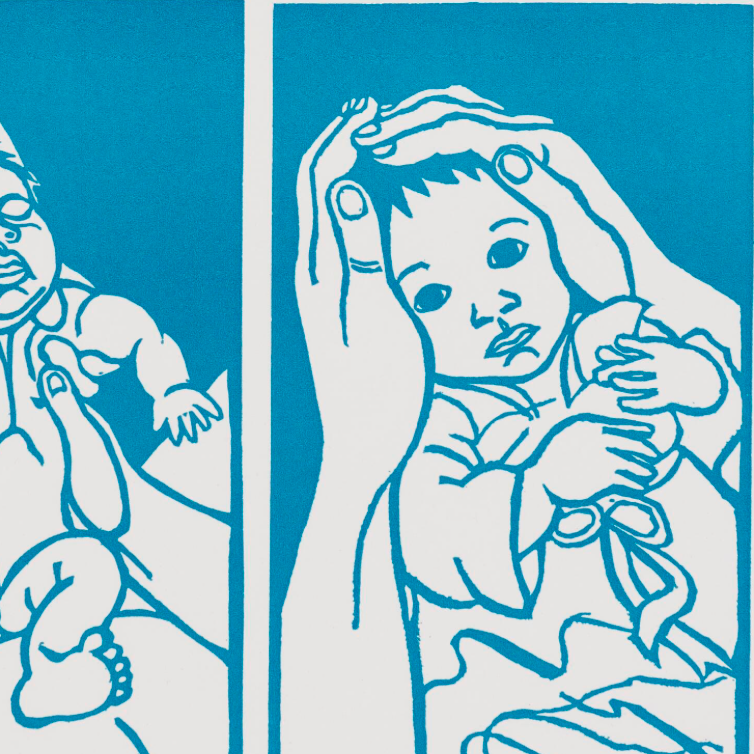
For today's episode, Pernille Ipsen chose Dea Trier Mørch's Fødsel or Birth from 1978 from the collection of the National Gallery of Denmark, Copenhagen.
“One thing I knew from the beginning was that I couldn’t write my mothers up against each other. Lots of documentary books written by journalists, and also documentary movies, will use the conflict between people as the driving force of the story, or as the motor in the story. I think that social movements actually do consist of many different voices. And that was where I wanted to go with it.”
“We are living in this moment where speaking about radical families and queer families and families that are not heteronormative seems to be very politicized, but then also sought after. Because this is the moment when we need to remind each other that families can actually be built in many different ways and are.”
“I realized that it was a lot easier for me to get access to my childhood memories and to dive fully into my mothers’ interviews if I was thinking in Danish and also writing in Danish. Then, the added benefit was that it loosened everything up completely, ‘cause I hadn’t written in Danish since I was in my early 20s, probably.”
Powered by RedCircle
This conversation with Christian D. Bruun occurred on December 2, 2025.
00:01
Pernille Ipsen
Unfortunately, we are living in this moment where speaking about radical families and queer families and families that are not heteronormative seems to be very politicized, but then also sought after. Because this is the moment when we need to remind each other that families can actually be built in many different ways and are. This is what American readers want to hear about.
00:26
Christian D. Bruun
My name is Christian D. Bruun. I'm the director of Danish Originals. Our goal is to celebrate Danish creatives who have made a significant mark in the US.
00:35
Christian D. Bruun
Today, our guest is Pernille Ipsen, a Danish writer and former professor. Welcome Pernille.
00:41
Pernille Ipsen
Thank you so much, Christian.
00:43
Christian D. Bruun
I am very much looking forward to chatting with you today, Pernille. I'm talking to you in Denmark from my home in Los Angeles. Will you tell us where you are at the moment?
00:52
Pernille Ipsen
I am in Østerbro in Copenhagen, where I have an apartment that mostly is inhabited by my son, but where I also spend about half the year.
01:02
Christian D. Bruun
I see. So you go back and forth between Denmark and the US?
01:05
Pernille Ipsen
I do.
01:06
Christian D. Bruun
Great. We'll get to all that in a little bit. I want to jump right to your book My Seven Mothers: Making a Family in the Danish Women's Movement. It's an English translation and adaptation of the original Danish title from 2020, called Et åbent øjeblik: Da mine mødre gjorde noget nyt, translated as "An Open Moment: When My Moms Did Something New" that won the prestigious Montana Prize for Danish literature.
01:35
Christian D. Bruun
In order that our listeners can catch up immediately, would you tell us what this book My Seven Mothers is about?
01:42
Pernille Ipsen
Yes, I would love to. My Seven Mothers is a collective memoir of my seven mothers who met in the Danish women's movement in the early '70s, and formed a commune that I was born into and lived in through the first four years of my life, and then was a weekend child, visiting every other weekend and every Wednesday, as many a divorced child has experienced, afterwards.
02:09
Pernille Ipsen
It's based on interviews with my seven mothers. I started interviewing them when I moved to the States permanently in 2009. I had been living in the States in several other capacities. But in 2009 I moved more permanently to the States and started immediately missing my mothers a lot.
02:27
Pernille Ipsen
And so I started interviewing them every summer and also over some winter breaks when I could, and collected a ton of material. And so it's based on their voices and archival research and other interviews that I did in 2015–2016 when I could get back to Denmark and do that work. I'm trained as a historian and so it made a lot of sense to me to do archival work for it as well. So it takes place from 1970 to 1976 in Copenhagen.
02:58
Christian D. Bruun
I see. And besides missing your moms when you moved to the States, what else generated the desire to write this book?
03:08
Pernille Ipsen
I have always, for as long as I remember, been super fascinated by their stories. Whenever we got together, they would tell all these anecdotes and stories about the '70s, and I knew there was a great story in it to tell. And when I became a teenager, a young teenager, I knew I wanted to write.
03:28
Pernille Ipsen
It seemed obvious to me that one day I would write this story. And so I very confidently declared when I was 16 that I was gonna write the story of our commune. And my mothers thought that was a great idea. And then it took me a while longer to actually write it.
03:43
Pernille Ipsen
I became a historian first and started, also, to understand that their story was not just a great storyline and a plot, but it was also a larger political and social story with importance to lots of other people than my mothers and myself. They turned out to be more central to the Danish women's movement than I knew.
04:08
Pernille Ipsen
I just grew up knowing what they had done and their work. And it wasn't until I became a historian that I realized that they actually sat and lived in the middle of the women's movement. And so I could tell that larger story as well by telling their more individual personal stories.
04:27
Christian D. Bruun
It's interesting as you grow up and realize if your parents have done something significant. Or children of famous people, they have no idea that their parents may be the most famous movie stars in the world. And you had to reflect on what your childhood was in that light.
04:41
Christian D. Bruun
So you were born in 1972 after your mothers came together. Can you share with us the first name of your birth mother as well as the first names of your other six mothers? And give a grief description of each of them? What were the women's individual political beliefs and personalities?
05:00
Pernille Ipsen
Sure. So one of the really cool things about my mothers, I say as a historian as well as a writer, is that they grew up in very different parts of Danish society. One of them also grew up in Manistee, Michigan because her father was a Danish priest in Michigan, and then later they moved to Chicago.
05:19
Pernille Ipsen
But the other six of them grew up in Denmark — one in Funen, one in Midtjylland, one in Northern Jylland, one in Southern Jylland, and a couple just outside of Copenhagen, different areas, and in very different families, class-wise and socially. And so I get to follow them.
05:38
Pernille Ipsen
So it starts in '71 on this feminist camp where they all meet in the summer of 1971 called Femølejren. It was a camp only for women in the summer of '71 that many Danes know of, or at least have heard of. And three of my mothers were part of the organizing group who planned the camp and the rest of my mothers just showed up.
06:00
Pernille Ipsen
One of my mothers was only there for three days, but declares with lots of confidence that those three days completely changed her life. So they had all moved to Copenhagen before they made it to Femø. They were all organized in different parts of what we today know as the broad youth movement.
06:20
Pernille Ipsen
So a couple of them were students at the university and were organized through the university in the student movement. Some were lesbians and were very active on the lesbian bar scene or gay bar scene in Copenhagen, were involved in Forbundet af 1948, which was the organization for homosexuals in Denmark at that time, today, LGBT+ Danmark. So they all come to Copenhagen.
06:47
Pernille Ipsen
And I should say their names, but there's no way, I think, if you hear about this for the first time, that you can keep them straight and connected to their individual stories. I hope you can when you read the book, because I've done a lot of work trying to make them unique enough that you can separate them in your head.
07:04
Pernille Ipsen
But anyway, their names are Sanne, Vibeke, Lotte, Hanne, Elsa Marie, Susanne, and Inga. Is that seven? And so they make it to Copenhagen through these different ways or from their different families. They come to this camp, and they radically transform their lives.
07:24
Pernille Ipsen
Even the women who had been part of the women's movement before, theoretically, or through the university, who had studied women's rights or women's issues, or been part of consciousness-raising groups through the Women's Liberation Movement, had not quite understood that they wanted to live really different lives.
07:48
Pernille Ipsen
Which is to say, that at this summer camp, they understand, all of them, that they want to live only with women. They want to live fully and wholly in the movement and live a life with women.
08:00
Pernille Ipsen
So when they come back from the camp in August of 1971, they start planning a takeover of these houses in downtown Copenhagen on a street called Åbenrå where there were three almost empty apartment buildings that the "Slum Stormers" had an eye on for their big offensive in September of '71, that people may have heard of if they know Christiania.
08:28
Pernille Ipsen
The free society of Christiania that still exists out in Christianshavn today was occupied in September of '71‚ Christianshavn's medborgerhus Stengade 30. The squatting actions that we know of today happened in September of '71.
08:46
Pernille Ipsen
And in September of '71, a group of women, my mothers included, met at the Round Tower in downtown Copenhagen with their brooms and coffee pots and other very important items, a lamp, I think, at 12 o'clock, and marched in open daylight down to these houses in Åbenrå, took over, moved in, and stayed there for the next five years.
09:13
Pernille Ipsen
It's a longer story, how they got to stay. And it's a fascinating story and I tell that in the book. But it speaks to this radically open moment as I call it. Also in the American version, the prologue is called "An Open Moment." It was a moment in which Danish society was so ripe for radical change when it came to women's issues.
09:39
Pernille Ipsen
Young people had fought for all kinds of social issues through the '60s, but women had not been front and center of those revolutions or that social work. So in the early '70s, women realized that they want their issues to be more centered in these movements, and they start their own women's movement and the houses in Åbenrå become the hotspot or the center for the women's movement in Copenhagen where meetings are held.
10:11
Pernille Ipsen
All kinds of actions are planned. There's a clothing swap and a bookstore and a coffee house. There's a printing press. There's a fantastic dance floor that was often very active in this old 18th century-building where the floors were bouncing as they played their very loud music on the reel-to-reel tape recorders. That's where I was born, a year and a half later.
10:37
Christian D. Bruun
Incredible. And I'm sure, like you said, it was a time that was ripe for change, and a lot of people supported that and a lot of things were happening in Denmark, such as Christiania, but the establishment also was horrified and people were trying to shut things down. It wasn't easy, it wasn't just moving in there and then everything was dandy.
10:56
Pernille Ipsen
So that's a super fascinating question. I was living in the US as I was writing the book, and knew quite a bit about the American women's movement because I was teaching the history of feminism to undergrads at my job as a professor. And so I knew about similar situations in the US including when a group of women's liberationists in 1970 tried to take over a house on Harvard's grounds in Boston.
11:24
Pernille Ipsen
And I had seen a documentary about this takeover and the women's liberationists who did that action were terrified. They were so sure that they were gonna be thrown out right away, and they were. They only stayed in that house for eight days, I think. And it got increasingly barricaded. It was a very violent situation. Nobody got really hurt, a few people got arrested, but they were just so sure that they weren't gonna be allowed to stay.
11:51
Pernille Ipsen
So I went into my project with my mothers thinking that the stories I had heard as a child had to be wrong, because the stories I had heard as a child were, we took these houses, we moved in, we stayed. And I would, as a child, be fascinated — can you just take a house? And why are there not any empty houses where I live? I'd like a house to move in with my friends.
12:15
Pernille Ipsen
When I returned to the project as an adult and started interviewing them about it, I was really adamant: you had to have been afraid, we gotta get into the nitty gritty of how you actually felt those first days 'cause it doesn't make sense to me. And then one of my mothers Vibeke said, if I could only find this audio recording that I did with the police officer the day we took the houses, I think you would understand how we had no reason to be afraid. And I said, I'd love to hear that audio recording, where do you think it is?
12:46
Pernille Ipsen
And then the only thing she could remember was something with a blue plastic bag under some stairs somewhere, two moves ago, at least. And so there was no way we were ever gonna find that recording. But then I was in the women's history archive and in her stuff that she had turned into the archive a long time ago, and found a cassette where she had recorded her conversation with the police officer.
13:10
Pernille Ipsen
So I found this conversation — between her and the police officer and the director of the Museum of Music — at Copenhagen University. So Copenhagen University owned these houses that they took over and the director of the Museum of Music was in charge of them. They were gonna expand the museum into these other buildings, they didn't have the money, so they were empty.
13:35
Pernille Ipsen
And so he was there at the scene and the police officer was there at the scene. And they have this conversation that goes something like — Are you planning to do something about this? The police officer asks the director. And he says, no, I don't think so. We've talked about it.
13:49
Pernille Ipsen
We've agreed that if somebody was gonna take over these houses, we weren't gonna throw them out because the houses are empty anyway. And we can't use them right now because we don't have the money to develop the houses. So we'll just let people stay if they wanted to stay. Okay, the police officer then says. And right around the corner on Landemærket, the police are there and they're ready to go.
14:11
Pernille Ipsen
He says, okay, then we won't do anything about it. We'll just retreat and leave. And then right as he's leaving, he says, I think I've seen you somewhere, to the guy from the museum. Really? Didn't we meet at this reception where the Queen was there and you were opening something and they said something? And then the museum director says, oh, maybe, maybe I did.
14:31
Pernille Ipsen
Well, then we know each other, so I'll definitely not do anything. And then he leaves. And then they get to stay. So then they sign a contract with Copenhagen University saying that if and when they find the money to develop the houses or to redo the houses, they get a three months' warning, and then they have to be out of there.
14:52
Pernille Ipsen
And that is then what happens five years later that they do get thrown out in the end. But they live there for free and they don't even pay for the electricity. They just have to agree to remove the snow in the winter time.
15:05
Christian D. Bruun
That does sound like a very pragmatic and humanistic Danish approach to conflict, even though of course later there was a lot of police clashing, and Christiania was always under threat to be closed down. So I'm sure it wasn't completely easy to make that move. Anyway, what a funny story.
15:22
Pernille Ipsen
No. And right at the same time, and this was something my mothers brought up as well, when I was asking them, weren't you afraid? They said there were other situations where there was a reason to be afraid. So like Havnegade, which was these big fancy apartment buildings down by the water that were taken at the same time, ended up in violent clashes with the police.
15:42
Pernille Ipsen
It was a host of very lucky coincidences, that it was Copenhagen University who owned it, that they had already made a plan not to throw people out. There were also rumors that it was because there were women who took over the houses that they expected would be nicer to the houses — which is really so patronizing and infuriating today —
16:02
Christian D. Bruun
Yes!
16:03
Pernille Ipsen
— but it might also work in their favor.
16:05
Christian D. Bruun
That's pretty funny. I want to stay a little bit in that era. So the backdrop of your book is the Red Stocking Women's Movement of the 1970s, called Rødstrømpebevægelsen in Danish. This movement brought your mothers together. Would you explain what the movement was?
16:22
Pernille Ipsen
Sure. So in the spring of 1970, a group of women from Copenhagen University get together and want to do something pertaining to women's issues. They've all been a part of the student movement before that, and they feel their voices and their issues are not getting met and heard in the movement. And so they decide to stage an action. And they are very inspired by some American women's movements at the time, including the New York Redstockings.
16:58
Pernille Ipsen
So a journalist, a Danish journalist, travels around in the US and studies social movements in the US, writes these big books about it, but also writes a very popular article in the journal called Super Love that all my mothers and these eleven women who end up walking down the walking street in downtown Copenhagen on April 8, 1970 have read.
17:24
Pernille Ipsen
So they have read this article. They've read about these American movements and they have taken their name, the Redstockings, from a New York group called the New York Redstockings. The New York Redstockings do not have anything to do with the Danish women's movement after that.
17:39
Pernille Ipsen
So they take their name from that movement and the idea of consciousness-raising groups, which in Danish is called basisgrupper, that a social movement should be organized in small units, small groups of women who will get together periodically to talk about their issues.
17:55
Pernille Ipsen
In the US, they called it "rap groups," not related, I think, to the music genre of rap. They would sit and rap about their issues. They would just speak truth and talk about the issues that matter to them as women. And then collect all the experiences that they learned about in these groups and create a politics from these personal experiences, thinking that all theories had been developed by men and that societal structures had grown out of men's issues, needs, wants, and politics.
18:30
Pernille Ipsen
And so they needed to develop everything from scratch. And so they needed to get down on the basic levels of people's lives and their experiences as women. And so this group of women from Copenhagen University, they dress up in exotic, traditionally feminine clothes with big bras and some big red felt hats that they buy at a shop down on Nørreport, right before they stage their action.
18:59
Pernille Ipsen
And they basically just walk down the walking street to the town hall. And they take off all their bras and their extra clothes and throw them in a trash can that two men hold, that says "Holde Danmark rent," Keep Denmark Clean, which all the trash cans said at that time. I was so excited when I thought that it was only that one, but it turns out it was all of them.
19:20
Pernille Ipsen
But anyway. Then they walked back down the walking street and that's the end of it. They pass out some flyers that have an invitation to a meeting the following week. And as one of my mothers, Vibeke, who was part of that action, says, nothing really happened, they just walked down the street and back. And yet it started a movement.
19:43
Pernille Ipsen
And so in the book, I get to tell the story of how at the very first meeting, the next week, 200 people show up. And then from that point on, over the following year, the movement spreads to all of Denmark. And in a couple of years, two or three years, everybody has heard of Rødstrømper or the Redstockings. And Rødstrømpe becomes the name for women's liberationists in Denmark. The movement is incredibly successful and it really happens as a wave in a very powerful way, from the spring of '71 till '75.
20:21
Christian D. Bruun
As as a child of the 1970s myself, I would say that the '70s feminist movement is very ingrained in my mind and in history. And Femølejren is something that I think everybody knew about. And I can imagine this being on the evening news and growing as a movement. What are some of the things that are being fought for at that specific time in Danish history?
20:45
Pernille Ipsen
One of the things that's so fascinating to think about today, when I think about the Red Stockings movement, is that so little had changed for women in the '50s and in the '60s. So we are used to thinking about the '60s as this time when young people lived lives that were completely different from their parents and completely different from what had been done before.
21:09
Pernille Ipsen
We know of the hippies who went to Northern Jutland and started a new society. We know of the new ways of dressing and behaving and speaking. And the music is radically different, and on and on and on. But when you look at women's lives, they didn't actually change that much in the '60s.
21:28
Pernille Ipsen
So even in '68, '69, when young people started living very differently, you can see in these hippie camps, it was still women doing all the cooking, women taking care of the children, women wearing long flowing dresses and playing the feminine role of keeping everything in harmony and so on. The change for women didn't really happen until the '70s.
21:50
Christian D. Bruun
I see.
21:51
Pernille Ipsen
So the '70s was the decade where the lives that you and I have grown up with were created, where women could broaden their identities and their ways of behaving and being in the world radically, and to all kinds of spheres that they hadn't been part of before. And so women become active in politics, but they also are active in work spaces in a very different way.
22:21
Pernille Ipsen
Not all women and not all at once, but very fast. And so when you look at the change between '71 and '78 or '79 in what people talked about, how they talked about gender, how they talked about women, how they talked about women's issues. I'm working on a book about Dea Trier Mørch right now, the artist. The things that she could write about and talk about, think about, were so different because of the women's movement.
22:50
Pernille Ipsen
And I think it's hard to overstate how the '70s changed lives for women in Denmark and many other places on the planet, including that they started owning their own houses, and in the US they could get a credit card, they could have their own bank accounts, and on and on. It is just a very different world for women after the '70s.
23:12
Christian D. Bruun
You set out to start writing a memoir, a collective memoir, and it's a result of interviews that you did over a decade long period. So, what was the process of writing it and what were some of the questions you had going into it? Did you change your questions over time?
23:28
Christian D. Bruun
Were there things you thought it was gonna be all about, and it turns out at the end of it was actually a different story? And how did you maintain ownership of it since it's a story of you and seven mothers?
23:40
Pernille Ipsen
That last part is a really interesting question, I think. So when I started the project, I thought it would be a much more collaborative effort. I thought that I would work with my mothers on telling our story together, that I would interview them, write something down, send it back to them, have them remember more, and bring them into the process.
24:04
Pernille Ipsen
I think I even in the beginning thought that they might write something themselves, that they would be part of the writing process. But that very quickly changed. Within the first couple of months, at least, I knew that that was not gonna work because I had a very strong desire to tell a good story. As much as I wanted us to work on it together, I also wanted authority, I wanted control. And I was a little ashamed of how much control I actually wanted.
24:36
Pernille Ipsen
But nevertheless, I had to admit to myself that I wanted to tell this story. And because my mothers end up on different sides in a very hard conflict and disagreement about feminist politics in part three of the book, I also knew that I would have to go through that conflict with them and figure out how to write it from all seven perspectives. It was very important for me that they felt equally heard and listened to, and that their perspectives were all represented.
25:11
Pernille Ipsen
I didn't want to pick sides. Even though I actually do have an opinion myself on the conflict that they ended up in, I was not going to let that show in the book. It was very important for me that I showed that a social movement consists of many different needs, desires, wishes, and that a functional and effective social movement needs to make room for such differences.
25:38
Pernille Ipsen
And that was a point from the beginning that I needed to follow. One thing I knew from the beginning was that I couldn't write my mothers up against each other. Lots of documentary books written by journalists, and also documentary movies, will use the conflict between people as the driving force of the story, or as the motor in the story.
26:03
Pernille Ipsen
And by writing people up against each other, you can make the story move forward. It makes a lot of sense. But to me it was very important that that was not going to be the driving force, because I think that social movements actually do consist of many different voices. And that was where I wanted to go with it.
26:22
Pernille Ipsen
I developed this principle for myself that I couldn't write my mothers up against each other, which made this third part where they disagreed pretty complicated. And as soon as I understood that I needed to go through that, I also knew that I needed full control and that my mothers couldn't read it until it was done.
26:43
Pernille Ipsen
And so I ended up not sharing it with them. I shared a little bit in the very beginning and then I didn't share anything until I felt it done and then they got to read it. And then a whole other story unfolded, that I should maybe see if you want to hear more about.
26:59
Christian D. Bruun
Sure! I'd love to hear that.
27:02
Pernille Ipsen
So I lived in Madison, Wisconsin, as I have for the last 20 years. And I flew home to Copenhagen in December of 2019 and I went into the publishing house Gyldendal and my editor printed out seven copies of the manuscript as it was. And I biked home to my birth mother's apartment where I'm sitting now. And we all met for gløgg and æbleskiver.
27:28
Pernille Ipsen
And then I stood up and I handed them the manuscript and I said, here it is, this is as good as I can make it. At this point, I would love to hear your comments on specific dates and times and things that I've gotten wrong, but I would love it if you don't start negotiating with how I've told the story because it's taking me a lot of time and effort to make all of your seven perspectives heard.
27:58
Pernille Ipsen
I don't think it'll work if you start negotiating with me on the story itself at this point. If there's something you absolutely can't live with, of course I'd like to hear it. Then I'll come around after Christmas and meet with you individually and hear what you have to say. And then I waited.
28:14
Pernille Ipsen
I'm born on New Year's Eve, 1972. And so New Year's came. On New Year's Eve, one of my mothers couldn't resist sending me flowers and saying she loved the book, but the rest of them I didn't hear from. That was a pretty intense Christmas vacation.
28:27
Pernille Ipsen
In January, I went around, met with them all individually and got extensive feedback and they all had very strong reactions to the book. They had all laughed and cried and had many feelings about it. One of my mothers could not stand it and had cried a whole lot and loved part one and two, but when it got to that conflict in part three, she couldn't accept the way that I had written about it or the conflict itself.
28:59
Pernille Ipsen
So at first she thought it was the way I had written about it. And then after months of back and forth, in the spring of 2020 as COVID hit and I was teaching 240 students a lecture course in Madison, I was on the phone with her a lot about what were we gonna do about this fact that she was so sad about that third part.
29:21
Pernille Ipsen
Slowly we were both understanding or learning that what she really was reacting to was the history itself rather than the way I had told the history. And then we could start to piece out what to do with it next. And there were a couple of things that I needed to adjust and roll back. She ended up loving the book. But it took a while. And it was intense.
29:43
Christian D. Bruun
I can only imagine the conflicts that show up. It's not easy to change the world or build a whole new world. And seven women living together. The feminist movement of the time wasn't just one agenda. What are some of the conflicts and expectations? I'm sure everybody had to live their own lives and not everyone agreed on expectations.
30:02
Pernille Ipsen
So that's exactly it. As powerful as the social movement of women's liberation was, because people came from such different places and recognized the power and intensity and energy in their difference, at some point, people started turning more inward, as happens in most social movements, and longing for sameness, longing for finding security in what they recognized as the same in each other.
30:31
Pernille Ipsen
And so that also happens in my story. So, in part one, they meet each other on Femø. In part two, they live in the squatter house in the center of Copenhagen for a couple years. I'm born on New Year's Eve, '72. When I'm ten months old, they buy a house together in the northwest part of the city, like a little villa, which today would not be affordable. But at the time they just borrowed a couple of thousand kroner from their parents and then they bought this house.
31:02
Pernille Ipsen
They move to this villa together and become what they call a real family. They start turning more inward towards each other. They start working again. That's a whole other story of how they left their studies and their work while they were full-time activists. But now they start living more, to us, recognizable bourgeois lives.
31:21
Pernille Ipsen
At that time, four of my mothers, which is a long story, they create or they start a new social movement in addition to the women's movement, called the Lesbian Movement (Lesbisk Bevægelse), that starts in March 1974. And two of my other mothers disagree with the establishment of the Lesbian Movement. They think that creating a lesbian movement separate from the larger women's movement will suck out a lot of energy from the women's movement, which does also happen.
31:53
Pernille Ipsen
Lots of the most active women in the women's movement were lesbians. They were the ones who didn't have to go home to their partners, as they say, who could just move their whole life into the movement in a different way than the straight women could.
32:06
Pernille Ipsen
And so they start this movement in '74 and two of my mothers are against starting that movement. And so they bring the fight or the conflict over the Lesbian Movement into our commune and end up having some really mean arguments, including some arguments that I happen to find on tape at the archive because they recorded some meetings in a consciousness-raising group that several of them were part of.
32:32
Pernille Ipsen
They've never really told me the details of what those arguments were about when I was a child and a young person. They would get together all the time and obviously loved each other. It never occurred to me that they could have disagreed that deeply, but they did disagree super deeply, especially in the winter of '75 into '76.
32:50
Pernille Ipsen
And then they break up the commune in the spring and summer of '76. The straight women move out, and they're not even straight, but they are not identified as lesbians. And one of them is living with a woman at the time. To make a long story a little bit shorter, they couldn't tell me these details because they were so interested in keeping their friendships.
33:11
Pernille Ipsen
So after I'd heard these recordings from the archive, I had to call them the next day and say, what happened after, what happened next? How did you ever find each other again? How did you ever make up? And then they were like, in the '70s, we fought and made up and fought and made up.
33:27
Pernille Ipsen
And I have encountered that a lot in the political parties as well. Maybe you remember some of it as well. There was a tendency to create smaller new parties, whenever you could, and fraction and fraction and fraction. And so they were used to those kinds of political fights in a way that we are not today, I think, or at least I'm not.
33:46
Pernille Ipsen
But because they made up and because they became friends again, I could interview them together and I could write the book, but then I also needed them to actually tell me the story of what happened. And that took some doing. So I have a chapter where that is the goal, figuring out what actually happened.
34:02
Christian D. Bruun
How is it growing up with seven mothers? Do each take a different role in your upbringing? Do you go to different people for different things? How is that dynamic?
34:12
Pernille Ipsen
So when I was a young child, I definitely knew them as separate people, but all my parents, so I would use the word "Mom." I was the only child, so I would use the word or the category "Mom," as hey, adult person, come help me with something. So I would sit in the middle of the room and say "Mom" and somebody would come and help me.
34:37
Pernille Ipsen
Later on, I would just say Mor Sanne, Mor Vibeke, Mor Hanne. Most of my mothers became bonus parents, we might call them today. They were like really nice aunts who would come by and take me on skiing vacations and buy me lots of presents. But they were not disciplining me in the way that they might have if I had lived with them full time.
34:59
Pernille Ipsen
So I think that that made it easier for me. Another thing that made it wonderful having all these mothers was that I had a very tight connection to my birth mother. So I was never unclear on where I belonged, so to speak. I've spoken with quite a number of other people who've grown up in communes who didn't have that very strong connection to one parent, and where it was a little more confusing.
35:23
Pernille Ipsen
I never had that problem. I just had a lot of really wonderful adults in my life, whom I remained close to and still to this day, am close to, and they are very different people. And I have used them for different things. I have definitely come to them with different issues from very early on. If I wanted somebody to walk with me in the rain or if I wanted to have two night stories instead of one, I knew which person to go to.
35:50
Christian D. Bruun
It sounds incredibly healthy in some ways, right?
35:53
Pernille Ipsen
I would recommend it for sure.
35:55
Christian D. Bruun
What was the feedback that you received from the original book when it came out in 2020? And are you receiving a similar or different reception in the US, especially given this is a time of a pretty fragile political moment in the US?
36:11
Pernille Ipsen
So it came out in August 2020 in the first COVID summer in Denmark, and got lots of attention in newspapers and lots of great press. I didn't give a whole lot of physical talks 'cause I was going back to the States to teach there. I gave lots of interviews, podcasts, but I wasn't out meeting readers the way that I might have been if I had lived in Denmark or if it hadn't been the COVID summer.
36:40
Pernille Ipsen
The following summer I started meeting readers in Denmark. And in the meantime I had gotten that Montana prize, which meant that it got another round of great attention. The Danish readers are super interested in the women's movement, they're very interested in hearing a story of those Redstockings.
37:00
Pernille Ipsen
They're also interested in my family story, but it took a little longer for that to become the central story that people were asking about. It became a story about the women's movement seen from the perspective of personal experience, which hadn't really been done in Denmark before.
37:18
Pernille Ipsen
And so there was a need to have somebody take seriously the personal experiences that went into these social movements of the '70s. You're probably familiar with some of the stories about the '60s. They're mostly told from men's perspectives, some from women as well, but they're often a little bit mocking.
37:36
Pernille Ipsen
They're often a little bit making fun of the '60s as this experimental time where people were just acting crazy and it didn't really go anywhere or it quickly ran out or whatever. And I think the younger people today, and also people in our generation are much more ready to take seriously these social movements. And then for women, that is the '70s.
37:59
Pernille Ipsen
So that was the story in Denmark for a long time until I was out meeting people and they would talk about the questions that you just asked too: what was it like to have seven mothers, what was my personal experience?
38:10
Pernille Ipsen
The American version, which is also written a little differently, I expected that the story of making a queer family and how to make a family of seven women would be of more interest to Americans than the larger women's movement in Denmark, both because the story of the Women's Liberation Movement in the US has been told a number of times and won't be as novel.
38:35
Pernille Ipsen
And also because the story about making a family is more easily recognizable, and it's something that is super politicized right now in the US as you alluded to before. And unfortunately, we are living in this moment where speaking about radical families and queer families and families that are not heteronormative seems to be very politicized, but then also sought after.
39:02
Pernille Ipsen
Because this is the moment when we need to remind each other that families can actually be built in many different ways and are. That is what American readers want to hear about. And then of course they wanna hear comparisons to the US: how was this different, how could it have taken place in the US, did it take place in the US?
39:19
Christian D. Bruun
And I'll ask you that same question. Could it have taken place in the US and what are some of those basic differences?
39:25
Pernille Ipsen
So it did take place in the US. So there were lots, and there still are many more variations on family structure in the US than there is in Denmark. There's no question about it. And there are lots of queer families in the US and there were also lots of women's communes in the US. Many of them started out or were in cities in the early '70s, but then later on, the move was to move to the country often, for lesbian communities or for women's communities.
39:56
Pernille Ipsen
I think the biggest difference is that like so many other things in Denmark, once something becomes popular, it becomes uniformly so. So everybody does similar things in Denmark, whether it's fashion or music or what they read. Danes tend to follow the trends very sharply.
40:21
Pernille Ipsen
So in the early '70s, it became very popular to live in communes, especially if you lived in cities and so not only women's communes, but many people lived in communes in the early '70s. It became the thing to do. And once those ideas from the women's movement had been adopted by political parties, most if not all political parties agreed very quickly that this was the thing to do.
40:47
Pernille Ipsen
So in 1972, when abortion becomes legalized — it's legal from January '73, but the political decision to make it legal is in '72 — and it flips. The women's movement fights and fights and fights and fights for it for two years or three, and then all of a sudden, it turns. And I think that that often happens in Denmark, that once it tips and becomes more than 50%, most people then start agreeing with it.
41:16
Pernille Ipsen
And I think that that happened with lots of women's issues that were institutionalized in a completely different way than it was in the US. So I often say, when people ask about differences between the US and Denmark and the feminist movements in the two countries, that the main political issues were the same. So, better rights and opportunities for women and children, reproductive rights, economic equality were also issues for the women's movement in the US.
41:45
Pernille Ipsen
The difference is that in Denmark, it actually became the platform for many political parties and also very importantly for the unions and for the Social Democratic Party in particular, that then builds this welfare state that we grew up with, that institutionalized these ideas from the women's movement in a way that is unimaginable in the US.
42:08
Christian D. Bruun
It's a very interesting distinction between the two countries and, of course, in light of everything going on right now, it's also important to be reminded that the US is also a very progressive country, that there are lots of groups fighting for exactly the same things, even if certain things take precedence in the news.
42:27
Christian D. Bruun
I want to switch a little bit to your other book. In 2015, you published, in English, Daughters of the Trade: Atlantic Slavers and Interracial Marriage on the Gold Coast, in which you followed five generations of marriages between African women and Danish men revealing how interracial marriage created a Euro-African hybrid culture specifically adapted to the Atlantic slave trade.
42:53
Christian D. Bruun
It's very interesting and no doubt a very complex topic that did push buttons, I'm sure, in Denmark. You seem to go into topics that do push the status quo, thinking about one's identity and as a nation. Can you tell me a little bit more about that book and how you got into that?
43:12
Pernille Ipsen
I started working on it as my PhD dissertation at Copenhagen University in 2003 or 2004. Later I wrote a book based on that research, and it grew out of originally an interest in showing that Denmark was not this tiny, naive, inward looking, politically safe and sound country that people on the right wanted to paint a picture of, basically, which was very much happening in the late '90s and into the new century and is still going on today.
43:50
Pernille Ipsen
So Denmark, as most people who look back into history just a little further, has been very involved with the world, and has been a trading nation and has settled all over the world. Many Americans now also know that Denmark has been, if not anywhere else, then at least in Greenland, for a long time, and so recognize that Denmark has a colonial past. But for many Danes, Danish nationalism has painted a picture of a nation that was separate from the rest of the world.
44:21
Pernille Ipsen
And so I was interested in showing Denmark's involvement with the rest of the world and with colonialism and with slavery. And so I got interested in these Danish men, and also Swedish men and German men, at the main slave trading fort in what is today Ghana (Christiansborg, it's called, just like the Danish Parliament), who'd married into African families to be successful in the slave trade.
44:48
Pernille Ipsen
Slave trading is really difficult work, as one might imagine, and to be successful in that trade, even more than in the fur trade or any other trade, marrying into a local family was the way to succeed. And so that's what Danish men did.
45:04
Pernille Ipsen
And so I followed Danish men marrying into African families on the Gold Coast over 150 years, and told a story of how the social construction of race takes place in practice, meaning that over those centuries and in these families, in practice, Danish men were part of creating the racial differences that we have grown up with and live in the aftermath of the biological race that appears in the 19th century.
45:37
Christian D. Bruun
It is something that is interesting and certainly something that I didn't really learn about in school. So I think any reality check of how things really work can only help people move forward and have a sense of who we are as Danes, and that the past is complicated and difficult.
45:55
Christian D. Bruun
So, thinking back, as a historian, was it a big switch going from academic nonfiction, Daughters of the Trade, to creative nonfiction, a memoir, like My Seven Mothers? Would you describe your role as the author in each instance?
46:12
Pernille Ipsen
So that was a big switch. I switched everything at once. I switched the font on my computer. I switched what I was reading at the time. I switched centuries. I switched topics, and then I also switched languages. And the reason why it made a lot of sense for me to write the book in Danish was in part that I was switching genres as well.
46:35
Pernille Ipsen
So, I had written in English for years because I was in academia. And in academia, many historians, and especially if you're working in colonial history and you want to go to conferences and meet other colonial historians outside Denmark, it made sense to write in English. And then I was living in the States.
46:51
Pernille Ipsen
So at that point, of course I was writing in English. At first I thought I would also write about my mothers in English 'cause that was what I had been doing for so long. But then I realized that it was a lot easier for me to get access to my childhood memories and to dive fully into my mothers' interviews if I was thinking in Danish and also writing in Danish.
47:14
Pernille Ipsen
Then, the added benefit was that it loosened everything up completely, 'cause I hadn't written in Danish since I was in my early 20s, probably. So it gave me a creative, free roam that I wouldn't have had if I had stayed in English, I think. Now I'm thinking I might go back. I've written some essays in English recently, and it's really fun to write in English as well.
47:38
Pernille Ipsen
So I don't know if I'll stay in Danish forever. The book I'm writing right now about Dea Trier Mørch, it's also in Danish, but because I wanted to work with the same publisher. Switching from an academic to writing a memoir in a much more personal tone was a big deal and it was really fun and also hard work.
47:56
Christian D. Bruun
I can imagine. Let's go back, a little bit, to after you left the commune and you're grown up in Denmark. You had some siblings. How did you get to the US? What is that story?
48:07
Pernille Ipsen
So after we left the commune, I got a lot of siblings, or several siblings. Most of my mothers had other children afterwards. And I moved to Copenhagen with my birth mother. I had lived outside Copenhagen in a place called Farum for a while. And then I moved back to Copenhagen. I started studying history and I was really interested in colonial history, that's what led me to the slave trade.
48:36
Pernille Ipsen
But it also led me to the US 'cause I got really interested in the British and Spanish colonization of the North American continent. In particular I was interested in the early 17th century and the settlements of the East Coast, and encounters with Native Americans there.
48:53
Pernille Ipsen
One thing led to the other and I did an exchange program. Copenhagen University had an exchange program with the University of Wisconsin in Madison. And so I went and did a year there during my MA work, before I did my Master's thesis. And had a great time and studied much harder than I ever had at the University of Copenhagen.
49:16
Pernille Ipsen
And came back and wrote my MA thesis, applied for a PhD at Copenhagen University, got that, and eventually went back to the US because I met my husband at a history conference in Seattle, and at the reception for the University of Wisconsin-Madison, because I was hanging out with my old friends there, and he worked there.
49:39
Pernille Ipsen
I had a child with another American, lived in Copenhagen, we split up, me and the child's father, but decided to all move back to the States. We all ended up in Madison, Wisconsin, where my ex married a Wisconsinite. And so we've had a little bit of family there. My husband of the last 20 years is from Boston. So he didn't have any family in Madison and I didn't, but now we have through our extended family.
50:03
Christian D. Bruun
Ah. Very Danish of you, it seems.
50:05
Pernille Ipsen
Very Danish of me, and American.
50:09
Christian D. Bruun
Of course, yes. And what are some of the differences between teaching and studying in Denmark and the US? What are some of the major differences?
50:18
Pernille Ipsen
So I've been at UW Madison, the University of Wisconsin in Madison, which is the flagship of the university system in Wisconsin. It's a state school, it's a very big school, a great university, a fantastic university in many ways. My job in gender and women's studies and history there for 15 years was so much better than my peers' situations at Copenhagen University.
50:44
Pernille Ipsen
Just the possibilities we have there, because American academia is so large and diverse and the resources are just very different working in English than in Danish. But also working for an American institution that was very well supported. Of course now is a very different situation than when I started, though in Wisconsin in 2010, we also went through a round of pretty severe cuts and threats and a difficult time when Scott Walker, the Republican governor, took office.
51:21
Pernille Ipsen
I think some of the very big differences between teaching in the US and Denmark is that Danish students are less hierarchical in their minds, for good and bad. Because you get paid to go to university in Denmark and you get to choose your education freely, your parents are not involved in it in the same way that they are in the States where parents pay for their children's education, Danish students tend to be harder to please.
51:49
Pernille Ipsen
They don't always show up and they don't always do their readings and they are not always interested in what you have to teach them, I found. But when they are interested because they find the subject interesting and not because they want to get a good grade for their participation or because they have been so well schooled in high school, they can't imagine not doing the reading.
52:13
Pernille Ipsen
And so the best of the Danish students are amazing. So are the best of the American students. In the beginning, I needed to do some adjusting when I started at Wisconsin, figuring out if people were just trying to please me or if they actually were interested in the material. But I have loved teaching in Wisconsin, and it is wonderful to come into a classroom and all the students are there and they've done all the reading and they really want to talk about it, which is not always the case here.
52:42
Christian D. Bruun
I studied architecture in the US and in Denmark, and I remember finding that there was a much bigger willingness to question things and push boundaries and come up with more experimental ways of thinking about the world in some ways here than in Denmark, even though Denmark in a lot of ways is a more humanistic and also very progressive country.
53:06
Christian D. Bruun
So you were at the university for 15 or 16 years and then you left academia and you are now a full-time writer. Based on the reception of My Seven Mothers, it looks like that suits you very well. Do you miss teaching? Do you miss research and interacting with students and colleagues?
53:24
Pernille Ipsen
I do miss teaching. I also miss my colleagues. They are a little easier to find, they're also my friends, many of them. I still spend half of my time in Madison with my husband and my daughter who's in her third year of high school.
53:39
Pernille Ipsen
I miss teaching. I miss the long-term relationships that I have had with students over the years of getting to see them grow up through their undergrad education. And that has been a very big part of my life and a very wonderful part of my life. And I do miss that.
53:55
Pernille Ipsen
I want to write. These 15 years I have been squeezing the writing in the summer times and in the early mornings and on Sunday afternoons. And being a historian has been a great career. But I have always known that I wanted to write. And so when my birth mother died a couple years ago, I was 50 years old and I was like, if I was ever gonna try writing all the time, this would be the moment.
54:24
Pernille Ipsen
And so we took over my mom's apartment and I thought that this was the moment and I haven't regretted it yet. In a couple years I might want some more teaching too, if I can squeeze it into a couple months here and there, I think it would be great.
54:39
Pernille Ipsen
I'm here for about half of the year or a little more. My husband and my daughter are in Wisconsin. They are here three months of the year or a little more. As long as Sophie's in high school, she can't really be here. She's been willing to be here all summer. She loves being in Denmark. Our son, who is 22, he lives here full-time and has done so for the last four years. He's also a draw to come here.
55:06
Pernille Ipsen
And both of my children speak Danish fluently and have done so always. And my husband understands a whole lot of Danish. In a good moment, he might say that he understands 80%. I don't know. And his accent is terrific. And so he can really pass in many situations.
55:23
Christian D. Bruun
I'm sure speaking the language gets him lots of points in Denmark.
55:26
Pernille Ipsen
It definitely does.
55:28
Christian D. Bruun
I am sorry for the loss of your birth mother. What was it like for your children to have seven grandmothers and for seven grandmothers to have these two grandchildren?
55:39
Pernille Ipsen
Somebody asked Elliot what it was like to have seven, all these grandmothers. He has more, because he has not only my seven mothers, but then they have married or they're partnered with people. And then I'm also divorced from his father, who also has on that side — he has a whole lot of grandparents.
55:58
Pernille Ipsen
And he said, I am just gonna say what my mother always says, I have never known any differently. It is special to have that many grandparents in that many different places. He also has grandparents in many different cities in the States. And then all over Denmark. So he can go to many places and stay with his grandparents.
56:19
Christian D. Bruun
Wow. On that note, what a fantastic and super interesting conversation. Thank you so much, Pernille, for being part of Danish Originals. I really enjoyed chatting with you and I've certainly learned a lot and got to relive a little bit of what I remember from the 1970s in Denmark.
56:36
Pernille Ipsen
Likewise. It's been so fun.
56:40
Christian D. Bruun
For today's episode, Pernille Ipsen chose Dea Trier Mørch's Fødsel or Birth from 1978 from the collection of the National Gallery of Denmark.
56:51
Pernille Ipsen
I chose a series of four blue and white linocuts by the graphic artist and writer Dea Trier Mørch. They're from 1978 and they are showing the progress of a birth. And that's also the title, Birth, or Fødsel in Danish.
57:10
Pernille Ipsen
First you see the crown of the head, then you see the shoulders, and then the whole baby is out. And then finally in the fourth frame, you see a pair of adult hands embracing the newborn child.
57:24
Pernille Ipsen
These prints are filled with energy. She worked with such pace and resolve and authority, and it shows in how the lines are so sharp and so clear. She could only do that because she was so sure of herself.
57:40
Pernille Ipsen
This particular piece of hers where this little baby comes out from the safe but private inner world of the womb and enters the larger social and political world, speaks so powerfully to this moment in the '70s when the personal became political. And her insistence on treating birth as an important event in not just private life but also in society, really speaks to me.