
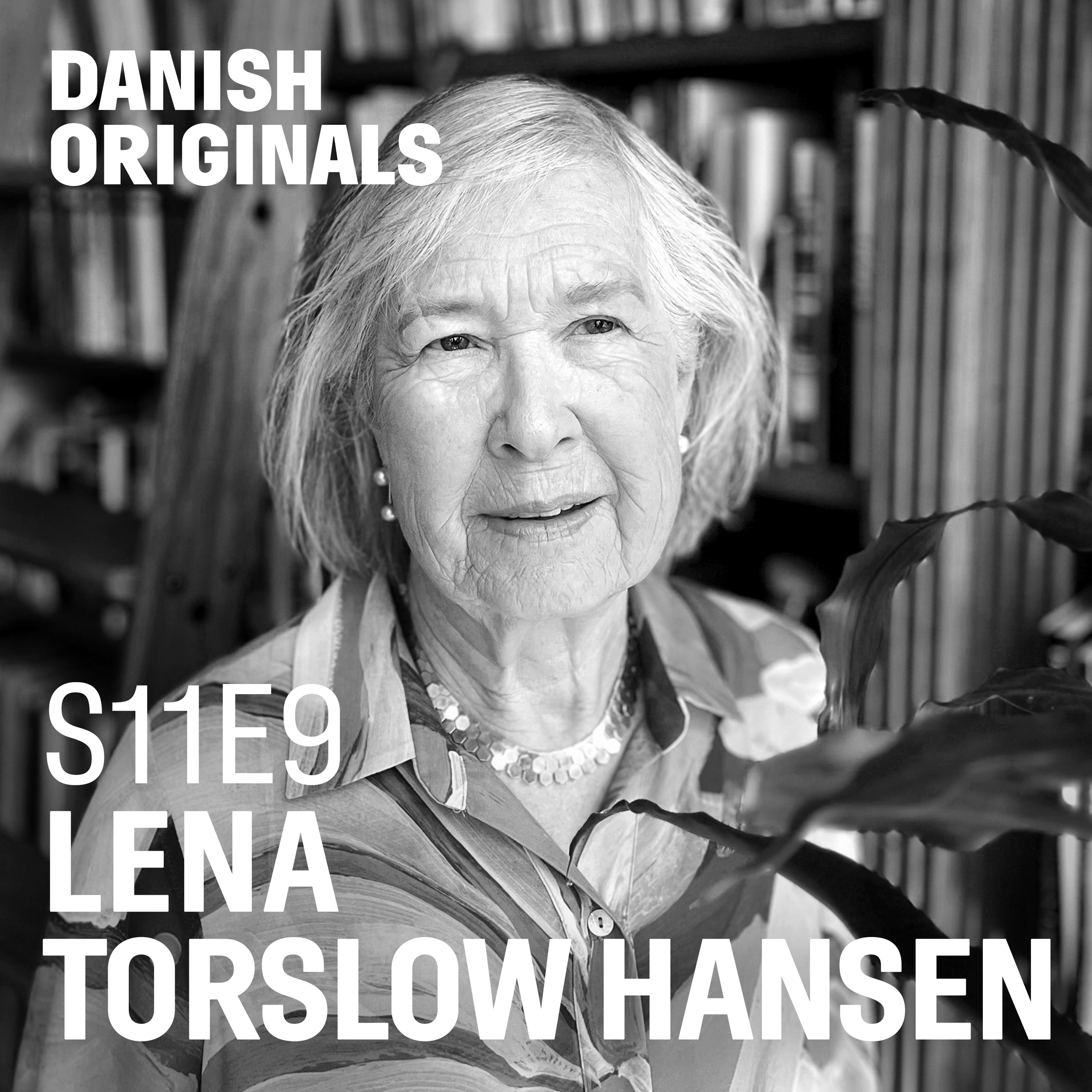
From her home in the Santa Monica mountains, Aarhus-born, Los Angeles-based Danish-Swedish ceramicist, curator, and bookseller LENA TORSLOW HANSEN revisits her first passion with clay and her roles with some foundational exhibitions: "A Broad Spectrum" (1984), "Golden Age in Danish Painting" (1994) as well as the 28 for the cultural festival "Scandinavia Today" (1982–1983). Lena also recalls cross-country road trips running Nordic Art Books and the pre-Amazon art book landscape.
Photographer: Aya Muto
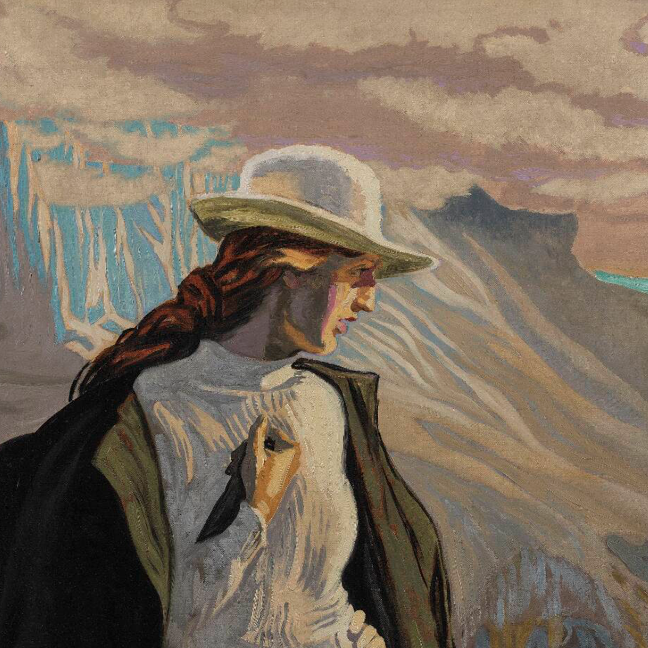
For today's episode, Lena Torslow Hansen chose J.F. Willumsen's En bjergbestigerske, or A Mountain Climber, from 1912 from the collection of the National Gallery of Denmark, Copenhagen.
“I created the biggest exhibit ever of contemporary LA art. Everyone had to have a studio in LA, within Los Angeles City or Los Angeles County. I wanted it really to be based in Los Angeles, just all about LA because that’s where the Olympics was.”
“The College Art Association had book conventions every year. And there were people representing books from Switzerland and books from Germany but nobody had ever seen anyone with Scandinavian books from Scandinavia or from the Nordic countries, I should say. So I just decided I wanted to do that.”
“I’m really adventurous. I’m like my father. I can imagine, when he was young, when he was here. He was in the United States for one year, one month, one week, and one day, it turned out to be. And he gathered 2,000 plants, which are more or less all of them in the botanical museum connected to Copenhagen University.”
Powered by RedCircle
This conversation with Finn-Olaf Jones occurred on May 8, 2026.
00:01
Lena Torslow Hansen
What was really important to me was not to show someone recognized in the whole world. I wanted to have some well-known artists but I also really wanted to have artists whom I felt were really good, but had no name whatsoever in LA already. And that's why I went to 450 studios to see all these different people's work. I created the biggest exhibit ever of contemporary LA art. Everyone had to have a studio in LA, within Los Angeles City or Los Angeles County. I wanted it really to be based in Los Angeles, just all about LA because that's where the Olympics was.
00:41
Finn-Olaf Jones
My name is Finn-Olaf Jones. I'm a journalist, businessman, and mountaineer, and I'm a guest host of Danish Originals. Our goal is to celebrate Danish creatives who have made a significant mark in the US.
00:52
Finn-Olaf Jones
Today, our guest is Lena Torslow Hansen, founder of Nordic Art Books and curator for dozens of Scandinavian exhibits in the US. Lena, tell us where we are right now. This is an extraordinary place we're sitting in.
01:05
Lena Torslow Hansen
We are in my home, and as you can tell, probably looking around, I'm a collector of all kinds of things, but mostly art, Scandinavian art. Right behind you is an Icelandic painting by Vignir Jóhannsson, the big one up there. But anyway, I collect a lot of different things, and I love nature.
01:24
Lena Torslow Hansen
So this is partly why when I saw this house, I was just so excited. My father introduced me to nature. My father was in the United States in 1927-1928, visiting several uncles, and that's how he started nature trails around Aarhus. And when I had the chance to go to the United States, he pushed me to go, and I came as an au pair many, many years ago. So nature is really important to me. My passions in life are nature, art, and travel really.
01:55
Finn-Olaf Jones
They're all combined here. There are hens on the outside here. Inside it's a library and art gallery. And I notice a lot of this art is personalized to you. You have known so many of these artists, you've championed so many of them, and I see they have personalized so many of these paintings and artworks to you.
02:13
Finn-Olaf Jones
So it's an extraordinary spot. It feels like we are in a very isolated place, we're in a canyon in Santa Monica. And how did a woman from Aarhus end up here? What was your journey?
02:25
Lena Torslow Hansen
It was really as an au pair. I was going to go here and then probably go back to college, but actually that's a whole story in itself. From sixth grade, I wanted to be an tresproglig korrespondent, whatever that is in English. I actually went to the college in Aarhus and enrolled myself, and then my father couldn't understand why. He wanted to come with me to the office at the school.
02:53
Lena Torslow Hansen
And then he said to the head of the office, "The way to a man's heart is through the stomach. My daughter's going to go to home economics school." And I said, "What?" I was quite upset about it. And he had a brochure from Den Suhrske in Copenhagen, which was the finest one, but it was so old-fashioned looking on the cover of the brochure that I said, "I am not going there no matter what."
03:18
Lena Torslow Hansen
I ended up, also against my will, to go to Skårup Husholdningsskole near Svendborg, and it was a total waste of time, actually, because my mother was a wonderful cook and elegant, and made wonderful dinner parties. So I had learned more from her even though I hadn't really cooked so much with her.
03:38
Lena Torslow Hansen
Now everything had changed because of what my father did to me. So I decided to go to England, lived with a family there for about a little more than half a year and took what's called the Lower Cambridge Certificate and had a wonderful time there, partly because I had a pen pal who lived up near Sheffield, but that's a whole other story in itself, how I saw northern England, the Lake District, et cetera.
04:04
Lena Torslow Hansen
And then after that I had a job in Aarhus, at Aarhus Oliefabrik a little bit. But then when a chance came to come here, my father thought I should do that. My mother did not, but I ended up going. I lived in Brentwood with a family and then quite not too long after I arrived, I met a Fynbo. I met a Danish man who had been here already for about five years. He was an engineer from Odense, and he worked on the Apollo project.
04:36
Lena Torslow Hansen
Within the year we were married, and then we had two children, a daughter first, and then we had a son. And we did a lot of camping and traveling, mostly within the United States. Most of my friends who were from Denmark, they would go to Denmark once a year or so, but my husband didn't want me to do that, and he didn't want to do it either. So I usually planned a whole month every summer, and we saw every national park west of the Rocky Mountains.
05:04
Finn-Olaf Jones
At some point the art bug must have bitten you, and I'm going to imagine that back then, LA was probably not the hotbed it is now for contemporary art.
05:13
Lena Torslow Hansen
No. At that time, actually, LA was not respected very much. They would always talk about San Francisco being the art capital of California, and I was always surprised about that because when I would go to San Francisco, I did not really see a lot of art. But here there was actually more, but somehow LA was considered a cultural wasteland.
05:34
Lena Torslow Hansen
I was interested in art. I was a ceramicist myself at that time. So for about 15 years I did ceramics. I did murals. I did a mural for British Airways, and I did dinner sets for people and all kinds of things.
05:50
Finn-Olaf Jones
So how did you become a ceramicist?
05:53
Lena Torslow Hansen
My children were young, and I wanted to have some activity outside of the home. So first, I remember I went to a junior high school where they were teaching ceramics at night, and I learned a bit there. Then I went to Santa Monica College, and there I found my mentor. He's no longer alive. His name was Bruce Tomkinson.
06:14
Lena Torslow Hansen
I often felt when I made ceramics that when I glazed the pot, I didn't like it anymore. Or if you just have a glaze, it really has to be an exquisite shape. Bruce Tomkinson, he did something I'd not seen before. He combined raw clay with glaze. So when I say raw clay, I had to prepare it quite a bit, because once I made it on the pot, it was almost all on the potter's wheel. When it dried, the consistency was like cheese.
06:46
Lena Torslow Hansen
So I could take a loop tool and carve into the clay. And that's usually a day after you have made it on the potter's wheel, then I could carve into the clay. That became my signature. Even though I had learned it from Bruce Tomkinson, he never did the things that I did. So I was known for my mountain pots, my family pots, my tree pots, because I would make a pot and then just carve trees all around.
07:10
Finn-Olaf Jones
To me it looks very Scandinavian.
07:12
Lena Torslow Hansen
You're not the first one who has said that. I guess it's in my blood, in my psyche, that it looks Scandinavian. But you can see most of my work has a large area that is carved.
07:22
Finn-Olaf Jones
Have you brought them to Denmark?
07:24
Lena Torslow Hansen
I had a show in Odense many years ago now, and I sold most of it, as far as I remember. So that was good. But I haven't had a lot of collectors from Denmark outside of my family because it's just too difficult to transport. It breaks and whatever. I love the ceramics I made, if I may say so.
07:45
Finn-Olaf Jones
Do you still have a kiln?
07:47
Lena Torslow Hansen
No, I do not. When I moved to this house, I was so involved with my book business that my husband said, "The kiln goes out." And we were getting a divorce at that time. I got married very young. He was quite a bit older than me, and it came to a point in my life where I needed to explore the world on my own. And he was a good man, actually, and we have two great kids. He's not alive anymore.
08:13
Lena Torslow Hansen
What got me away from ceramics was "Scandinavia Today." Atlantic Richfield and a group of people from LA wanted to bring "Scandinavia Today" out to the West Coast, because it was really only scheduled to be in New York and a little bit in Washington and Minneapolis.
08:30
Finn-Olaf Jones
I saw it in Minneapolis.
08:32
Lena Torslow Hansen
That's right. And they invited me to come to a luncheon, and I was gung ho about this. Partly because I worked in ceramics, I thought I would maybe be perfect for art and architecture exhibitions and things. I got really, really involved, and it was really my first big endeavor, you might say, outside of home.
08:53
Lena Torslow Hansen
And it was great, and it was very interesting. I brought a lot of exhibitions here that would not have come here. For instance, one of the exhibits was 43 paintings by Munch, Edvard Munch, that had never been to the United States before. So I was in charge of placing it somewhere, and I thought rather than placing it in a large museum, I would rather place it in a smaller museum that would get more credit, and it would do something good for the organization too.
09:20
Lena Torslow Hansen
At the time, it was the Newport Harbor Art Museum, and it really put that museum on the map. So that was very satisfactory to me that this happened, and they arranged symposiums and all kinds of things. And then there were large exhibitions and small exhibitions, and I wanted all the countries to be represented, which I succeeded in doing. It was the early '80s, '81 and '82, basically. There were 28 exhibitions over the 16 month period.
09:50
Finn-Olaf Jones
I remember they had the leaders, the presidents, and the royalty from all the respective countries gathering for the opening of these exhibits.
09:57
Lena Torslow Hansen
When it first opened here, Princess Benedikte from Denmark, Princess Astrid from Norway, and Princess Christina and her husband Tord Magnuson from Sweden came for the opening. The president of Finland, Vigdís Finnbogadóttir, did not come.
10:16
Finn-Olaf Jones
Oh, she came to the one in Minneapolis.
10:18
Lena Torslow Hansen
And the ambassador from Washington came to represent Iceland. And we had a big luncheon under the big chandeliers in the music center, that's where all the tables were set up. And then from Los Angeles, the mayor and all kinds of dignitaries. And it was quite wonderful.
10:36
Finn-Olaf Jones
And the Northern Light painting exhibit, that was such a groundbreaking event.
10:40
Lena Torslow Hansen
Oh yeah. But it never came out here. We could not get it out here because it had already been planned, and one of the main things when you have a large exhibit like that is the indemnity. If it had come here, they would have to arrange for all the loans all over. And they had only arranged for it to be in New York and Minneapolis. I did go to see it at the Brooklyn Museum, and it was wonderful.
11:04
Lena Torslow Hansen
So in New York and back East, I had nothing to do with "Scandinavia Today." Los Angeles was not even supposed to be part of it. See, "Scandinavia Today" was, actually, the "Today" programs, I should say, they were started by the National Endowment for the Arts. First it was "Belgium Today," I think, and then "Japan Today," and "Scandinavia Today" was the last one, and it was the only one that incorporated more than one country.
11:30
Lena Torslow Hansen
And it was not supposed to come to LA at all, but it was Atlantic Richfield, really. The head of Atlantic Richfield wanted it to come here. He was part Scandinavian. And then we had a team that really got going and made it big, really. For a while, every museum had a Scandinavian exhibit. So that was "Scandinavia Today."
11:52
Finn-Olaf Jones
And "A Broad Spectrum," that was the largest contemporary art exhibit of its time, wasn't it?
11:58
Lena Torslow Hansen
Yeah. And it still is, actually. That was '84, because it was celebrating the Olympics. Somebody I knew a little bit, he was Norwegian, Ragnar Qvale, his brother had actually asked him to run this building that he had bought downtown, right on Spring Street, which was the old Title & Trust Building.
12:16
Lena Torslow Hansen
It was a beautiful old building from the 1920s, and it had a big bank on the second floor, and hand-painted ceilings and columns and travertine walls. He had seen me in action during "Scandinavia Today," so he said, "I want you to do an exhibition in this space for the Olympics."
12:36
Lena Torslow Hansen
And I said, "The public Olympics Art Festival was all international art. The thing to do is a contemporary art exhibit of Los Angeles art, so all of these people that come in to see the Olympics or experience the Olympics can see what we do in this city." He accepted that, and then I started looking up artists.
12:59
Lena Torslow Hansen
I went to 450 studios in three months. And since I was new at art in the city, I could see how the ones who are really involved in art already, they could slaughter me almost. So I hired a jury of three women, and we picked 118 artists because that's what we thought at the time we had space for in this room.
13:24
Lena Torslow Hansen
What was really important to me was not to show someone recognized in the whole world. I wanted to have some well-known artists but I also really wanted to have artists whom I felt were really good, but had no name whatsoever in LA already. And that's why I went to 450 studios to see all these different people's work.
13:45
Lena Torslow Hansen
I created the biggest exhibit ever of contemporary LA art. Everyone had to have a studio in LA, within Los Angeles City or Los Angeles County. I wanted it really to be based in Los Angeles, just all about LA because that's where the Olympics was.
14:02
Lena Torslow Hansen
And a number of people got galleries from having seen their piece in"A Broad Spectrum," and that made me feel really good. Some of them still contact me, and they're just still so happy because they felt that I really made their living. And to think about it now, it makes me really, really happy.
14:20
Finn-Olaf Jones
Well, you gave them a world stage there with the Olympics.
14:23
Lena Torslow Hansen
Maybe a national or West United States stage, I think, not international, I don't think.
14:28
Finn-Olaf Jones
Tell me, what do you think makes a good curator? Is it empathy? Is it fundraising? What made you a great curator?
14:36
Lena Torslow Hansen
I'm Scandinavian, so it's hard to say really good things about myself.
14:40
Finn-Olaf Jones
All right, but in general then.
14:41
Lena Torslow Hansen
It's a lot of, I would say, sensitivity, and when I think of the big "A Broad Spectrum" show, 118 artists and trying to put them all together so it seemed harmonious, was not easy. But it was fun, actually. It could really be creative and it had to hold together in some ways.
14:59
Lena Torslow Hansen
I think sensitivity is probably a lot of it, to art. And because I love art. After I got very involved with art here in Southern California, when I travel the whole world, the one thing I do in every city I go to is go to the art museum and the applied arts museum.
15:15
Finn-Olaf Jones
I've been to a few museums with you, and you seem to know everyone, and everyone seems to know you. It's always fun to go with you. You've collected or championed a lot of great artists over the years. Is there anyone in particular that you are particularly proud of?
15:28
Lena Torslow Hansen
Vignir Jóhannsson was a really good artist. I arranged a show for him at an institution that doesn't exist anymore on Robertson Boulevard that only showed contemporary art. So he's one of the ones I got to know.
15:40
Lena Torslow Hansen
Probably the one I got to know the best was a Danish artist, Svend Wiig Hansen. I have a lot of work by him. And I arranged an exhibit for him at the ARCO Center for Visual Art, which also does not exist anymore. I got really close to his family and everything too. I've known a lot of artists.
15:58
Finn-Olaf Jones
How does the process work for you? You see something you really love, you meet these artists. Where do you get that spark that you know you're going to promote someone?
16:06
Lena Torslow Hansen
I love talking to people, and learning from people maybe more than anything. So, I don't know, I'm not really sure. But I have not curated so many shows with single artists really.
16:19
Finn-Olaf Jones
And let me ask you about your time with the National Endowment of the Arts.
16:23
Lena Torslow Hansen
I had applied, actually, a couple of times. I thought it could be interesting to have a fellowship there. And my kids were grown and I thought that if it was okay with Borg that I left home a little bit. So I got in the second time.
16:36
Lena Torslow Hansen
So I got into the program for arts managers, and it was really incredible actually because you followed what the NEA was doing every day. We would have meetings on who they were giving grants to. And it was also at that time, it was in '85, it was a pretty wild time at the NEA because some congressman from Texas had gone in and stolen or taken out files.
17:06
Finn-Olaf Jones
This was during Reagan's time, right?
17:08
Lena Torslow Hansen
Yeah, I guess it was in '85. I guess it was Reagan. So they had stolen files or taken files because of pornography. They were afraid that we had been giving grants to pornographic artists.
17:21
Finn-Olaf Jones
I remember. That was Mapplethorpe and people like that.
17:24
Lena Torslow Hansen
Exactly. Mapplethorpe, and it was interesting because the exhibit of Mapplethorpe that had been to the Corcoran in Washington, DC, and it had been to Cincinnati, I think it was, and Des Moines, Iowa, and they had never even discovered that it had pornography in it. But then all of a sudden some congressman figured this out, and then it was banned. This exhibit couldn't be shown anymore in the United States.
17:47
Lena Torslow Hansen
So the whole thing was very interesting. I stayed in Georgetown, and I stayed with someone who had known Jackie Kennedy really well. She would go to Dumbarton Oaks every day with her kids and talk to Jackie. I loved Jackie Kennedy, so that was interesting. And it was interesting to be in Georgetown, and I could run along the canal every morning, and I loved it and saw all the museums, of course, and it was a wonderful three months.
18:14
Finn-Olaf Jones
And so they taught you to be a curator.
18:17
Lena Torslow Hansen
Yeah, in a way, arts manager. I learned a lot about the arts there.
18:23
Finn-Olaf Jones
So that was quite a transitional period for you.
18:26
Lena Torslow Hansen
It was. The early '80s until about a little later than the mid-'80s, I had a really busy schedule doing a lot of wonderful things really, I think.
18:38
Finn-Olaf Jones
So at some point you started Nordic Art Books, the largest distributor of art books from Scandinavia.
18:46
Lena Torslow Hansen
It has really partly to do with "Scandinavia today," because Scandinavia seemed so unknown to most Americans I met. They knew about mid-century furniture. When it came to other things, they did not really know.
19:00
Lena Torslow Hansen
The College Art Association had book conventions every year, and they had it at the Biltmore that year, and I went down specifically to see it and talk to people. And there were people representing books from Switzerland and books from Germany but nobody had ever seen anyone with Scandinavian books from Scandinavia or from the Nordic countries, I should say. So I just decided I wanted to do that.
19:26
Lena Torslow Hansen
Because I had also gone to university libraries, both USC and UCLA, and everything they had was very old. And so then I went to Mark Hennessey at Hennessey + Ingalls in Santa Monica, and he just thought it was a great idea. He said, "Yeah, I can't wait," and "We will buy a lot of books and try to sell a lot of books for you."
19:46
Lena Torslow Hansen
My first two catalogs I typed myself on my Selectric typewriter, but then after that I had them printed. I think my largest catalog, I should show you a couple today, they were 120 pages, so it was a whole book. And then once a year I would go to the book conventions. It used to be called ABA, American Booksellers Association. It's a completely different entity nowadays because of Amazon, really.
20:14
Lena Torslow Hansen
I drove from here in my Ford extended minivan to Chicago eight times and I was part of the convention. It was amazing because I had 35 boxes in this minivan and that was a good old day, so to speak, because I had two booths usually, and I set all these books up on modern and traditional fine art and architecture and all the applied arts like ceramics and glass and textiles and industrial arts, et cetera, et cetera.
20:46
Lena Torslow Hansen
And within three or four days, I had shown all these books to people from Taiwan, people from Europe, people from all over the United States, and got huge orders.
20:57
Finn-Olaf Jones
What is the largest number of titles you ever carried?
20:59
Lena Torslow Hansen
About 7,000 titles.
21:02
Finn-Olaf Jones
Wow. All of them warehoused here?
21:05
Lena Torslow Hansen
Yeah, more or less. Sometimes I bought pretty large quantities, like 100 or more books, and I wish I hadn't now with Amazon doing what they did. But what I usually managed to do with the publishers and the museums was that I said for me to put it in our catalog, I will need to have one sample. So then they sent a sample, and in the beginning when I didn't have so many titles, I would show it to Hennessey + Ingalls, for instance, or LACMA.
21:32
Lena Torslow Hansen
LACMA used to buy a lot of books from me, too. "Oh, yeah, yeah, yeah, we would want to carry that." So that's how I learned really what they would carry. And I still feel that was a good way, actually, hands-on.
21:45
Finn-Olaf Jones
Did you have a favorite title? Was there any book in particular that you prized more than anything else?
21:50
Lena Torslow Hansen
Yeah. Many, many. It's too hard to say. But actually I'm glad you asked that question because I had one book on Anders Zorn. I still have one copy. I won't sell it. It's a very large book written by Hans Henrik Brummer, who happened to be a friend of mine. He's the expert in Sweden on Anders Zorn. So it was a book he had put together with a lot of color illustrations, but totally Swedish text. I sold 800 copies of that book, and that is amazing to me, and that was 500, 600 pages.
22:25
Finn-Olaf Jones
That's interesting. Why did that hit a nerve?
22:27
Lena Torslow Hansen
In those days, a lot of collectors would call me and pick my brain, and artists too, and I said, "Why are you buying this book that's all in Swedish text you can't even read?" And it was before Google Translation or anything. And they said, "Because Zorn was the greatest portrait painter that ever lived." He only used three primary colors.
22:50
Lena Torslow Hansen
After they told me that, I could see it. There was an exhibit of Anders Zorn put together by the Swedish Consul General in San Francisco. And when I looked at his watercolors, I have never seen anything in this whole world that is as incredible as Anders Zorn's watercolors. They are just amazing.
23:08
Finn-Olaf Jones
I know he did portraits of a lot of prominent Americans.
23:11
Lena Torslow Hansen
Yeah, he did three presidents. President Taft and… I can't think of it.
23:16
Finn-Olaf Jones
Cleveland was the other one… and Roosevelt.
23:18
Lena Torslow Hansen
Yeah, maybe it was Roosevelt. And actually, when we talk about Zorn now, what's interesting about him, the one who really inspired him, was Isabella Stewart Gardner. She has a museum by her name in Boston, and she became very close friends with Anders Zorn.
23:36
Lena Torslow Hansen
He came, actually, eight times to the United States, and on a boat, of course. It was before airplanes. And I think she was really the one who helped him also get in touch with Taft and Roosevelt. He did a lot of portraits of famous people, of artists, and he's often compared really with Sargent, John Singer Sargent, and also Sorolla. And somebody was actually gonna do a show of those three artists in San Francisco, but it never happened. But that would be a wonderful show.
24:08
Lena Torslow Hansen
So, there's many artists I love. Carl Larsson I love. It's more folk-oriented. And of Danish artists, there's so many. Vilhelm Kyhn is my favorite landscape artist. He's also superb, I think. And I love Wilhelm Freddie, the surrealist. So yeah, there's lots of great art everywhere.
24:28
Finn-Olaf Jones
What were some of the more popular books you were selling?
24:32
Lena Torslow Hansen
I would say in design mostly, and that goes back to furniture design. But really a lot of different things. At the book conventions, people were interested in Scandinavian textiles, ceramics, and glassblowing. Swedish glassblowing has been very much of interest and collected for over 100 years, I would say. I think more than painting, what was really admired was the applied arts.
25:02
Lena Torslow Hansen
And then after the convention was over, I would find a hotel somewhere, or I had made friends too in Chicago so I would go to their cottage on Lake Michigan, and then I would sit there and create my purchase orders. In that same venue, when I was driving, I specifically made my route. I'm very proud to say actually that I have driven through every state in the United States all by myself.
25:29
Finn-Olaf Jones
Fantastic. With books?
25:31
Lena Torslow Hansen
With books. With 35 boxes of books, yeah. So that was exciting. And then a lot of things happened. One time, I was driving from the book convention in Chicago and I was going to the next book convention in San Francisco. The one in Chicago was a book expo, was a big one, and then in San Francisco was maybe just a state book fair.
25:54
Lena Torslow Hansen
So anyway, I was driving through Utah, and I get gas, and the attendant who helped me said, "You have threads hanging out of your tires here. I think you should get some new tires while you're here." And I said, "Oh, put it up so we can look at them from below." And so he put it up, and I looked at them, and I didn't think it looked too bad. And I said, "I'm a woman who takes chances, so I'm just gonna go on."
26:20
Lena Torslow Hansen
So then I drive west towards Nevada, because I'd been told that if I wanted to find a place to stay for the night, I should go west. I'm driving along, and I hear this, somebody's blowing a torch, if I have to say it in English. And then I look to my left, and there's probably 50 antelopes rushing from the foothills towards my car.
26:47
Finn-Olaf Jones
Wow.
26:49
Lena Torslow Hansen
And then they stopped, and they turned around, and they went back the same way they had come. It was at dusk. It was an incredible sight. And then I drove on towards Nevada, and I stopped in a little town, and I saw a woman in the window, and I said, "Is there a motel in town?"
27:06
Lena Torslow Hansen
And she said, "No, you have to drive another eight miles to Nevada, and there's a five-room motel." So I start driving again, and I hear people behind me. It was a bunch of kids who were chasing me in my car, and I said, "What's wrong? Why are you chasing me in my car?" Then they said, "Oh, we want to have your address so we can send a Mormon missionary to your house."
27:34
Lena Torslow Hansen
So I said, "That's not necessary. I'm a happy Lutheran," I said. So then I went on to this wonderful little town, which was right next to the Great Basin National Park, and I got one of these five rooms. That was really terrific. And right next door they had this wonderful gift store. And I remember the next morning when I went in, they had ducks and ducklings walking all around the store.
28:00
Lena Torslow Hansen
There was another time I remember I was driving in New Mexico, and then I pump gas, and then I see there's a little brochure that says that the oldest population in the United States are the Acoma Indians.
28:15
Finn-Olaf Jones
Right. New Mexico, right?
28:17
Lena Torslow Hansen
In New Mexico, yeah. And so I found out how to get up there, up on the mesa. And there was a bus, and I went up there. And I have a few pots that I bought from the Indians up there. So, things like that, they were just adventures. I'm really adventurous.
28:33
Lena Torslow Hansen
I'm like my father. I can imagine, when he was young, when he was here. He was in the United States for one year, one month, one week, and one day, it turned out to be. And he gathered 2,000 plants, which are more or less all of them in the botanical museum connected to Copenhagen University.
28:52
Finn-Olaf Jones
He brought them in from the US?
28:54
Lena Torslow Hansen
He pressed them. I even have the equipment he used right here. He pressed them in the herbarium. They're all brown and black nowadays. I haven't really seen them for many years.
29:05
Finn-Olaf Jones
Will Nordic Books continue as a going concern, do you think?
29:08
Lena Torslow Hansen
Amazon tried very hard to ruin it. I am selling a few times a week, one at a time usually, to people all over the world, really. It will exist until the inventory is gone, and that will probably be after I'm no longer on this earth. So that's how that is.
29:27
Lena Torslow Hansen
In the United States there were major art and architecture bookstores in Chicago, Boston, in all the big cities. There's none of them. The only one that is still open is Hennessey + Ingalls. Otherwise they're all closed.
29:42
Lena Torslow Hansen
I would sell hundreds of books every month to museum stores. They never buy. The Guggenheim used to buy a lot of books from me all the time. Now they sell maybe a couple of books on Frank Lloyd Wright, because he designed the building, and then they sell one or maybe two books on their art collection, and then they will have a couple of catalogs on the exhibits that they are showing right now. The rest is giftware. It used to be a major bookstore.
30:10
Lena Torslow Hansen
So this is really what Amazon did. I know several people that went out of business. They were very specialized, and they couldn't make it anymore. So Amazon definitely contributed to thousands of bookstores closing in this country.
30:26
Finn-Olaf Jones
In the 1990s, the Golden Age of Danish Paintings was truly a groundbreaking event. You were very involved with that one, weren't you?
30:34
Lena Torslow Hansen
It was '93. And I was only involved in... I called up and asked for a meeting with Rusty Powell, who was the head of LACMA, and I said, "You know, isn't it about time we have a Scandinavian exhibit in Los Angeles?" And I really wanted to have a Scandinavian exhibit.
30:50
Lena Torslow Hansen
While I was in Rusty Powell's office, he called in Philip Conisbee, who was a curator of European painting and sculpture, and he said, "Lena is suggesting this exhibit of Scandinavian art. Could we do something like this?" And then he said, "No, no, we want to do the Golden Age of Danish painting."
31:09
Lena Torslow Hansen
And I think there had been an exhibit traveling around Europe, and it never came to the United States, so that's why he was set on that. And while I was sitting there, Rusty Powell, he called up the head of the Metropolitan and said, "I have someone in my office, and I've just consulted with Philip Conisbee, and we would like to do an exhibition on the Golden Age of Danish painting. Are you interested?"
31:32
Lena Torslow Hansen
And immediately said, "Yes." So then it went to the Metropolitan afterwards. And it was even more fun in New York, really, than here because Crown Prince Frederik came for the opening in New York.
31:43
Finn-Olaf Jones
And you wanted to include Thorvaldsen and make it broader, right?
31:48
Lena Torslow Hansen
So he was really part of the Golden Age, Bertel Thorvaldsen. And I knew about the painting that Eckersberg had painted of Thorvaldsen, I think it was in 1819, I am not sure now. I wanted that to be part of the show, and they said, "No, we can't do that because it needs to be restored." And then I said, "So what does it take?" And then they said, "We need $5,000." So, I raised the money here, and it was included in the show.
32:17
Finn-Olaf Jones
Did the art gene run in your family?
32:20
Lena Torslow Hansen
Not so much really, no. My father was a naturvidenskabsman. What is that?
32:26
Finn-Olaf Jones
Naturalist.
33:28
Lena Torslow Hansen
Naturalist, and he had quite a few irons in the fire. He was very intellectual and wherever we would go, he would always know the Latin name of a plant. Wherever. Of course, we couldn't check it in our own mind, we didn't know them. But I trust he was the most honest man you could ever meet.
32:47
Finn-Olaf Jones
And was he supportive of your business and your art career?
32:50
Lena Torslow Hansen
He was. But since they were living in Denmark, they were not really very involved in it. I was here, and they were in Denmark.
32:58
Finn-Olaf Jones
I grew up with this also, where no one knew where Denmark was when I was growing up in Minnesota, and suddenly everyone is going gaga about Danish design, Danish art, Danish food. And you were at the vanguard of the Danish art part. At what point did you realize this had caught on, that people were very interested in Denmark suddenly?
33:18
Lena Torslow Hansen
I think that really came with the mid-century furniture. And it's still very big. It's just amazing to me that you can buy an old Hans Wegner chair, and it costs ten times as much as a brand new one, and it's really the same company.
33:31
Lena Torslow Hansen
But artists here have such a tough time surviving, so it was difficult to get people to be interested in the art, actually. This is why I wanted to start the Scandinavian Arts Foundation. In "Scandinavia today," we had it all arranged. We had all the museums, it was all there for us to just say, "We have this exhibition," and they accepted it. But afterwards, it was not easy. Because in America, there's just so much competition already.
34:01
Finn-Olaf Jones
By the way, what do you think of the new LACMA? You've just been to the opening.
34:05
Lena Torslow Hansen
It's crazy, unbelievable. My first thought was, I have been to probably 100 museums around the world, and this is different from any other museum that I've ever seen. And I could not understand when I entered to see the museum for the first time. I had seen it also when it was empty before they installed the art. So now they installed the art.
34:28
Lena Torslow Hansen
So in this book that they gave away, it says, Wander. And I thought, "What?" That's a strange word to put on the front of a catalog of the whole museum. And I've actually been very critical of it, because LACMA is the only encyclopedic museum we have on the West Coast, and they built a museum that is smaller than the one we had.
34:54
Lena Torslow Hansen
They have a collection of about 155,000 items, and they can only show between 2,000 and 3,000 items. And they paid a billion dollars almost for this museum, so I've been against it all along. But it was interesting to see. When you walk around this building, one second it's Egyptian art, then you walk into a room, and then there's Impressionist art. It's all mixed up.
35:17
Lena Torslow Hansen
And it's all concrete walls, ceilings, floor. I had a young friend with me, and she got very tired after two hours walking on this concrete floor. And it's dark in many areas because it's dark gray concrete. But anyway, that's the new LACMA, and it can never be expanded.
35:36
Finn-Olaf Jones
Is there any trend in the contemporary art world, in the museum world, that makes you optimistic?
35:42
Lena Torslow Hansen
Oh yes. It's wonderful in Los Angeles. The Broad downtown, MOCA, and there's lots of great art everywhere. The art scene is vibrant in Los Angeles, maybe more than any other city in the whole country.
35:59
Finn-Olaf Jones
What do you think you're going to stay active with promoting Danish art or Scandinavian art and culture here?
36:04
Lena Torslow Hansen
I've come to the stage of my life, I have four chickens, I have a dog, I'll probably have a cat in a few months. My house was built five years before I moved into it. I moved into it in '88, so it was built in '83. It's almost a full-time job for me. I live almost in a forest. It's amazing how much upkeep there is with a house.
36:26
Finn-Olaf Jones
What do we have, 12,000 books here?
36:28
Lena Torslow Hansen
I'm not sure how many I have. And then reading, I'm hoping to have more time for reading. I love to read, and I love to read biographies. One of the latest biographies I read, and I just happened to find it in my home library here, and I didn't remember I even had it, and it was about George Jensen.
36:45
Lena Torslow Hansen
He was such a good man, other than just being incredibly talented. It was really a wonderful book to read about George Jensen. So I love to read biographies. Georgia O'Keeffe, and Renoir. I've read so many books in the last few years. So that's a very important thing for me to do nowadays, and then hiking as much as possible in the mountains.
37:06
Finn-Olaf Jones
You have your chickens and you have your garden, so you are totally self-supporting here.
37:10
Lena Torslow Hansen
That's right. I love it here. I'm fortunate I live in a place that I really love. Running creeks all year. I often think when I hike, it's just amazing that you think of the Los Angeles area, Southern California, what is it, 20 million live here? And most of the time I hike I never meet one person. I hike with a friend and my dog.
37:32
Finn-Olaf Jones
But you seem to be at every single museum opening, every exhibition opening, and everyone seems to know you, and so you are obviously still very active.
37:39
Lena Torslow Hansen
You are right about that. I love the arts.
37:42
Finn-Olaf Jones
Any good developments in Scandinavia?
37:45
Lena Torslow Hansen
I'm not going to create any more exhibitions. That's up to other people now. I've done a lot! So it's enough!
37:53
Finn-Olaf Jones
You certainly have. What did you enjoy more, being a curator or a bookseller?
37:58
Lena Torslow Hansen
The books... Let's see, I started that in '86. So my first catalog that I typed was in '86. That's when I started it. So I was through with all the art managing and curating. But then I have done smaller shows since in galleries and things. The books came afterwards.
38:19
Finn-Olaf Jones
Because as you probably know, I am of the third-generation book collectors, we're all fanatical about books.
38:24
Lena Torslow Hansen
Yeah. I will probably never read on a Kindle.
38:27
Finn-Olaf Jones
No, me neither. But sitting in a house like this full of these incredible books, I think I could probably spend a few years here.
38:34
Lena Torslow Hansen
There's a lot of good books in here, and other places in the house too.
38:39
Finn-Olaf Jones
What do you think Americans see in Danish art? For instance, someone like Anna Ancher is huge.
38:44
Lena Torslow Hansen
You're absolutely right. Anna Ancher and quite a few of the Impressionists. And it's interesting you bring that up because it was during "Scandinavia Today," that the first Danish historical painting from the Skagen painters, a P.S. Krøyer painting, sold for over a million kroner. And I think it was in Berlin at an auction.
39:05
Lena Torslow Hansen
And then we had "Scandinavia Today" and Time and Newsweek did big reviews of the Scandinavian show that was at the Brooklyn and in Minneapolis. And one of them picked out Hammershøi and then they took Munch because Munch was already so well known.
39:22
Lena Torslow Hansen
I credit "Scandinavia Today" for Scandinavian art becoming very popular in Europe. Before, at auctions, you could buy it for next to nothing. All of a sudden, Sotheby's were interested and Christie's were interested and it really raised a lot of prices. It's still very low, though, compared to of course French and Italian art.
39:46
Finn-Olaf Jones
I noticed that the tastes over here are very different from Denmark. If you go to Denmark, I think most Danes would probably not know much about Hammershøi or Eckersberg, who are huge over here.I guess they would know them now 'cause they're getting such high price tags for their paintings in auctions and things.
40:01
Finn-Olaf Jones
But honestly, I don't think most Danes would really pick up on those two painters, but Americans, because of all these exhibits I've come to, are very fluent with them.
40:12
Lena Torslow Hansen
Museums here really do not have much Scandinavian art at all. Of course Købke and Munch are at the Getty. The Metropolitan does and, and actually the Detroit Institute of Arts have quite a lot of Danish paintings, but that was because a certain curator just loved Slott-Møller and people that nobody else has in the United States, I think, or not many anyway.
40:35
Lena Torslow Hansen
Zorn is widely collected. You go into the library at the Metropolitan Museum in New York, and there's this full body painting by Zorn right inside the door. So, Zorn, and he is Swedish, of course, there's a lot of paintings by Zorn all over the United States, and a lot of shows. But Danish art, there's one here and one there, but not a lot. And Norwegian the same, and Finnish the same, and Icelandic the same.
41:04
Finn-Olaf Jones
Tell me, after all these years, do you feel more Danish or American?
41:09
Lena Torslow Hansen
I would say more American, but with our state of politics right now, I would like to say I feel more Danish, and avoid feeling American. I could never have imagined in my whole life what has happened to this country. It's so sad because we have done so much to make this a great country environmentally and everything.
41:31
Lena Torslow Hansen
And I am very much an environmentalist. I recycled before anyone else did, almost. I can fill one trash bag in three weeks. I don't have any trash really, basically, except for eating blueberries. I have all these plastic things. That's the only way I can buy them.
41:47
Lena Torslow Hansen
When I go back to Aarhus and to Moesgård, I feel very Danish, and that's my pearl in life to go back there. I didn't use to go once a year, but I'm trying to go once a year now and just spend some time in that little house. When my parents knew that they expected a baby, that was me, their first born, they bought this little house. I can't say it in English, an aftægtshus.
42:11
Lena Torslow Hansen
So that meant it was built during the beginning of the Second World War for people who were retired. It's next to Fulden Bakker, next to Moesgård, next to that incredible world-class museum, the Moesgård Museum.
42:26
Lena Torslow Hansen
I can walk everywhere. I can walk to the beach. I usually bike to the beach every day. I walk to Fulden, this tiny little village where when I was a little child, my mother would put me in a wooden wagon, and we would walk out on our little road called Kvægdriften.
42:45
Lena Torslow Hansen
And the reason it's called Kvægdriften was that all the fields were around Fulden Bakker, and they pulled the cattle through Kvægdriften to Moesgård. Because when I grew up, Moesgård was still a manor house, was still an herregård, which now it all belongs to Aarhus University.
43:04
Lena Torslow Hansen
The person who managed it, his daughter was my only friend really in that area when I grew up. And my father's best friend at the time was a guy who was putting together botanical gardens in Aarhus. So he helped plan the garden and all the natural stone steps going up to the house.
43:22
Lena Torslow Hansen
We had a thatched roof, and it was just a cute little house. And we lived there for half a year. We would move out there every spring, and then be there for about six months. And then when I started school, my father was a gymnasielærer at Cand Mag. We would bike to the city every morning and bike back at night. About nine kilometers actually, so it was good exercise, in rain or sun or wind or whatever.
43:50
Finn-Olaf Jones
What would you tell your younger self now that you have made this extraordinary journey?
43:56
Lena Torslow Hansen
I'm happy about my life. I'm happy about the things that I did and the support I had from other people to encourage me to do those things. And I guess that's about it. I'm still traveling. I am not through traveling. Most people I know who are my age, they don't travel anymore, and don't drive at night. I drive at night anywhere I need to go.
44:19
Lena Torslow Hansen
There's so many places in the world I want to see that I have not seen yet. And I'm taking my daughter's two children, my two grandchildren, my grandson, who is six and a half feet tall, Grant, who's going to go to UC Santa Barbara this fall. I'm taking him and his sister, who graduated a couple years ago from UC Santa Cruz, I'm taking them to Denmark this summer to show them everywhere I went as a kid.
44:45
Lena Torslow Hansen
And I'm hoping to take them maybe to Transylvania outside of Bucharest, because I have a Swedish cousin who has been to every country and every territory in the world. And when I asked him what's his favorite place in the world, he said Transylvania. So I feel I have to see Transylvania while I'm still alive.
45:01
Finn-Olaf Jones
Wow, that's a first. Well, thank you very much, Lena, that was really great.
45:06
Lena Torslow Hansen
It was fun. Thank you.
45:08
Finn-Olaf Jones
For today's episode, Lena Torslow Hansen chose J.F. Willumsen's En bjergbestigerske, or A Mountain Climber, from 1912 from the collection of the National Gallery of Denmark.
45:23
Lena Torslow Hansen
I chose J.F. Willumsen's painting The Mountain Climber.
45:27
Lena Torslow Hansen
I have loved Willumsen's art ever since I went to Willumsens Museum in Frederikssund many years ago. That's a museum that's dedicated to his art. And then seeing the retrospective at ARKEN, the museum south of Copenhagen, in the last couple of years was really a life experience for me to see it all under one roof. I think he's one of the greatest artists from Denmark. His style is quite different than any other Danish painter, I would say.
45:58
Lena Torslow Hansen
And I love this particular piece because it's a beautifully made painting, and I like the subject matter too. I have climbed to the top of Mount Whitney myself, and here's a woman, a mountain climber, from a time that was quite different than nowadays. I admire that image of a woman climbing a mountain. So this painting has always been attractive to me, I would say.