

From her home in Burbank, Aarhus-born, Peabody Award-winning Danish podcast host, director, and producer LEA THAU retraces her journey from New York to Los Angeles, first leading The Moth, the live platform for storytellers, to creating the podcast Strangers. Lea describes the gradual insertion of own self at the center of her storytelling, exemplified by the "Love Hurts" and "Lea in Trumpland" miniseries. And after a 7-year hiatus, she hints at upcoming shows of yet another kind of storytelling.
Photographer: Kevin Zacker
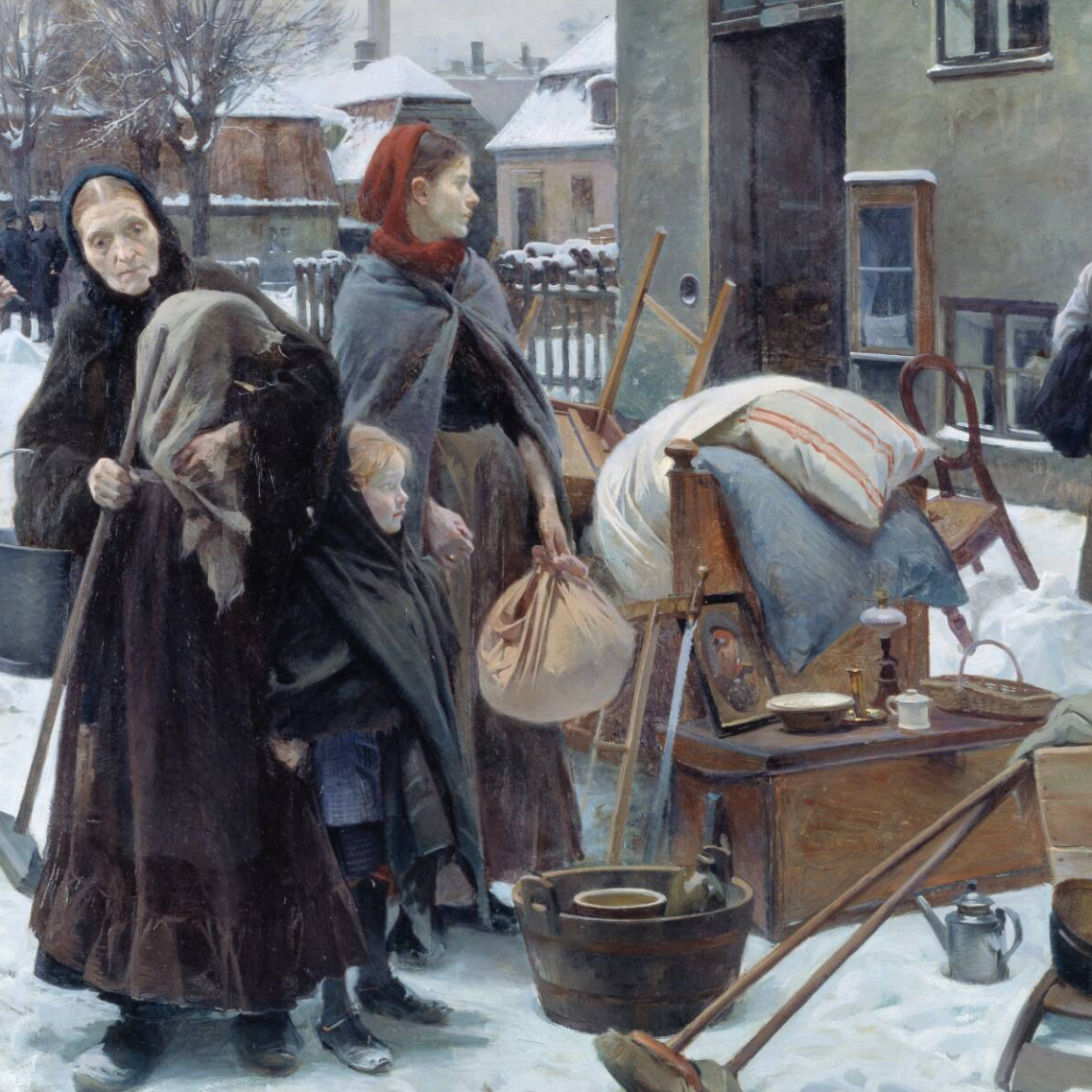
For today's episode, Lea Thau chose Erik Henningsen's Sat ud, or Evicted Tenants, from 1892 from the collection of the National Gallery of Denmark, Copenhagen.
“If I interview people and then I edit them, this gives me phenomenal control and other possibilities, and I really like that. I still wanted to tell true stories from people’s lives, but instead of putting them on stage, I would go interview them for many, many hours, sometimes for days, and then edit that into a half hour story.”
“Terrestrial radio — people just turn it on and it’s very passive. But podcasting, people have to come back and they have to feel a connection in order to make that extra effort to go download and subscribe. And so I became a bigger and bigger character, and then people responded to that more and more.”
“I had been interested in interviewing conservatives because I looked at the American right and I just didn’t understand. I was like, that’s not even a society. Why do you even wanna have a country? If you don’t wanna be a collective, then why do we even pretend to have any kind of umbrella here?”
Powered by RedCircle
This conversation with Christian D. Bruun occurred on December 10, 2025.
00:01
Lea Thau
I've chosen the painting Sat ud or Evicted Tenants by Erik Henningsen, it's from around 1900.
00:09
Lea Thau
I was not that interested in art as a kid. It was honestly a hard thing with my dad that we spent so much time in art museums. But one painting by Erik Henningsen's brother Frants Henningsen made it okay for me. This one reminded me of that a little bit. It's in a different style. The one that I loved as a kid is more of a tear jerker.
00:31
Lea Thau
It's a mom clutching a baby and some dirty little toddler clutching her skirt and they've also been evicted. I would sit there and I would cry imagining the lives of these people. The plight of this poor mother who had been so abandoned, but as a kid I could relate to that.
00:50
Lea Thau
This one by Erik Henningsen is much more sober. I've spent my life trying to tell other people's stories so that we might be a little bit moved by the life of a stranger, of a refugee, of a homeless person, of somebody whose life is different and maybe less fortunate than ours. And I think it taught me how art could stir a real connection to the human condition and the inequality in the world.
01:28
Christian D. Bruun
My name is Christian D. Bruun. I'm the director of Danish Originals, a podcast series created in partnership with the American Friends of the National Gallery of Denmark. Our goal is to celebrate Danish creatives who have made a significant mark in the US.
01:45
Christian D. Bruun
Today, our guest is Lea Thau, a Danish Peabody Award-winning podcast host, director and producer. Welcome Lea.
01:54
Lea Thau
Thank you.
01:55
Christian D. Bruun
Thank you for speaking with us here in your home in Los Angeles. Would you describe your surroundings and what part of LA we're in?
02:03
Lea Thau
We're in the beautiful suburb of Burbank, and we're sitting here in my living room looking out at the palm trees and the hibiscus and all the LA bounty, the exotic California nature that we have here.
02:17
Christian D. Bruun
I see the pool in the back here. Very nice. You made your name in New York as the executive and creative director of the nonprofit group, The Moth, from 2001 to 2010. Most New Yorkers would certainly remember The Moth being this live theme-based storytelling show. You ran this very successful creative universe and cultural powerhouse for ten years.
02:41
Christian D. Bruun
In fact, you're credited for turning The Moth into a global phenomenon. You created new live and digital formats, and you won a Peabody Award in 2010 for The Moth Radio Hour. So my first question to you is, you were 23 when you came to the US. You were new to New York, you were new to the country. What inspired you to devote a decade to this work and this particular organization?
03:07
Lea Thau
That's a great question. I don't think I decided upfront that I was gonna dedicate a decade to this. We never do. We just live life and it unfolds and suddenly we look back and ten years have gone by. I was still enrolled at my Danish university in Aarhus. I really wanted to live in New York City, but I also really wanted to finish my studies and I didn't want to pay American tuition.
03:27
Lea Thau
So I found a way to be at Columbia and then send my papers home. And then I had a degree, but I still didn't really have work papers or any real work experience. I was an intern at the UN. I was hoping to get a job there 'cause it was one of the few places you could work if you didn't have a green card.
03:42
Lea Thau
And I was actually offered a job at the UN. But it was a job I really didn't want. The woman who was gonna hire me, she closed the door and she was like, everybody goes home crying here. I really don't think you wanna work here. And I was like, oh shit, I don't think I do either.
03:55
Lea Thau
I married my boyfriend, which was the other way to get a green card. And while I was trying to figure it out, okay, now I could theoretically apply for any job in the world, granted I'm not a native speaker, how am I gonna get a job related to literature or publishing? Will they ever hire a foreigner with no experience and with a degree from a university they'd never heard of in Århus?
04:18
Lea Thau
And then I saw that The Moth was hiring. My boyfriend, who had just become my husband, had told a story there. They were hiring someone to start their community outreach program, which was going into homeless shelters and prisons and all kinds of marginalized groups, as we call it in American society where there are a lot of marginalized people.
04:40
Lea Thau
And I thought, wow, this combines everything I'm interested in in a lot of ways. I was sick of academia at that point. My parents were pretty academic and I thought maybe that could be a path. And while I was finishing my thesis, I was like, no fucking way do I wanna — can I swear?
04:59
Christian D. Bruun
You can swear.
05:00
Lea Thau
No fucking way do I wanna spend my life on something so abstract and so far removed from actual life. But I also really liked stories and storytelling. And so this idea that you could apply storytelling to the real world and not just to academic theory was something I was super into.
05:17
Lea Thau
And so I think probably the woman who ran The Moth at the time brought me on because I was like, I don't have work papers for the next two months, so I have to work for free for two months, and she was like, you're hired. And then she ended up leaving and I took over and it just grew.
05:34
Lea Thau
And it was ten years of just all we ever did was work and The Moth just kept growing. And I probably would still be there if I hadn't gotten into a huge conflict with the board that ended up getting me out of there.
05:47
Christian D. Bruun
Maybe talk a little bit about how did it go from being these live events to being something that was put on the air, so to speak?
05:54
Lea Thau
That's actually an interesting story 'cause it really wasn't easy. I for years wanted The Moth to be a radio show, and so did the board. Everybody thought this is obvious for radio, it's audio storytelling. It was very little visual even though it was a stage show.
06:10
Lea Thau
The Moth is pretty purist, so you can't really bring props. You're not supposed to bring your guitar, you can't bring a script. You are talking supposedly, at least, extemporaneously. And it lent itself very well to audio, but nobody wanted our show.
06:24
Lea Thau
And the way it works in the US is there are all these smaller markets. It's not like Denmark, where it's centralized 'cause it's a tiny country and everything is DR, Danish Radio. Here, there's all these independent stations in cities and markets around the country, and then there's an umbrella.
06:41
Lea Thau
And the way to get on the air was to get on your local station and to maybe get syndicated nationally. And the local station in New York did not want our show. There was somebody there who wanted it who was the head of all of WNYC at one point, and there was somebody else who was a programming director for a little while, or head of new development.
07:01
Lea Thau
And one after the other came to me and was like, maybe The Moth could be on the radio. And then there was this one guy there who was like, over my dead body. And it was really hard.
07:11
Lea Thau
And then Apple announced something called podcasting. And a friend of mine who was one of our regular hosts at The Moth, he was like, I think this could maybe be a good idea for The Moth. And I was like, podcasting? It was literally the first press release that Apple had sent about podcasting that he forwarded to me. And I was like, we're not gonna give away our content for free. Are you kidding?
07:35
Lea Thau
We've been so poor. We've been sitting on the floor eating canned spaghetti at 11:00 pm cold with a fork, 'cause we had no money and we had no time. But we still put five or six or $700 into recording every show really well because we knew that this could be our big national and international break.
07:55
Lea Thau
And I was like, so now that we've done all that and we have this treasure trove, you want me to go put it out for free on a podcast? It seemed so counter to the way we were all thinking at the time. I reacted the way the music industry did when they were like, you mean streaming? We can't get on board with that.
08:10
Lea Thau
And then, a year later or whenever it was, six months later, when we still had had every door slammed in our face radio-wise, we were like, screw it, let's launch a podcast. And then that took off overnight and not only of course brought us ad revenue, but also brought us membership from around the country and listenership. And we started doing national tours and we started having chapters in other cities. And so it was a huge deal for sure.
08:37
Christian D. Bruun
Amazing. And you think because there was a built-in audience that already knew The Moth?
08:41
Lea Thau
There were a few things. Podcasting was really small back then, so it was always, always the same ten shows in the top ten. And at the top of that was always, always This American Life. Maybe they dropped down to number two or three for a week or two, but that was it. And we pretty early on had a story on This American Life. So I think honestly the best podcast marketing advice to date, I think, is get on other people's podcasts.
09:12
Lea Thau
Because then you are already reaching a listening audience that likes podcasts, knows podcasts, which back then most people didn't even know how to listen to a podcast. And then there's of course an exponential effect. But I also think The Moth had that kind of response also live. There was also something in that format and in that style of storytelling that I think was the right thing at the right time. Now storytelling is everywhere. It's a little bit like improv.
09:39
Lea Thau
I actually wrote to the board of The Moth. One of my first presentations where they were like, we want a three to five year plan for you, when I took over as executive director. You gave the dates earlier, I was actually there a little bit longer total, but in 2001 is when I became the head of The Moth.
09:54
Lea Thau
And they were like, okay, what's your goal for this organization? And the number one thing was radio. And I said, I think we could be to storytelling what Second City in Chicago is to improv, because Second City had started this movement of improv and had fed everybody who went on, of course, to Saturday Night Live, not everybody, but a lot of people.
10:19
Lea Thau
And suddenly there was an improv place, open mic or performance space on every corner in New York City. But that was not the case for storytelling then. If I said we do storytelling, people thought it was either super hokey folktales with leprechauns in the woods, or else it was for children, storytime storytelling.
10:39
Lea Thau
Nobody had the idea that urban adults in New York City could get up on stage and tell stories in that way. So I think it also was just that the format has very little friction, if you will, for better or for worse. Moth stories kind of go down like milkshakes a little bit. So it has a kind of mass appeal and it also was new in that form to people, even though storytelling is obviously as old as humans.
11:08
Christian D. Bruun
What kind of stories were most popular with people or what really drew in people?
11:13
Lea Thau
I think what people really responded to at The Moth and maybe in all forms of storytelling, is authenticity. And I think at The Moth, that was particularly obvious because like I said, the format is pretty purist, you can't hide behind a podium or a guitar or anything. You really are stepping out on that stage.
11:36
Lea Thau
There's hundreds of strangers in the room and you have nothing to hide behind and not even a script to read from. You have to find a way to connect with that audience. It doesn't even really work if you are reciting, if you've memorized the story.
11:55
Lea Thau
Of course a lot of Moth storytellers do know the story and have worked on it for weeks and months, even with Moth directors. So it's not like it's extemporaneous like that. But in the moment, the storyteller has to be communicating to and connecting with the audience in order for the story to land or connect. And I think that translates on radio and podcast as well. People can feel that. And it's part of what made The Moth so exciting because it really was live in that way.
12:28
Lea Thau
And it made every show and every story feel a bit like a high wire act. And so you could work on a story as a director for weeks and months with somebody and could be a great story, but if in that moment of meeting the audience, they became afraid and they shut down, even if they got through the story and had memorized it enough that they could just get through it, it didn't land, it didn't connect and it became much smaller than it could have been.
12:52
Lea Thau
And a story that maybe relatively wasn't really as interesting or multi-layered, but the people felt this person is really talking to me and we're sharing this moment. It's as if it's happening right now. And that magic, I think, is part of what made The Moth special, that intensity.
13:12
Christian D. Bruun
It was a little bit like standup. You can actually bomb at delivering your Moth story.
13:16
Lea Thau
And that raises the stakes, doesn't it? But there's a different attitude from standup. I think, in standup, you walk in or you walk out onto the stage and there's a vibe that everybody in the room is leaned back and they have their arms crossed over their chest and they're like, make me laugh if you can. There's almost a dare. We're not gonna give it to you unless we already love you and you're Kevin Hart or something, then we'll give it to you. But if you're new, you have to earn it.
13:40
Lea Thau
Whereas at The Moth, I think there was an innate understanding of how terrifying this was. People would put themselves in the place of the storyteller. There was an understanding that these are not professionals, and they're sharing something really personal and it's not a set that they do every night. This is one time that they're sharing this story and they might break down and cry. They might lose it. They might falter and not even get through it. They might run off stage, which happened a couple of times.
14:06
Lea Thau
And I think that made people want the storytellers to succeed. We're here with you and we've got you. And if the storyteller just dares to meet the audience, if they just in that first moment or those first moments of meeting the audience didn't shrink or hide or become so afraid that they forgot everything and shut down and look down at their shoes.
14:26
Lea Thau
If they actually dared to meet the audience, then they would feel I'm being carried by this audience. They're wanting me to do well. And that was a really beautiful feeling that was a little different from standup, I think. It's a fine line. You want people to be on your side 'cause you seem a little nervous, but you don't want to seem so nervous that they get nervous and can't relax.
14:48
Christian D. Bruun
Let's talk a little bit about how your years at The Moth evolved and how you eventually left.
14:55
Lea Thau
It was one of those classic things. When there's no money and you're a garage band rehearsing at 11:00 pm for free, nobody cares. The moment you make it huge, everybody starts fighting. The Moth was a nonprofit, nobody owned it, but I'd been running it for so long and I felt the board had been a pretty corporate board considering how artistic we were. It's pretty typical in a nonprofit also, that there's tension between a board that doesn't work there day to day, and the people who run it every day.
15:24
Lea Thau
We had some big fights, and looking back, I might have fired me too. This was actually my first real job and I'd never had a boss. I was also very Danish. I think Danes are not that used to such hierarchy and authority and the whole American corporate structure. I was a little bit like, I've been running this show by myself for ten years. I wasn't strategic about it.
15:51
Lea Thau
I honestly for a long time just couldn't imagine them ever getting rid of me because my performance had been really stellar there. And they did say in the final conversation, it's not in any way your performance, it's only your communication. We don't want you to report directly to us anymore, so we're gonna put somebody in who's your boss and you report to that person but you can still stay here. And I was like, nah, I don't think I'm interested in that.
16:20
Lea Thau
I would say I would still be there if they hadn't forced me out. That's not what I wish had happened in my life. Thank fucking God I'm not at The Moth anymore. I don't think about it often, but when I do, that's how I feel. The worst thing I could imagine for my life is if I had stayed at The Moth, but I don't think I would've left because it was such a huge success and I don't think I would've walked away from that. They did me a big favor.
16:45
Christian D. Bruun
Okay, it sounds like it was time anyway.
16:47
Lea Thau
I certainly didn't feel that way at the time. At the time it was devastating, but looking back, it was the best thing that ever happened to me.
16:54
Christian D. Bruun
I can imagine. So then you got a chance to move across the country, further away from Denmark and to the West Coast. How was that move to LA versus New York?
17:06
Lea Thau
I really didn't want to live in LA at all, and I told KCRW, who's the radio station here and my partner starting my next project Strangers, I'll come out for six months and I'll get this project started and then I'll move back to New York.
17:19
Lea Thau
And they were okay with that 'cause they wanted it to be a national project, so it wasn't gonna be LA specific. And that was unusual then. But they were okay with it. They also didn't promise me that the project would continue forever, but they were like, let's start it and see. Then a few things happened.
17:36
Lea Thau
LA is a terrible place to visit, right? But it's a great place to live. And I had only ever been here for work. So I had never really been in LA to enjoy the leisure. And I remember the first time I came out here was with The Moth. We were doing our first big LA show at Royce Hall.
17:51
Lea Thau
We had landed at LAX at 4:00 pm or something and our hotel was only three miles away, but it took an hour and a half and I was like, who can live in this godforsaken place? There is one thing and one thing only to do when you land in LA and it is to start heading back east as fast as you possibly can. There's nothing for any humans here.
18:12
Lea Thau
I didn't particularly like San Francisco either for other reasons, but didn't know it as well. But LA, I positively hated. And I just also had for The Moth taken TV meetings out here. I just was like, the people in this town have no culture, the traffic is terrible, the architecture's ugly. I will never live in LA.
18:29
Lea Thau
But when I came out here, a few things. One was obviously that The Moth board had ousted me. My original American husband, who's still one of my great friends, we were together for ten years, but we didn't end up lasting forever. I was 34 and I pretty soon met the man who'd become my son's father.
18:50
Lea Thau
We moved quickly and got engaged and I got pregnant and I had a hit show. I was on top of the world with The Moth and I now had a fiancé and I was pregnant. And it was all those things that you have to make happen in your 30s of career and husband and baby, it was all happening. It was everything I'd worked towards.
19:12
Lea Thau
And then every piece collapsed at once because my fiancé and I ended up breaking up when I was eight months pregnant. He moved out. The Moth board conversation we had about me not being there anymore happened the day I came back from maternity leave.
19:28
Lea Thau
So there I was alone, almost 40, single, no job, tiny baby. And in that context, coming out to LA was also a huge relief. In New York, I still had all my friends, I still had all my connections. My old staff at The Moth would be like, come to the show on Tuesday, we'll save you a good seat. I would be like, do I really wanna go to The Moth? Ouch.
19:56
Lea Thau
But do I also not wanna go to The Moth? I didn't have a single friend or a single anything in New York that wasn't connected to The Moth. It had been my entire life. So being in a different city was just really nice. All that failure and misery and everybody leaving me and ousting me, and nobody wanting me, maybe I could leave that in New York and start something new here.
20:18
Lea Thau
And I love that about being in LA And then I also had a tiny child. And suddenly, having a yard and having a car and having this nice weather. And I had a very active boy who's still an athlete and who loves LA and loves that you can run around kicking a soccer ball in the middle of January on a green grass field. I ended up completely falling in love with LA.
20:40
Lea Thau
I learned a lot of things about LA I loved, not just the obvious things like the fruit trees and the climate and all that. But also there's so many cool artists that were moving out here from New York because they'd been priced out in New York, and New York had become in some ways so boring.
20:54
Lea Thau
At least the East Village, which had been for me the heart of New York. I spent ten years barely leaving the East Village. I was like, who needs anything outside of the East Village? And the East Village had become all freaking investment bankers.
21:04
Lea Thau
And so I was like, wait, there are actually real artists here and they're cool and they have space and they're like, come over, we have some extra whatever we've thrown on the grill. And the weather was always nice and people had cars, and I felt much less isolated with a small child. And I fell into a community of independent radio producers, who are just the nicest people in the world. I ended up loving it.
21:26
Christian D. Bruun
That's great. That is a LA typical journey. Everybody comes out here like you say, and don't feel at home and don't understand where there's a center to go to or there's no nothing to hold onto in some ways. Then beneath the surface, there's a lot going on. There's a lot of artists and writers and super interesting, smart, caring, good people, right?
21:46
Lea Thau
Exactly. And also you drive down Sunset Boulevard or something and you're like, this is the famous Sunset Boulevard. It looks so trashy with strip malls and everything is ugly, but then you turn down that residential street and everybody has a lemon tree in their front yard, and all the architecture's cool. And nature's pushing through the concrete everywhere to just get out. And I love that.
22:06
Christian D. Bruun
And people have studios in their garages. That's a big revelation.
22:10
Lea Thau
But some people never get there. I have people who are like, oh, I still hate LA. I never embrace LA. New York is the only place. These days when I go to the East Coast, sometimes I bypass New York City and just go see my friends in the Hudson Valley. 'Cause I love New York still, but I also don't need it as much in my life.
22:24
Christian D. Bruun
So when you came out here, you came out for a new multi-year long podcast called Strangers, which is described as, I'm going to quote, "stories about people we meet, the connections we made, the heartbreaks we suffer, the kindness we encounter, and the frightful moments when we discover we aren't even who we thought we were." So tell us a little bit about that show and how it is different from The Moth and, and where did that idea come from and how did it evolve?
22:53
Lea Thau
So Strangers. It is different from The Moth in that it's not live. So I decided, oh wait, you know, for all these years I've been working with storytellers, after weeks and weeks of helping them craft the perfect story, they still have the power to get up there and completely blow it.
23:07
Lea Thau
But if I interview people and then I edit them, this gives me phenomenal control and other possibilities, and I really like that. I still wanted to tell true stories from people's lives, but instead of putting them on stage, I would go interview them for many, many hours, sometimes for days, and then edit that into a half hour story.
23:28
Lea Thau
People always like, oh, Strangers, it's great 'cause you can just go interview strangers, that's what you do, I guess. And that honestly was part of it. I was like, I want a theme that's a cheat theme. I want a theme that any story could go on because I don't wanna have a great story and then not be able to tell it, 'cause I boxed myself into a corner with a theme. But I also do want a kind of theme.
23:49
Christian D. Bruun
So like Seinfeld's a show about nothing?
23:52
Lea Thau
A little bit. Yeah, exactly. But that moment when we think that we aren't even who we thought we were, I'd really had that. Or, it wasn't just, oh, the people we meet. I was just turning 40 and I'd gone through this breakup where you're lying next to somebody every night and you think you know each other. You think you're getting married, you think you're gonna spend the rest of your lives together.
24:11
Lea Thau
And suddenly he doesn't want that at all. And you're like, wait, how well do I even know him? Did I know him? He was lying there next to me having completely different thoughts and dreams. How well do I even know myself if I knew that on some level but didn't know it? And aside from being a stranger in a strange land, always having that immigrant experience and always feeling that's informed my life, I had also had it on a very personal level.
24:40
Lea Thau
And so it was more of an existential investigation into the human condition and how knowable we really are to ourselves and each other. But when I said that people's eyes glazed over, it was a little too intellectual as a tagline, I found out after two, three years of saying that. So then people would be like, oh, it's about the people you meet. And I'd be like, yeah, I guess it's about the people I meet. Let's leave it at that.
25:04
Christian D. Bruun
So as part of the process, you insert yourself more in the production of these stories, and in the topics more than The Moth, perhaps?
25:12
Lea Thau
That was also a gradual process. In the beginning, I really didn't want to do that. One thing I had not enjoyed at The Moth particularly was hosting the Radio Hour. I never liked performing even in school plays as a kid. I had no training and it came more naturally to some. And the producer would be in my headphones going, Lea, can you say that sentence? You'd go down an octave at the end of every sentence. You read this in a very flat, very monotone way.
25:38
Lea Thau
It's still not my strongest suit, to be honest. I could probably use a little formal training. I did a story once with a teacher who couldn't read, and he was like, why did I become a high school teacher when I couldn't actually read and have to give myself that stress of having to fake it every day? He was like, maybe I just have to go tame that tiger.
25:55
Lea Thau
And I think a little bit about that because I think of all the things I could have done, I had a few offers after The Moth. Why did I want to go be a radio podcast person when the thing that would literally have me sleepless all night was when I had to go in and host The Moth Radio Hour? I didn't think I was good at it, but maybe you have to sometimes tame that tiger.
26:14
Lea Thau
Like the very thing that's the hardest for you to do, you have to somehow prove that you can do that. And The Moth board had said, and maybe that's part of it too, now thinking about it in a sort of Freudian way, they had also been like, your radio voice is terrible and we hate having you on the air. And it was just part of their excuse to get me out, I think. But they also weren't totally wrong.
26:31
Lea Thau
And so I had a wound there, so I had to go prove something. So in the beginning I would just go into KCRW and I'd be like, okay, here's the story. And then people are like, podcasting is different from radio. The Moth Radio Hour was a collective of people hosting it and presenting it, and it was a community thing. This was much more of me, by me. And people who were smart said, you are gonna have to be more of a character, 'cause that's what people come back for.
26:54
Lea Thau
Terrestrial radio — people just turn it on and it's very passive. But podcasting, people have to come back and they have to feel a connection in order to make that extra effort to go download and subscribe. And so I became a bigger and bigger character, and then people responded to that more and more.
27:07
Lea Thau
And at one point I did a series called "Love Hurts " that was very personal. And people responded to it in a really big way. And so suddenly I became associated with maybe being the storyteller on the show, but that had not been the case until then.
27:25
Christian D. Bruun
That was going to be my next question. Because it does seem you get more and more involved, more and more at the center of your story. You created two limited podcast series with you right at the center. One is called "Love Hurts" from 2014, and another is called "Lea in Trumpland" from 2017 during the first Trump administration. I know you already talked a little bit about "Love Hurts," but maybe talk a little bit about both of these projects.
27:51
Lea Thau
So "Love Hurts." I'd been online dating since I came out here and had a little baby, and it was a good way to meet people, even if it wasn't necessarily a love match. But four years in it started getting a little exhausting. I was like, wait, this might actually never happen. Dating is not that much fun if you don't think that there's gonna be a prize at the end. And I was starting to lose faith.
28:12
Lea Thau
And I was also just wondering what was going wrong. Because I know so many people, male and female, who would like to meet someone. Why can the connection not happen? And I really became interested in investigating that. It's the ultimate Strangers theme. There's two strangers on a date who don't know each other and are trying to connect.
28:34
Lea Thau
But I thought, I can't do this without using myself. I can't go ask, hey Christian, how come you didn't want to go on a second date with Teresa? It would be rude. But I could go ask that on my own behalf. So I went to the guys I dated in recent years and asked them why they turned me down, essentially. Some interesting things came out of that.
28:55
Christian D. Bruun
That's very brave.
28:57
Lea Thau
I thought I could learn something —
28:59
Christian D. Bruun
Did you?
29:00
Lea Thau
I think I did. It's a long time ago now. But what you learn is that 90% of it is about the other person and where they are and has nothing to do with you. But that was helpful in itself 'cause you think maybe it's 'cause I have weird toenails or because I didn't laugh at that joke. You internalize a lot of that and you think of your own insufficiency a lot when you're dating, it's a vulnerable thing. So learning that people are just wrapped up in their own shit and it's just a hard thing.
29:30
Christian D. Bruun
And "Lea in Trumpland," I know that we're getting into deeper waters here with that topic. But tell me about that show.
29:37
Lea Thau
Both that and "Love Hurts" were under the Strangers umbrella, so it was never conceived of as a standalone miniseries that had a kind of beginning, middle, end. I had wanted to interview conservatives in this country even before Trump, to be honest. And I had, and I ended up not doing anything with it 'cause the people who worked with me at the time didn't think it was that interesting.
29:57
Lea Thau
Coming from Denmark, I really could not understand the American right. I felt conservatives in Denmark still think collectively in some fundamental way that Americans don't. And it's of course very much a stereotype and a cliché, but it is really true, I find, that it's hard for a lot of Americans to think collectively, 'cause there is no real collective to begin with.
30:20
Lea Thau
But the degree to which, and not really having seen much of this country, I couldn't really understand it. I did a road trip at the beginning of this year that I'm writing about and telling stories about now, and being out in the American West and seeing the distances out here that you can drive for ten hours and barely see another human, barely see anything manmade other than the road you're on.
30:41
Lea Thau
How could you think collectively where the nearest neighbor is literally a hundred miles away? I understood something very banal about the American psyche that is very obvious, but I had never felt it viscerally like that. Holy shit, this country is so huge. Denmark could fit a hundred thousand times in each of these little pockets.
30:59
Lea Thau
But I had been interested in interviewing conservatives because I looked at the American right and I just didn't understand. I was like, that's not even a society. Why do you even wanna have a country? If you don't wanna be a collective, then why do we even pretend to have any kind of umbrella here?
31:14
Lea Thau
At one point I'd said on the podcast, if you're a conservative, I'd like to talk to you. And it was hugely surprising to me how many people wrote to me. Maybe 50 people wrote to me then. This is before Trump, and were like, I'll talk to you. I had millions and millions of listeners, but the idea that there were even 50 conservatives among them, honestly surprised me.
31:30
Lea Thau
I was not that political overtly, but sometimes I was. But I was very political in my kind of slant, I felt. I thought, how could you even relate to my podcast if you're a conservative? Because I can't relate to you if you're a conservative. I don't understand you. I don't think there's anything acceptable about your values, like at all.
31:51
Lea Thau
And so how could you like something that I like? Of course, I see how naive that was. I understand that maybe half of my listenership might have been conservative, but at the time they really just seemed to me like a strange group of heartless aliens. And I wanted to find out more.
32:09
Lea Thau
And so then I had all those emails when Trump happened and I was like, if any of you voted for Trump and you want to talk to me, then I would want to talk to you even more. In one case, I tried arguing and making all the points why Trump was a bad guy. And in another case, I tried bonding with the woman and staying in her house and talking about being single moms.
32:27
Lea Thau
And I don't think any of it did any good or moved the dial on anything. And actually the one who was the single mom, we bonded and she loved my show and she'd loved "Love Hurts" 'cause she was also a single mother and she put me up in her daughter's bedroom, her daughter was away.
32:39
Lea Thau
I'm not a journalist. I really embed with the people. I'm a storyteller. I want to get to know them. And she was so lovely and she wrote to me after Trump was re-elected now and said, hi, I wonder if you'd like to talk again. And I said, if you voted for Trump, I have no interest in talking to you. I don't think there's any point.
32:58
Christian D. Bruun
And that was the end of that?
33:00
Lea Thau
That was the end of that. It was also when the election had just happened, so I was smarting and it also just broke my heart that she was still for Trump. I was like, I could see in 2016 how you could be, but now — Of course I've learned. I find it so complicated. I find it so complicated. I wanted to say, of course, I've learned that there are decent people on that side because now I've learned how many people are for him. I go back and forth on this. I'm sure everybody does.
33:26
Lea Thau
It's very hard to sometimes figure out where that line is. I don't think dialogue is gonna be possible or has any point. I don't think hating — I spent so much time in the first Trump administration hating them and hating him. I honestly don't read The New York Times headlines half the time. I can't bear to click on the articles. I don't follow the news that much anymore.
33:50
Lea Thau
I just am hoping this is gonna be over. It will be in one way or another, but whether it's gonna be World War III or whether it's gonna peter out. I felt more stressed when I thought we could maybe stop it. The same with climate change. I've just thrown in the towel and been like, I just wanna ride this shit out. It's too late. We're just gonna have to see what happens.
34:12
Christian D. Bruun
That's a very sobering thought. And it is bewildering to most Danish people, I think, what is happening in this country, a country that we all watched on TV and grew up loving and admiring, and at least was fascinated by a lot of aspects of it. So to see the changes in the last 20 years is bewildering at least.
34:32
Lea Thau
And then again, to my point earlier about conservatives, being interested in them even before Trump. I see Trump less as an aberration and more as the logical conclusion of some things that I think have been really wrong in this country for a very long time, sadly.
34:48
Christian D. Bruun
On that sobering note, I want to go back in time a little bit. So let's talk about Denmark and let's talk about your upbringing. Where did you grow up and what was your childhood like?
34:58
Lea Thau
I was born in Aarhus and raised in Aarhus and I lived mostly with my mom and my half brother. But I also, just like '70s style, did weekends and every Wednesday with my dad who also lived in Aarhus at the time. And I guess it was very Danish middle class — safe. I don't quite know how to summarize it.
35:22
Lea Thau
My mom was a publisher, she's retired now, and she had studied literature. And my dad was a philosopher and architecture historian. And so I definitely had that, I think, privilege of being raised by parents who'd read a lot of books and talked to me about a lot of things. Very stimulating environment, very super smart parents I had.
35:49
Lea Thau
Which I do really value, the older I get, the more I see in addition to all the other inequality in the world — financial of course, all the ways that we don't get an equal start in life, with how much the educational piece also matters. And what a huge advantage you have from the time you are even three or four or five years old and still in preschool and you start school and people who read books to you and talk to you about things and teach you things and travel with you and teach you languages and all that.
36:25
Lea Thau
And I also think I was a little intimidated, maybe, my dad was well known in academic circles and was terrifyingly smart. And I remember when I started university, everybody was like, oh, are you related to Carsten Thau? And Aarhus is a small place too. And so I just felt I have to live up to that name.
36:49
Lea Thau
And I studied Idéhistorie, which he had also studied, so that was probably a mistake. I switched pretty quickly. But the first year I did, I remember the professor at the time, he was a friend of my dad's and they had studied together. And after my first presentation at university, he said, when I studied Aristotle with your father, we spent a year on ethics alone.
37:07
Lea Thau
And that was his only comment to my presentation. And I was like, okay, clearly I'm not measuring up, so there was probably something attractive about being abroad in that I didn't have to live up to that. I think it's inherent they did expect a lot of me.
37:24
Christian D. Bruun
Just for full disclosure, I just learned today when I met you that your father was Carsten Thau and he was a professor / lecturer at the School of Architecture in Aarhus. I was a student and he taught classes and he was incredible. And yes, he was a very intimidating person and intellectually maybe one of the smartest orators in Denmark at the time at least.
37:45
Lea Thau
So you feel my pain a little bit.
37:47
Christian D. Bruun
I feel your pain, but I also will tell you, having listened to your podcast, I understand where the passion and where your stories and where your talent comes from.
37:55
Lea Thau
He was a fantastic storyteller, my dad. Really, truly, if you boil it down, I mean, it's not what it says on his gravestone, it says arkitekturhistoriker, it's a very long word in Danish, one word "architecture historian," or whatever you want to say in English, and it's not what it would've said in his bio when he was alive.
38:14
Lea Thau
He was a philosopher, he was an architecture historian, he was an art historian. He was many things, but you maybe wouldn't have said storyteller, but really, if I was gonna boil down my dad's genius to one thing, it's maybe that in his books, in his teaching, in his lectures, in his thinking, what he really was able to do was synthesize very disparate types of facts in the story.
38:37
Christian D. Bruun
Yes, absolutely.
38:37
Lea Thau
He could take the whole culture, he could take the low brow. One moment he's talking about Marilyn Monroe in some skimpy outfit, and the next moment he's talking about Wittgenstein, and then he's talking about some piece of art and he's connecting it all in some way that you never thought he could. And that's really what storytelling is.
38:53
Lea Thau
And you think you've run away from home and you become something very different from your parents. And I sort of rejected the more intellectual aspects of him. But looking back, I'm like, shit, I did pursue maybe inherently what my dad did too.
39:05
Christian D. Bruun
Of course. So from Denmark, you went to Paris? Were you trying to get out of Denmark?
39:09
Lea Thau
I wanted to get out of Denmark. Yes. I wanted so badly to get out of Denmark, and it wasn't necessarily for negative reasons. I just felt the world was so big and so exciting. In my second year of high school, I was on the Interrail with my boyfriend and I woke up on the train in Yugoslavia. We'd been sleeping all night and the sun was just rising over the mountains and we were headed to Greece and to Turkey and the world was wide open and I was on a train and I had the happiest, the most intense feeling of joy and excitement I'd ever felt.
39:41
Lea Thau
And so the moment I graduated high school, I moved to Paris, which just seems like such a fantastic metropolitan city. And I was familiar with Paris because I'd come there quite a bit as a kid. So I think it was just like, this is the biggest closest city, I wanted to learn better French. That seemed like a reasonable argument to my parents for why I should move to Paris. And yeah, I love Paris.
40:04
Christian D. Bruun
Amazing. And did you study there?
40:07
Lea Thau
First I just waitressed in a restaurant, and then I wanted to stay there a second year and I thought this might be a harder sell at home if I don't get started on some kind of studying. So I studied for a year actually in Tours, 'cause my boyfriend got a job in Tours — a French boyfriend I had at the time.
40:22
Lea Thau
And I didn't like the French University system at all. Again, it's a little bit the hierarchy thing. The French system is very rigid. If you were supposed to write on every other line and not on every line, then even if you got every answer correct, you're getting a zero because you wrote on every line and you were supposed to skip a line.
40:38
Lea Thau
You have to learn by heart and you have to shut up and then you have to write down the answers. And if you get all of them correct, then you get 20 out of 20. This is what undergrad is like in France. And I was coming from a culture like Denmark where it's like, do you have an opinion and why don't you share that?
40:52
Christian D. Bruun
Group work.
40:54
Lea Thau
I didn't like it. So we moved back to Denmark and I studied there for a couple years before I then moved to New York.
40:59
Christian D. Bruun
And what took you to New York?
41:01
Lea Thau
Really just wanting to live in New York City. So this French boyfriend, he'd lived there. We went there. I'd been there with my dad when I was in high school also, and it was my first time in New York. And it did make a huge impression on me. But it was one of those things where my dad would've liked to spend every single day at the Metropolitan Museum except maybe for the three days that we would do the other museums, but he literally could have spent seven days straight at the Met. That was his favorite place in the entire world.
41:30
Lea Thau
And I was 16 and wanted to see the downtown culture and wanted to see the youth culture, but instead I was seven, eight hours with my dad at MoMA, seven, eight hours with my dad at the Met. And so I was intrigued by New York. But I was also like, I can't wait to come back here and see some of that other stuff. Like how do real people live in New York City? That's the part that I always wanted to know.
41:51
Lea Thau
I came back with my French boyfriend and it was just like bam! I was in love with New York City like I'd almost never been in love with a person or a thing or a place before. I was like, this is the only place I want to live. I don't know how you can know that New York City exists and then go live somewhere else on the planet. That's how I felt. But I had just moved back to Denmark with this French boyfriend who had taken a job in Denmark because I didn't wanna study in France.
42:18
Lea Thau
And so it was like we were not about to move to New York City. Literally for two years, it was almost like I was a little unfaithful to this boyfriend in my mind, 'cause all I fantasized about was New York as I trudged to lectures in Aarhus. I was like, why am I in Aarhus when I could be in New York? So the moment he and I broke up, I was like, if I don't go now, then I have to find another place to live. I just gotta go.
42:40
Lea Thau
So I just went on a tourist visa that summer and stayed six months and then I applied to Columbia as a visiting scholar as a way to stay and get a legal way to be there and visa and all that, and not have to go home and continue my studies. But it was really just, I want to live in New York City, I'll figure out the rest later. So I took six months off from my schooling and just moved there right in the middle of my studies.
43:04
Christian D. Bruun
Amazing. And how long were you at Columbia?
43:07
Lea Thau
About a year and a half.
43:10
Christian D. Bruun
So, in 2018 you took a hiatus. Will you tell me a little bit about what that was about?
43:16
Lea Thau
Since 2018, I've only been doing work for paying subscribers. And for a long time that was a closed circle. I'm about to reopen, but in a lot of people's minds, I've been on hiatus since 2018 because I've not put out anything publicly.
43:32
Lea Thau
It was about a lot of things. It was mostly just about hitting a burnout wall. The Moth was ten years of relentless work. I didn't have kids yet, I worked 12 hours most days, and then Strangers was the same. That was the hard part about starting Strangers. The easier part was, oh, there's a place like KRCW that wants to give you money 'cause you've already done The Moth. And so you're not starting from scratch. There are people who were like, Lea from The Moth? Okay, yeah, I wanna do an interview with her.
44:01
Lea Thau
But the hard part is what it takes to build something from scratch. And in that way it's harder the second time. And it's harder when you also have a small child and you're a single parent. And I was still young-ish, so I just worked and worked a lot. And often after my son was in bed, I'd work till two in the morning and then I'd get up at six or seven with him. And sometimes if I had a deadline, I would be up all night and take him to school and then work all day and just not sleep that day.
44:28
Lea Thau
I was on a mission because my whole life had collapsed. I needed the show to be a success. I didn't wanna be a failure after The Moth. I was driven by the need to make money and being terrified about being alone and not having a real job. So it had to make money. So it was driven by a lot of that ego stuff. Even though the stories were amazing, I could never slow down long enough to enjoy any of it. I would put out a story and I would've been up all night doing it and the moment I posted it, I'd be like, fuck, I don't know what I'm doing for the next one. And I was already behind.
44:59
Lea Thau
Also suddenly a lot of the pieces of the things that I really wanted have fallen into place. I met Paul, who's now my husband and the love of my life. And we decided to move in with our three combined kids. I had one, he had two, and they were six, eight, and ten. I was trying to buy a house, I was trying to make a family. I was all that while also doing Strangers on a relentless schedule.
45:22
Lea Thau
And I was part of a network at the time and I said to them, I cannot do 24 episodes a year, cannot be done. I know I agreed to that a couple years ago, but it's killing me. I wanna go back to monthly. And they were like, okay. And then a week later they were like, nah, it's gonna be a domino effect, everybody's gonna wanna do fewer shows. It stays in everyone's contracts that they have to do 24 episodes a year. And I was like, then I'm out.
45:44
Lea Thau
I literally had arrived at a point where I was so stressed and exhausted that I felt I could really have a full-on nervous breakdown. It was not possible for me to keep going. I was like, I cannot make a family and keep working like this. Moving in with three kids was really hard. It's not an easy thing to do because moving in is not easy, right? When you're young and you move in together and you don't have kids, even if you're in love, you're like, oh holy shit, you never close the cabinets in the kitchen, or you never do that, just that experience of learning to live with another human.
46:19
Lea Thau
But when you're doing that while you also have kids and you are also having to agree on parenting and we could not be more opposite. We compliment each other well, but it's in situations like that, I would be red and he would be blue. It's not like we fought all the time, but it just felt like everything I want is gonna once again collapse on me if I try to do it all.
46:40
Lea Thau
And the only thing that matters to me right now is the thing that matters most: making this family work. Because if we don't make this work and we have to sell this house and we have to put those kids through another breakup, I was like, that's the worst thing that could happen. And what will any of that success mean if I don't have a family?
46:58
Lea Thau
And so now my son's gonna be 16 next week, and the other two are 17 and 19, and we have the most beautiful family. I gained two bonus kids that I love like they're my own and I have such a beautiful relationship with them, and I think I could wish on anybody step parenting. I think very few things teach you as much about yourself and about love and about flexibility as learning to love kids that aren't your own like they were your own.
47:28
Lea Thau
And so I've had hugely ambivalent feelings honestly, about my project to now come back. I've kept putting it off and off and off because I really wanted to make sure we were ready. Also because I talk about my life and increasingly I talk about my life in real time and I talk about my personal life and what's going on in it.
47:46
Lea Thau
And you can't do that without a really solid foundation. I made that mistake, I think, a little bit with "Love Hurts," and it was already maybe five years ago or whatever when I did that in the past. But I wouldn't do that that way now. I think it was raw and honest, and people responded to that. I don't think it was fair to my ex, for instance, at all. I think I'm way too victimy in that series.
48:14
Lea Thau
I would not do that kind of storytelling now. Paul and I have to be so solid that no wedge can come between us because it's not gonna be easy. If my premise is that I talk honestly about my life, then I can't really have dark corners. I can have boundaries of things I don't wanna talk about but I can't have dark corners that I don't dare to explore. And so I had to get my whole life cleaned up in a way where I was like, are we good, are we not good? Are you with me, are you not? Can I talk about you on the air?
48:46
Lea Thau
I've had mixed feelings about it because being in the public eye sucks, to be honest. It's exhausting and it's very hard to stay out of the ego space when you're constantly having people reflect back to you that you are amazing or you suck. It's very hard. You have to get to a place where you don't care. But that can also be a little artificial, I think. 'Cause is there a human on the planet who doesn't care on some level? So it's not quite that.
49:18
Lea Thau
You can make that decision, but then you are shutting down something where you're not fully authentically available either. You have to find a way to both care and not care, to both let it wound you for a moment and let it pass through. But it takes a lot out of you and I have so enjoyed these last seven years of learning for the first time in my life what it feels to be me from the inside and what I actually think and feel.
49:51
Lea Thau
So the fear has been that once you start getting all that outside input and feedback again, that then you lose that, or that I will, and I guess it remains to be seen. But I felt I really needed seven years, even though I kept being like, I'll be back in three months, one year, three years. I kept thinking it will be now. But I needed those seven years to learn about myself.
50:15
Christian D. Bruun
So are you ready for a new chapter? I know you developed new shows.
50:22
Lea Thau
So yeah, I'm gonna start putting out public stuff again. You're catching me at a good time.
50:29
Christian D. Bruun
It is a wonderful thing and part of why you're being an artist, right? That you are sharing yourself in your stories and you do put yourself out there.
50:35
Lea Thau
It's only fairly recently that I've come to think of myself as an artist, and I think it's only fairly recently that I deserve the label. I don't think I ever did any of the things I did before in order to make art. If I'm being honest, even Strangers, I did it so that people would think that I was awesome at making stories. And maybe that's what I had to go learn in order to be ready to come back. If you drive from that, it's a little bit like the stock market. You rise and fall with the winds of the day. And your own mood is so dependent on outward validation or external validation.
51:16
Lea Thau
I don't think people are gonna like my new series as much as they like Strangers. And I'm okay with that. And I'm also not saying I'll never go back to Strangers. I actually for the first time, feel like I would like to. And I've not felt that way at all. So maybe I'm coming full circle in some way. But I had to go do some other stuff that I also felt was more complex in how it spoke to what storytelling even is and how we construct stories.
51:44
Lea Thau
People get mad at me when I say bad things about Strangers 'cause they love that show so much. So I'm a little careful now. I'm not the person I was then. And I think the Strangers stories are a little manipulative and very manipulated into creating a certain kind of effect or response. And I think it sometimes is at the expense of the true complexity of what life is really like.
52:10
Lea Thau
It's a little bit also, like I said about "Love Hurts," which was also part of that. If you stay in that victim mode, you can tell great stories that everybody else who's also feeling really hurt about something will relate to. And we've all been there and it's powerful. But you could also reflect on things from a point of view where you're maybe less of a victim. And that interests me right now.
52:30
Christian D. Bruun
Well that is a beautiful place to have arrived at being able to learn about yourself by telling all these stories about other people and then you found something in yourself. I think that's a beautiful place to be in.
52:43
Lea Thau
And maybe I needed to tell the stories about myself in order to learn those things. 'Cause in recent years, I've started some projects that weren't supposed to be about me, and then they end up being about me after all. I'm like, what the fuck happened? I thought I was tired of talking about myself. Wasn't that the very thing I was trying to get away from? But I think that maybe I needed to do that in order to figure out myself.
52:59
Christian D. Bruun
I think that is the journey. And to come full circle, would you ever consider going back to Denmark or even do stories in Denmark or telling Danish stories? Is that something that is somewhere inside you?
53:14
Lea Thau
Way more than if you had asked me even a couple years ago, way more for lots of reasons, I think. Of course one is Trump and political and circumstantial, maybe. And another, I think, is middle age, and the perspective on life and the kind of nostalgia that brings and the appreciation for those deep roots and those old roots and those deep connections.
53:38
Lea Thau
My dad died and my mom is gonna be 80 in the next couple years. Actually, I went to Denmark in May and I did a four part series about what an existential mind fuck it was to be there in May because I had a feeling that I have never had, and it is 30 years ago that I left Denmark for the US and moved to New York.
54:03
Lea Thau
And not once have I gone back and thought, yeah, I wish I lived here. It was the first time that I was like, if it wasn't for the fact that I have three American kids and a very American husband also, I don't know how he would feel about it, but personally, I could go back and live here.
54:21
Lea Thau
I wanted to, I felt compelled to. Could I really, and would I really, and obviously the reality of that would be complex, but just even the feeling, wow, I wish I could live here again, and then everything that brought up. So it's a four-part series where I'm basically having that debate with myself.
54:41
Christian D. Bruun
Is it available somewhere?
54:43
Lea Thau
It's called "The Way Forward."
54:45
Christian D. Bruun
"The Way Forward," got it.
54:46
Lea Thau
"The Way Forward," it's a series I used to do about my life as it unfolded, because I was doing a series also at the time called "The Way Back," which was about my history and growing up and moving to New York and a lot of the things we've talked about.
54:59
Lea Thau
The podcast is only available for paying subscribers mostly, but I put it out as a blog. You can find it on Substack or on Patreon, or hopefully by the time this comes out, my own new website, leathau.com will be up and running. And so you can actually read it there because it's unlike my other work, which is very audio driven, this is really just chapters that I wrote and read. So it's like an audio book except with some music by my husband.
55:28
Christian D. Bruun
Thank you so much, Lea. This has been incredibly fun and insightful to talk to you and talk about Denmark also, which now is a very different country than it was 30 years ago when we left. The world has changed and Denmark has certainly changed in incredible ways.
55:42
Lea Thau
Do you go back often?
55:44
Christian D. Bruun
I do go back often, yes. And more often now. And yes, I have the same feeling. Suddenly, oh yeah, I could definitely live here. It's just changed so much.
55:53
Lea Thau
And how many years have you been gone?
55:55
Christian D. Bruun
30 as well.
55:56
Lea Thau
How come we don't know each other? You lived in New York at the same time. You lived in Aarhus, we've had such parallel lives.
56:01
Christian D. Bruun
I know. It's weird.
56:03
Lea Thau
We might have to become friends now.
56:06
Christian D. Bruun
Well, 30 years into it!
56:08
Lea Thau
It's not too late!
56:09
Christian D. Bruun
It's not too late!
56:10
Lea Thau
We must know people in common, I imagine.
56:12
Christian D. Bruun
We'll go down that rabbit hole. Thank you, thank you, Lea, so much. Really had such a pleasure talking to you and getting to know you. And thank you for being part of Danish Originals.
56:20
Lea Thau
Thank you so much. It's been really such a pleasure. So fun.
56:26
Christian D. Bruun
For today's episode, Lea Thau chose Erik Henningsen's Sat ud, or Evicted Tenants, from 1892 from the collection of the National Gallery of Denmark.