
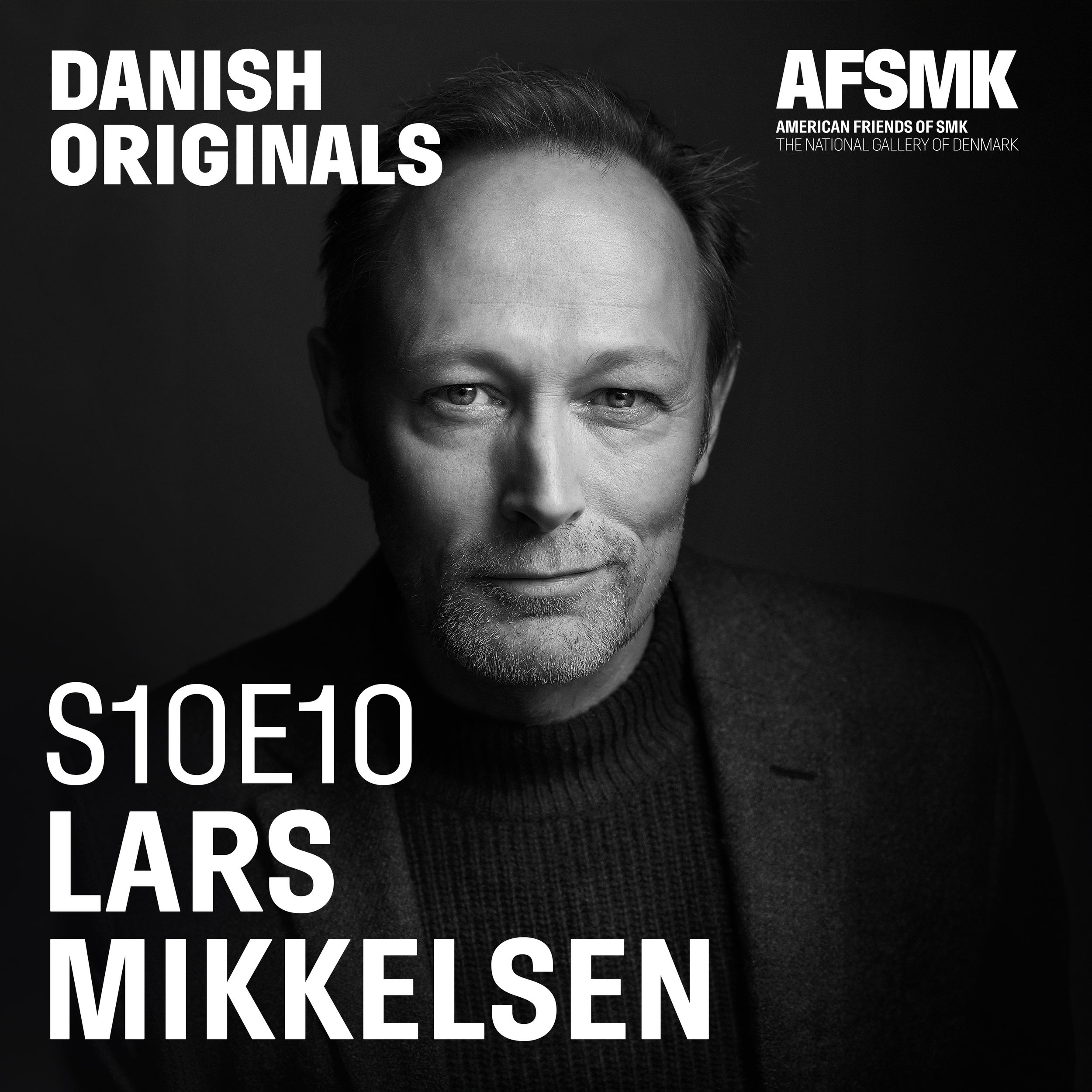
From his home in Copenhagen, Gladsaxe-born Danish actor LARS MIKKELSEN talks about his role as Captain Anderson on Frankenstein (2025). He recalls his start as a street performer before Shakespeare sent him on his path to acting. Of his long career, Lars reflects on the TV series Sherlock, The Killing, and Borgen that brought him attention abroad and that led to the American series House of Cards. He talks about faith, Jante Law, his love for language, and seeking significance in his work.
Photographer: Robin Skjoldborg
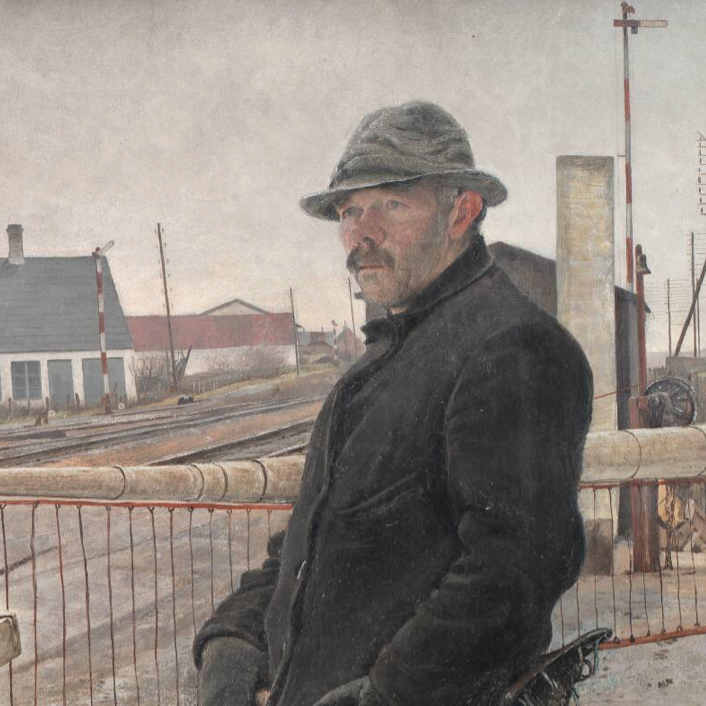
For today's episode, Lars Mikkelsen chose L.A. Ring's Når toget ventes. Jernbaneoverkørsel ved Roskilde Landevej, or Waiting for the Train. Level Crossing by Roskilde Highway, from 1914 from the collection of the National Gallery of Denmark, Copenhagen.
“Am I ambitious? To a certain extent, I am. I’d like to do stuff that has a certain kind of challenge and some kind of significance, I’d say. The older you get, there’s so many things you’ve visited and there’s no need to revisit. But what I look for is, does it have a significant story?”
“You always bring something from what you do. I expect everybody does, really. It could be the collaboration between the cast, or it could be the insight you get from a very well-written text. It can be the embrace of a character that makes you understand something within yourself. You always bring something with you.”
“I didn’t know that you could, as a Dane, go outside the borders. I think that was for all of us, a bit of a shock, a bit of a wow, whoa, okay, let’s step on this rollercoaster. That’s fine. And Borgen came after that and did the same thing, and also made people aware that we’re still here. But I think The Killing was significant for me first.”
Powered by RedCircle
This conversation with Tina Jøhnk Christensen occurred on January 13, 2026.
00:04
Lars Mikkelsen
The picture I've chosen is by L.A. Ring (Laurits Andersen Ring). Part of the title is Waiting for the Train.
00:11
Lars Mikkelsen
And that painting just hit me immediately when I saw it. It's something in the eyes of the guy standing there with his bike and waiting for that train to pass, so that he can pass. There's something for me about industrialization in that time and age, you know. This guy, he must ride his bike back and forth every day and he's looking at it. Where's the damn train? Where are we all gonna go from here? Today, it's trains. Tomorrow, it's ugh.
00:37
Lars Mikkelsen
There's something in his eyes where he's just confronted with modernity and the modern times and his own existence in the waiting of the train that just hit me like a hammer. And that face, lost in transition, just struck me. You have to see it up front.That's where you get the impact from it.
00:56
Lars Mikkelsen
Laurits Andersen, he was a socialist. He went around with a gun, waiting for revolution. And he was the embodiment, actually, of Jante, in some ways, because he was all about the commoner. He painted for the commoner and he painted commoners. He was tied into the working community and the worker. Maybe it's the old socialist in me that also feels aligned with them.
01:25
Tina Jøhnk Christensen
My name is Tina Jøhnk Christensen, and I'm the host of Danish Originals, a podcast series created in partnership with the American Friends of the National Gallery of Denmark. Our goal is to celebrate Danish creatives who have made a significant mark in the US.
01:40
Tina Jøhnk Christensen
Today, our guest is Lars Mikkelsen, a Danish actor. Welcome, Lars.
01:45
Lars Mikkelsen
Thank you.
01:47
Tina Jøhnk Christensen
I am at my home in Los Angeles with a view of a pool and palm trees. Where are you and what does your view look like? I can see lots of books behind you.
01:57
Lars Mikkelsen
I'm in my apartment in Copenhagen. It's freezing. It's just above zero. Everything's melting now, but it is pretty winterish.
02:10
Tina Jøhnk Christensen
Above zero Celsius, we should add, for our Fahrenheit listeners.
02:16
Lars Mikkelsen
Yeah.
02:17
Tina Jøhnk Christensen
Since the last movie I saw you in was Frankenstein, I would like to start our chat by asking you about this. You play Captain Anderson in the film and your men are stuck in the ice on the way to the North Pole when you meet Frankenstein and his monster. They were adventurous, the Danish shipmen, or the Danish sailors, and they were explorers. Are you yourself like that? Could you see yourself in Captain Anderson?
02:43
Lars Mikkelsen
Not at all.
02:45
Tina Jøhnk Christensen
No?
02:47
Lars Mikkelsen
I really like my home and being around friends and I'm not much of a traveler really. But I must say, the job has brought me abroad a lot. And I do travel a lot with that nowadays. But if it was just up to me, I'd just stick around here.
03:06
Tina Jøhnk Christensen
You would never be stuck in the ice in the North Pole.
03:09
Lars Mikkelsen
I'd never be stuck in the ice of the North Pole. I really don't like the cold at all.
03:16
Tina Jøhnk Christensen
Nikolaj Lie Kaas and Joachim Fjelstrup are among the Danish actors who are cast alongside you in Frankenstein. It is a great film shot by the amazing Guillermo del Toro, and you actually helped Guillermo with the script because you get to speak your own language in the film too. What kind of translation job did you do for him and how did the two of you collaborate on the text?
03:40
Lars Mikkelsen
I think we all did. It was written down in English, of course. We took it from there. We just had a discussion between us, the three Danes, and this translation, it's not very elaborate. We are saying, shoot! We just did it and he trusted what we did.
04:00
Lars Mikkelsen
Of course he couldn't understand what we were saying, but he's so good at what he does and he knows what he wants. In that sense, he of course understood more or less what we were saying. But maybe we took it back and forth a couple of times and we had a go with it.
04:17
Tina Jøhnk Christensen
When I spoke to him at the afterparty of Frankenstein in Toronto, he spoke very highly of you and said he was in love with your face, and he immediately decided to give you a role in his next film, a stop motion film. What is it like getting this kind of praise from a director of his caliber? Does it motivate you to be even more ambitious, and are you ambitious, or are you too affected by the Danish Jante Law to admit that to us?
04:46
Lars Mikkelsen
Ooh, that's an elaborate question. Am I ambitious? To a certain extent, I am. I'd like to do stuff that has a certain kind of challenge and some kind of significance, I'd say. The older you get, there's so many things you've visited and there's no need to revisit. But what I look for is, does it have a significant story? Is there something here that is worthwhile, really? And of course it's worthwhile when it's Guillermo, and of course it makes an impact on me that he says that.
05:27
Lars Mikkelsen
I felt that we had that. It was really nice. He's very accommodating, very open, very nice to work with. So in that sense, even though it was such a vast and big set, it just felt like what we do here, really. We had real discussions back and forth on what we were doing. That whole first sequence is a big setup.
05:51
Lars Mikkelsen
He's one of those directors where he can do anything. He can do the whole machine, the big machine, and the small machine. When we get into the cabin later on, he's very good with the actors. He trusts his actors, but he's also there for the nursing of what we're doing. He understands.
06:10
Tina Jøhnk Christensen
He's a very gentle soul, right?
06:13
Lars Mikkelsen
He is, and he's a very funny soul also. Yeah. And I think there's something there with the sarcasm. He's got funny bones. Real funny bones. It's long shoots — humor really helps!
06:28
Tina Jøhnk Christensen
Yes, it does. Do you think the Danish Jante Law has affected you in any way?
06:34
Lars Mikkelsen
Oh yeah.
06:36
Tina Jøhnk Christensen
Is it a factor?
06:37
Lars Mikkelsen
Of course it is. There's a real gap between how you consider yourself in this country and in other parts of the world. 'Cause we grew up with that, and it's got two sides to it. In one way it's good that you align yourself with everybody else and you never become wildly taken with yourself.
07:02
Lars Mikkelsen
And then there's the other side to it, is that we can have a hard time actually embracing that we are maybe better at somethings than other people are. So it's got those two layers to it. I mean, it's good and bad to that, I think. So, I rarely praise myself. I rarely do that. So really nice that he does.
07:29
Tina Jøhnk Christensen
It is. Frankenstein is a big Hollywood production. It's an American production. It has a huge budget. It was shot on a stage in Toronto, as is the case with many Hollywood productions. The Danish film industry is pretty impressive, but we don't do movies on Guillermo scale, budget-wise.
07:52
Tina Jøhnk Christensen
How would you describe being on a big set like that? What are the main differences from these big Hollywood productions and the smaller sets in Denmark, which are also impressive in their own way?
08:05
Lars Mikkelsen
The main difference is that we'd never be able to do that start sequence in Denmark. It's not possible. So we concentrate on what we are doing in the cabin later on. So on the relations, on what happens between people. Because there's so many similarities, I'd say. The job's the same, the moment you're in front of the camera, the same. It's staying true to what the material gives you, the other actors, and the story you're telling.
08:37
Lars Mikkelsen
And you have to forget about the whole big machine around it. I'd say there are more similarities than there are differences. The biggest difference is that on a big scale, we'd never be able to do stunts and we can never do the big machine. I'd say the lunch budget alone on some of these things is a Danish movie.
08:59
Tina Jøhnk Christensen
What about the social aspects of it? Do you just come to set, do your thing, and leave and go home? Is it strictly professional? Do you get to know people?
09:09
Lars Mikkelsen
I think everybody's there for the work, so you don't hang out every day, but you do when there's an opportunity to do it. So once in a while you can do it, keeping in mind that you're actually here to do the work. This time around we were three Danes and we had a week off and stuff. That was quite nice, 'cause we had hung out quite a lot, dinners and training and stuff like that. But you do it to that extent that it won't hurt your work.
09:40
Tina Jøhnk Christensen
Guillermo del Toro's from Mexico. And he said to me that the Danes are very much like the Mexicans in the sense that they are just crazy. He loved that about you. Did you see the comparison and is it how you see the Danes, too, as a little crazy? Or how would you characterize us as a people?
09:59
Lars Mikkelsen
I think we are a little crazy. Taking away the Jante Law that sometimes puts a lid on everything, once we leave that behind and we are on a job like this, we become a bit crazy, in a good way. These characters need that. That movie needs that sort of embrace.
10:17
Tina Jøhnk Christensen
What do you think he meant by it? Maybe the humor?
10:19
Lars Mikkelsen
I think it's the humor. I think it's that, yeah. You're down on your 12th, 14th hour of shooting and you can still crack a joke and have a laugh. You don't sit around moaning about your wet feet or whatever, you're having a good time. This is a once in a lifetime experience for me, so let's have a laugh while we're doing it. Yeah. And that might come across as being a bit crazy.
10:46
Tina Jøhnk Christensen
Guillermo changed the original script in Mary Shelley's book — Frankenstein is based on her book — they were British. He changed them to Danish and you speak both Danish and English in the film. He said that there is something in Danish men that leads back to the Vikings. They're robust and mythical, he said. What do you personally think the switch meant for the story, that they were Danish instead of British?
11:13
Lars Mikkelsen
It brings it out a bit, doesn't it? It opens the story a bit more, that it's not all British or confined to that circle of storytelling, that it's a bit more universal that we come from another country. Apart from that, it's the same story, we are doing what they do in the book.
11:30
Lars Mikkelsen
Like Dracula, at that time a lot of these novels were constructed on letters, of course fictional letters, from the captain to his sister, and in Dracula, it's between the main characters. That's not part of it. We discussed at one point, if that should be a part of it, these letters going back and forth to his fictional sister.
11:51
Lars Mikkelsen
I was a bit like, you don't need it, mate, because it's such a good story, it's so tight as it is. And of course it didn't become that way. But that's also really nice that he's sort of, oh, should we do that? We could do that, maybe we should do that. Because it makes the working space come alive when he shares that with me. It's nice.
12:19
Tina Jøhnk Christensen
And speaking of Vikings, you were the host in a television series about the history of Denmark going all the way back to the Ice Age. It's a ten episode documentary series, and I had the pleasure of watching it for the first time during my Christmas break, even though it's from 2017. It was really good.
12:38
Tina Jøhnk Christensen
Through reenactments of historical situations and interviews with scholars and with you as the host, it tells our country's history. What were the highlights of making this series for you and what did you learn about our nation that you did not know in advance?
12:56
Lars Mikkelsen
Oh, so much. As an actor, of course you know a little about your history. 'Cause whenever you do something about something from the 1800s to 1900s, what we call the Modern Breakthrough. And then you dig into what did that mean in that time and age for Strindberg, or what did that mean for these characters in that time and age? But it's always a very narrow pin that you put into that time in history.
13:26
Lars Mikkelsen
So this time I had the big, overlaying vision of that whole period, from the Ice Age till modern times, and I met all the professors that knew the most of it. I visited all the places that were significant in that sense. I learned so much, and I'm so proud of it.
13:45
Lars Mikkelsen
I have small kids coming up to me in the streets going, it's you, it's you from The History of Denmark, isn't it? And yeah, it's me, yeah. Because again, what you pushed on with one of your early questions, to find something significant to do with what we can do, so we are not just repetitive in that sense, that oh, I can do this, let me do that again and again and again.
14:12
Lars Mikkelsen
This was nerve wracking, going into that storytelling of our national history. But it was at the same time, I felt it was poignant and significant that you're being part of telling the story of our national history to the next generation. And in 20 years, somebody else has to do it because history is ever flowing, it's not a constant. We look at history and tell it from there. And in 20 years they look differently on that national history and it'll have been told again.
14:58
Tina Jøhnk Christensen
We are reminded that the Vikings went far, they also went to America. And we do learn that the Danish language infiltrated English. We kind of knew, but we are reminded that we say "egg" and "window" and "knife," for instance, in English because of the Vikings. Those words derive from Danish, the Vikings actually being present on the British Islands for quite a while, and Britain was part of Denmark for a short time. Were there any other fun words that you were reminded of?
15:31
Lars Mikkelsen
There were other words, but I can't remember now. I'd say after we'd done the whole thing, I actually had the idea that you should follow words around Europe and see how they evolved and where they originated from. And because a lot of the Danish language actually originates from Germanic or French.
15:50
Lars Mikkelsen
So saying it's actually the Viking, it could be actually something Latin or something Germanic that led into that. I don't really know, but I'd really like to do that, that show, where you follow words. 'Cause I love languages and I think most actors do, because we're into words.
16:11
Tina Jøhnk Christensen
Did this program lead you to do more research about certain parts of our history and have you become a history buff since then?
16:20
Lars Mikkelsen
I don't know. I don't know. I've always been interested in history. I told you before, we hit on a certain character, a certain place and period in time, we dig into that time. So it's always fun, but I have a tendency to not be able to remember, what year was that? It's just that I have a different kind of brain.
16:46
Tina Jøhnk Christensen
I think that's okay. The series also reminds us of our history with Christianity, how we believed in the Nordic gods, like Odin, and how the Vikings were introduced to Christianity. I know that you yourself found a Christian pass, so to speak, when you played a priest in the Danish TV series Right Upon The Storm, it's called in English.
17:07
Tina Jøhnk Christensen
He's a priest, and does not seem to behave quite like one expects a priest to behave. But this role led you to become baptized into the National Danish Church. Can you talk a little about your relationship to the church and what it means to you and how this role led you there?
17:25
Lars Mikkelsen
Part of what you do, I do, as an actor, is talking to people, doing more research, before I get into it. So I was talking to these various priests and I had a look around at many — because the Danish Church is not one thing as such. It's up for interpretation by the local priest.
17:50
Lars Mikkelsen
Now, this character I played is what we call a Grundtvigian, from a character called Grundtvig from the 1800s. He was quite a character too. He was bipolar. And in many ways this character was too. So, I went straight there. But having talked to all these priests, I just found at one point that at least within me there's this constant search for meaning throughout.
18:32
Lars Mikkelsen
You might gather that from when I say let's do something significant also. But that's been part of my life all the way through. And our childhood was alcoholics. My mother was an alcoholic and I always had that dialogue to try to exist through something that was hard to understand for me at that point.
18:56
Lars Mikkelsen
So within that church that we have and the priests that are the conveyors of the faith, I actually found exactly what I wanted in terms of discussing the existence. I just embraced that. I had to embrace it. Do you know — like when you find something, you're walking along, oh yeah, oh this is good, maybe it's good, don't know.
19:31
Lars Mikkelsen
But you walk, you walk on the seaside here and you find that small stone, you didn't know you were gonna find it. You have to put it in your pocket because somehow you've always been searching for exactly that stone. So in that sense, I just had to embrace it. It puts you on edge, in this business, at least in this country, 'cause we are so secular, especially in this business.
20:00
Lars Mikkelsen
It was not a popular thing when I expressed it, but it was a thing I had to do, I just had to do it. So I got baptized one morning, with one of my friends who's also a believer and the priest. Beautiful, small ceremony. It's just to bring the dialogue closer. Do you understand why — I have this notion that people understand why I say when I say that.
20:36
Tina Jøhnk Christensen
No, I think I do.
20:38
Lars Mikkelsen
But I just needed to bring the dialogue closer and not be a hypocrite about it, because this is what I do. I do have this dialogue. It's really nice.
20:51
Tina Jøhnk Christensen
Does it bring you peace somehow?
20:53
Lars Mikkelsen
It does, it does. And first and foremost, it just brings me in line with something that I can address — my problems and my thank yous, too.
21:12
Tina Jøhnk Christensen
That's beautiful. Have you had other roles that were life changing in this way? You so intensely go into the material that it's almost inevitable that it will affect you somehow. But have there been any other roles that do that to you?
21:30
Lars Mikkelsen
My wife says it happens all the time! So, in that sense —
21:36
Tina Jøhnk Christensen
Next time you'll become a Buddhist!
21:38
Lars Mikkelsen
Oh my God, not again. You always bring something from what you do. I expect everybody does, really. It could be the collaboration between the cast, or it could be the insight you get from a very well-written text. It can be the embrace of a character that makes you understand something within yourself. You always bring something with you.
22:09
Lars Mikkelsen
It's not that it's always the whole character you bring. At one point I played a pedophile mass murderer, and luckily you don't bring that with you. But there's always some small understanding, something within it. And especially with Shakespeare, you bring that inner understanding of the text that grows with you as you get older, that also gives to your life. And so yeah, it becomes part of you. Yeah. So yeah, in that sense, yeah, I always do it, but I can't pinpoint it.
22:51
Tina Jøhnk Christensen
And maybe it's time to go back in history and talk a little bit about what made you become an actor in the first place. You just described your childhood as a little rough, it must have been a little rough having a mom who is an alcoholic. Your brother also became an actor. His name is Mads Mikkelsen.
23:09
Tina Jøhnk Christensen
And he's also, like yourself, an international star. So maybe you can detect something in your childhood that led the two of you to decide to become actors, maybe the need to express yourself artistically or maybe something else.
23:25
Lars Mikkelsen
There's a lot to be said for the time and age we grew up in, where we could have a look around. We weren't forced into education as such; you could spend some years having a look around. I think some of that is the difficulties of alcoholism that will enhance your emotional enlightenment.
23:55
Lars Mikkelsen
I wouldn't consider myself to be very intellectual or very academic in that sense. But I do have an understanding of what happens on an emotional basis with people in conflict. And I think that could have been a foundation somehow. At the same time, there's very nice things in that home too. We had radio plays and old skits with comedians and stuff. And we'd go through that.
24:26
Lars Mikkelsen
My mom would sing with us, stage songs and stuff. Our father would read a lot to us, so it is a mixture. So in some ways we were nurtured into having an interest for it. Our hunger for all that was just enormous. Our father had to put his readings into tape because he was just exhausted, we wanted more, more, more, more. So in that sense, yeah. And so, that emotional insight, I'd say, and the time and age. So a bit of all that shit!
25:01
Tina Jøhnk Christensen
Yes. And you went to Sjællandsgade Skole. What were you like as a student and was there a drama teacher or somebody else who inspired you in a special way to initiate an actor spark in you that eventually led you to skip the biology studies and study at the Danish National School of Theater?
25:23
Lars Mikkelsen
I don't think so. Sjællandsgade Skole was just the first two years of my audition for the Copenhagen Boys Choir School called Sankt Annæ. And then from third grade, I went to that and became a part of the Copenhagen Boys Choir over a period of two years or something, and sang there for two or three years until your voice turned.
25:46
Lars Mikkelsen
So in a sense, there's something there where I started performing with the choir and it is quite a professional choir, even though we're just boys. First and foremost, we were just boys. But you did understand when you were conveying, when you were communicating. And after that I went into the military and then university just for half a year, I think, for biology.
26:20
Lars Mikkelsen
And then my girlfriend, now wife, came home and could juggle after two days on a juggling course. And I went, oh my God, I was there with a thousand pages, books, and I went along and that was the first time I actually felt that this is me, this is right. 'Cause they were an edge of society at that point. I felt at home for the first time in my life.
26:53
Lars Mikkelsen
And then five years of juggling, street performing, clowning, led into somebody handing me Stormen (The Tempest) by Shakespeare. And I just couldn't understand it, but I knew there was something there that I wanted to learn, I wanted to understand, and that led to me applying for the schools and then becoming an actor. Da da da da da da.
27:26
Tina Jøhnk Christensen
I know that there was a clown, a Russian clown, Slava Polunin, who inspired you. How did you get to know about him and what was it about him that inspired you so much?
27:37
Lars Mikkelsen
They came here. There was a clown company. It must have been in the '90s, maybe late '80s, early '90s. Slava Polunin, and I think the performance was called Licidei or something like that. And they were just brilliant clowns.
27:54
Lars Mikkelsen
From an early age, my grandfather, he was a Communist. You gotta understand that Communism at that point was a working class thing. You were either a Social Democrat or Communist. And it was a party where the workers struggled to get part of the economy.
28:14
Lars Mikkelsen
But every time the Russian State Circus came, we had to go see that, I had to see that. And the first time the Russian State Circus came around, it was them and Oleg Popov, he was a clown. And ten years after they came, it was Oleg Popov and the Russian State Circus.
28:32
Lars Mikkelsen
'Cause he was so phenomenal. And there's something about that approach. I don't know if it's like that nowadays, but at that point, that approach to the clown that the Russians had, they made the child come alive on stage. They didn't throw cakes in each other's faces. They didn't slap each other like the Italian clowns did. They just let the child express itself on stage. And it was just so funny and so poetic.
29:05
Lars Mikkelsen
So I really wanted to be that. I was sure that was what I was gonna do.Slava Polunin had that same feel, that same approach to it, the child on stage. I was just so mesmerized by it, and I wanted to do that, but then somebody handed me a text and then I got astray from it.
29:27
Tina Jøhnk Christensen
Okay. You have also played a Russian president. He is called Viktor Petrov. He is calculating, manipulative, and cold hearted, which is also the case with most of the American politicians in the series, by the way. It is called House of Cards, and it is quite a cynical depiction of American politics in particular. How would you describe the series and your role in it?
29:57
Lars Mikkelsen
I loved the series.
29:58
Tina Jøhnk Christensen
I did too.
29:59
Lars Mikkelsen
I was very proud to be part of that. At one point Kevin said —
30:04
Tina Jøhnk Christensen
Kevin Spacey.
30:05
Lars Mikkelsen
He said in an interview — where we go from here, we are being surpassed by what's really happening. So in that sense, certainly there are similarities right now, aren't there? But I was just so proud to be a part of it. And I didn't really realize how big it was until I was there. One of the producers said, Hey, this is one of the good ones, you gotta know that. And I realized that.
30:37
Lars Mikkelsen
It was fun and big. I'd done a small film in Ireland and a small film in London and I'd done Sherlock in London too. So I had some hair on my chest when I came there, but this was by far the biggest I've been part of at that point. Really nice.
31:02
Tina Jøhnk Christensen
And the first scene you shot in House of Cards, you were in the Oval Office with Kevin Spacey as he plays the American President. And the sets that you were on looked amazing. What did that set make you reflect on?
31:20
Lars Mikkelsen
It made me scared shitless. This was the first day in the Oval Office. Of course it's a very iconographic setting, but you can't think on these things. When you're there, you gotta do what you're there for. Being there with Kevin, he's such a good actor that I can't sit there, going oh my God. I gotta act, be part of the scene.
31:47
Lars Mikkelsen
So you don't let yourself be too influenced by that. And maybe the whole Jante Law thing is quite good there. We are not easily impressed. We're here to do the job. But of course, if you think on it, if you start thinking on it, how can I do this? How can I sit across from Kevin? How can I match him? You gotta not go there. You just gotta look into his eyes and go. And luckily, he was very nice to me.
32:17
Tina Jøhnk Christensen
Obviously you've been in DC, but did you also get this opportunity to be part of the real thing, the White House? It's actually smaller than you think it is when you're there.
32:28
Lars Mikkelsen
Is it? We didn't go to a real White House. That's why they built the whole thing. We did go to DC once where we shot my entourage arriving. And as we did that, suddenly everything came to a halt and the real president came driving. It was quite a meta thing. Wow. Whoa.
32:52
Tina Jøhnk Christensen
All of a sudden you were second to —
32:54
Lars Mikkelsen
Yeah! You're taking my mojo, mate. No, but that was fun. Most of it was on studio. Some of the others might have been more up in DC doing stuff there, but most of it was studio.
33:09
Tina Jøhnk Christensen
Did it spark your interest in American politics? And do you feel that you have an advantage now that you've been behind the scenes?
33:18
Lars Mikkelsen
Does anybody have that advantage?
33:22
Tina Jøhnk Christensen
You tell me.
33:24
Lars Mikkelsen
Isn't it just too sort of random? I do follow. I think the whole world follows the Americans, what's happening, always done, because it's such a vast impact on a lot of us, what's being decided there. And at the moment, everything here is about Greenland and the latest, what do you call it, idiocies. I have to say it. But no, I have no advantage and I don't think anybody has.
33:53
Tina Jøhnk Christensen
You were a spin doctor in Nikolaj Arcel's Kongekabale or King's Game, as they call it in English. That's also a rather cynical film about Danish politics. What do you think are the main differences between the world of politics in the US and Denmark? Maybe right now the situation is different than it usually is.
34:16
Lars Mikkelsen
It also has been over the last 20 years, and then security is tightening up also around here. I remember some of my friends in the States, when they saw Borgen and they asked me, does your Prime Minister really ride a bike around Copenhagen? And, I went, yeah, sure. But security has changed over the recent years, because of various threats.
34:40
Lars Mikkelsen
It's very different societies. In many ways we've created a society where everybody's approachable in some way. Also, Jante has something to do with that, that you should be approachable, which is good. I think that's true. But it's not always the truth because things are changing in terms of how professional politics are becoming here.
35:08
Lars Mikkelsen
We have a 13-party system. We have a variation of parties that we can vote for, and then they will make a coalition that normally will find a consensus of meanings and then politics will derive from there. That is not the situation in your country. So that's very different from the States at the moment.
35:37
Lars Mikkelsen
Of course, we are also struggling in all of Europe with some of the same problems. There are a rising right wing and also left wing that is tangible. So let's see how long we have it. But I think there is a vast difference between our country and yours. And one thing that is quite clear is that we have a much, much healthier take on truth.
36:10
Tina Jøhnk Christensen
Yes. It was the role as Charles Magnussen in Sherlock with Martin Freeman and Benedict Cumberbatch that led the producers of House of Cards to you. That was another great international series or British series. Were you a Sherlock Holmes fan like me? What attracted you to it?
36:32
Lars Mikkelsen
I think we all are. Having grown up in the '60s, they were part of what we consumed, these really, really well done BBC narrations of that. So yeah, I loved it before. It's the foundation of a lot of new crime stories. That character is so iconic and it's flown into a lot of other characters. I'd say Colombo's got a bit of that. There's something within that character that's flown into a lot of crime stories.
37:03
Tina Jøhnk Christensen
And it was The Killing and Borgen that made you visible outside of Denmark. They became very popular abroad, mostly in the UK but I also have a lot of American friends talking about Borgen. What did they mean to you, these two series?
37:17
Lars Mikkelsen
Like anything on the roads of sitting here today, it's all part of me and it was part of me becoming who I am now as an actor. The Killing was funny. It was 20 episodes on one murder and we didn't know who'd done it when we started off. We didn't know until we got the last script.
37:39
Lars Mikkelsen
It was quite a thing in Denmark. I think at that point we were 5.5 million people and I think it was 2 million watching it on Sundays when it came out. Whoa! So it was a big thing. It had done what it did, it was fine, and then two years passed and all of us that were part of it, we'd forgotten about it. We were onto other things.
38:02
Lars Mikkelsen
And then suddenly it hit in the UK and it got that second wind, the attention from the world outside, and it brought a lot of us out. 'Cause suddenly agents were engaging with us. And for me at least, there had not been a possibility up until that point. I didn't know that you could, as a Dane, go outside the borders.
38:31
Lars Mikkelsen
I think that was for all of us, a bit of a shock, a bit of a wow, whoa, okay, let's step on this rollercoaster. That's fine. And Borgen came after that and did the same thing, and also made people aware that we're still here. But I think The Killing was significant for me first.
38:56
Tina Jøhnk Christensen
You worked with your wife. Do you think you'll work with your brother Mads in the future, or is it too close to home?
39:03
Lars Mikkelsen
If it happens, it happens. It's not that we don't want it, but if it happens, it happens. It's not something we seek out, it's not something we don't seek out. It's like, I think with that generation where we wait for the phone to ring. It won't come from us, I think.
39:18
Tina Jøhnk Christensen
I know you both played handball when you were kids. Are you competitive with each other?
39:23
Lars Mikkelsen
Oh yeah, yeah, yeah, yeah. Less nowadays. It doesn't really make sense anymore 'cause none of us can really run anymore. But we were when we were small. Everything, everything —
39:36
Tina Jøhnk Christensen
He's your little brother.
39:37
Lars Mikkelsen
— in a healthy way. It is nice to have a brother to compete with.
39:40
Tina Jøhnk Christensen
You are an acclaimed actor, but following your international work and maybe especially The Witcher, which became a huge success, now you're an international star. How does fame treat you? Is it a positive experience or maybe less so?
39:55
Lars Mikkelsen
It is so funny you say that. I don't consider myself to be that. I'm an actor, and I don't really think much about it. I don't know, I don't know. It doesn't really enter my mind sphere at all.
40:11
Tina Jøhnk Christensen
No?
40:12
Lars Mikkelsen
I really like the work, I really like the work. And hopefully, I'd like it from here on. There's always a possibility of it drying out, because it is tough sometimes. It is not tough to do the job actually, but the whole shebang around it can be sometimes a bit of a —
40:32
Tina Jøhnk Christensen
Red carpets, interviews, fans, all that.
40:37
Lars Mikkelsen
Yeah, from the outside it looks like, oh, that must be fun. It is not really, it's crappy. So. But no, I'm here for the job. I like the work. It's fun. And like we were discussing earlier on, I'm here for the bits that I carry on from every job, for that skin renewal that it brings every time.
41:04
Lars Mikkelsen
And also for the learning. I'm still learning, and it was so much fun when we got out of Denmark, 'cause having to do it in another language, and to approach that, it's such a learning experience. Like here, I'm searching for words the whole time here in English to be concise about what I mean. I wouldn't do that in Danish.
41:25
Lars Mikkelsen
So that learning experience of trying to make characters come alive in another language because I'm so language based. I derive from Shakespeare, from talking characters. And that's also what I normally do when I'm being cast in English or American productions.
41:45
Lars Mikkelsen
I do talking characters. I'm not the mysterious guy in the corner. In that sense, it's such a learning experience and I hope that never stops. I really like learning and I really like the journey that it brings me on every time.
42:02
Tina Jøhnk Christensen
How important do you think it is for you to work across borders? Do you think it helps us create bridges and do you think art can help us build bridges?
42:11
Lars Mikkelsen
Definitely. We can't always do that with what we do, change people, but we can make them think sometimes. Sometimes we can just entertain them. But does it make bridges, does it construct bridges between people? Yeah, it does. It does, sometimes.
42:34
Lars Mikkelsen
Like when people approach me and say, is it right that your prime minister really rides a bike to work? And I go, yeah, sure. So that telling that story of a society that it's like that — it's right next to the life you live, but it's so different, that we are the same, but so different.
42:54
Lars Mikkelsen
I'd say the first time I saw Van Gogh, the first time I heard Beethoven, the first time I saw a play with one of the grand old ladies here, where she was personifying that character to such a degree that everything came to a halt. It can do that. We can do that and that will change your path. But we don't always do it. It's difficult.
43:27
Tina Jøhnk Christensen
And Lars, my final question to you. What is still on your bucket list? What do you still want to achieve?
43:34
Lars Mikkelsen
People tend to ask me that, and it is very present with me. Like I said, I'm in that generation where I'm so privileged that I set myself down and waited for the phone to ring. And then somebody phoned me up and then I'm suddenly part of something and that will bring me somewhere.
43:52
Lars Mikkelsen
A couple of times I had the privilege of defining something we wanted to do with Shakespeare, but I consider it to be a minor exploration. But my two young sons have become actors too, so on my bucket list is for them to succeed in this, for them to experience that same thrill doing the work.
44:18
Tina Jøhnk Christensen
What is your advice to them? What should they be wary of? What should they focus on?
44:25
Lars Mikkelsen
Keep at it, keep at it. And talent is just a part of it. The hard work is actually what brings you to your goals.
44:37
Tina Jøhnk Christensen
On that note, hard work brings you to your goals. Thank you so much for being part of Danish Originals. We really appreciate you being with us.
44:47
Lars Mikkelsen
No worries.
44:49
Tina Jøhnk Christensen
No worries! Alright!
44:55
Tina Jøhnk Christensen
For today's episode, Lars Mikkelsen chose L.A. Ring's Når toget ventes. Jernbaneoverkørsel ved Roskilde Landevej, or Waiting for the Train. Level Crossing by Roskilde Highway, from 1914 from the collection of the National Gallery of Denmark.