
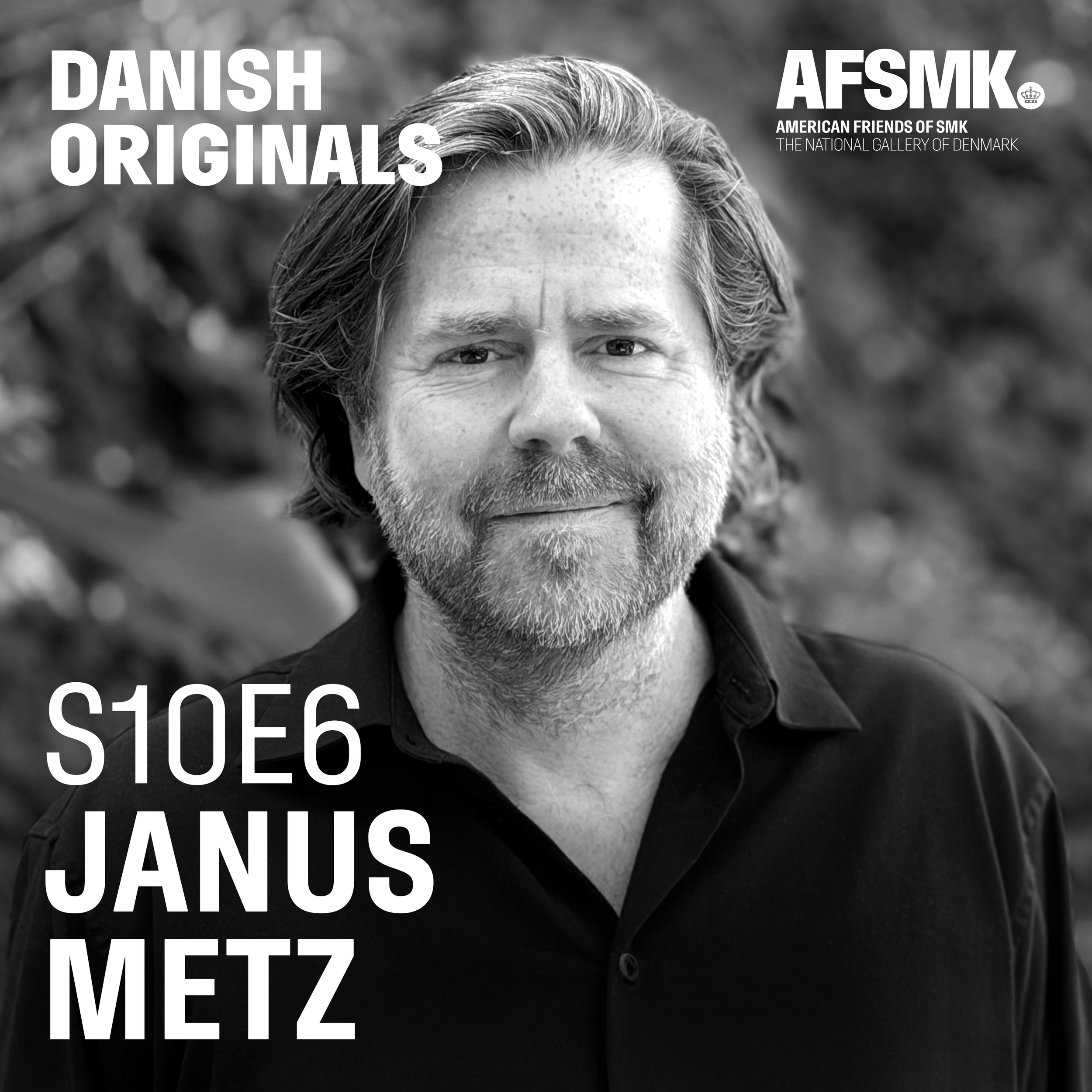
In Los Angeles completing his upcoming film about Unabomber Ted Kaczynski, north of Viborg-born Danish film and television director JANUS METZ talks about being drawn to characters that look into darkness. From his documentary Armadillio (2010) about Danish soldiers in the war in Afghanistan to his big budget tv series Star Wars: Andor (2025) to the miniseries ZeroZeroZero (2020) about the global cocaine trade, Janus talks about the anthropological approach and perspective in all his work.
Private photograph
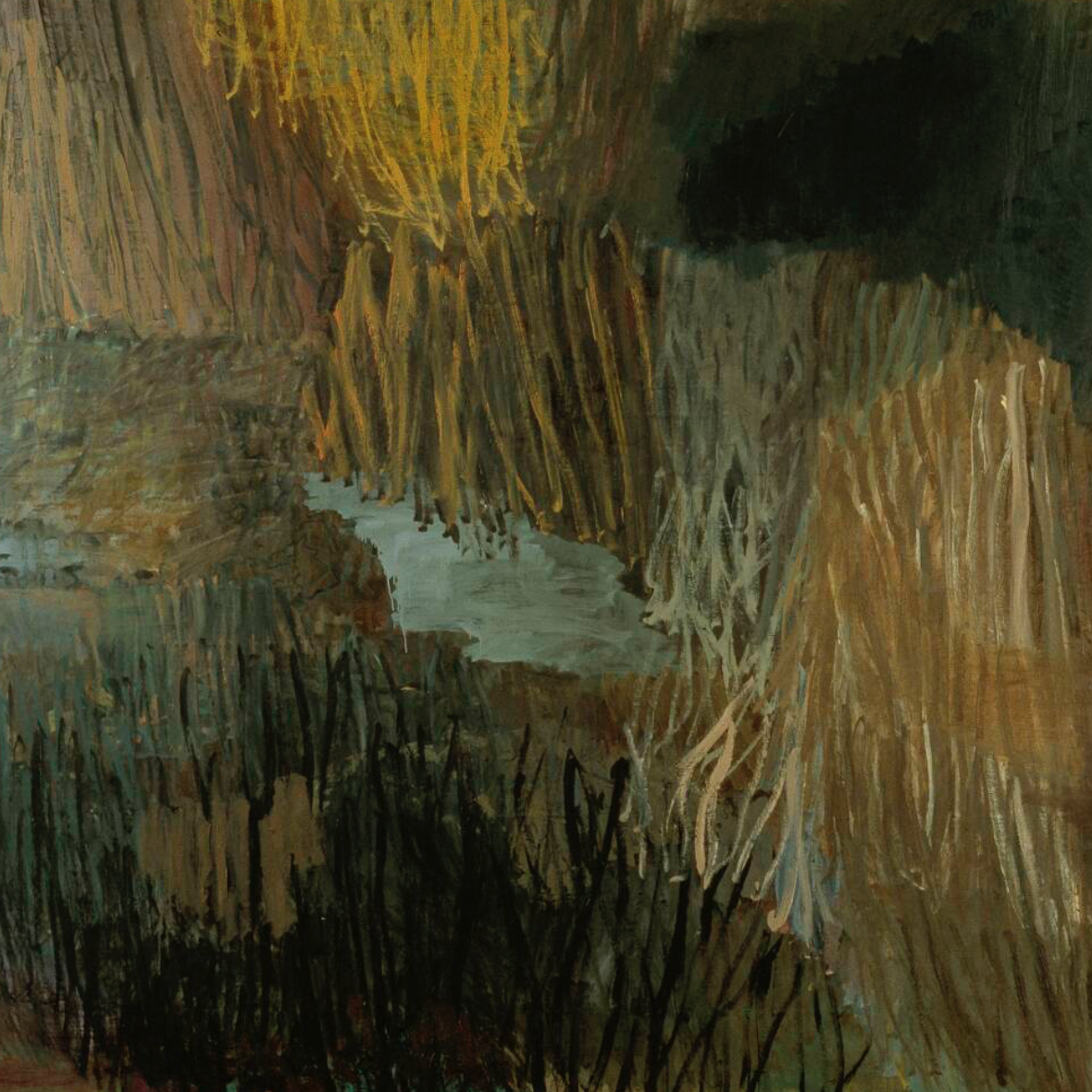
For today's episode, Janus Metz chose Per Kirkeby's Uden titel (Vinterbillede), or Untitled (Winter Picture), from 1995 from the collection of the National Gallery of Denmark, Copenhagen.
“I don’t believe in objective filmmaking. First of all, I find it uninteresting. I think a filmmaker should come from a perspective of the people that are looking at something. And I think it’s inevitably going to be the case even if you say it or you don’t say it.”
“I somehow get drawn to characters that are looking into that same darkness in so many ways and trying to understand who they are and trying to understand how to make sense of this short time we’re given on this weird stone in the middle of an inexplicable universe.”
“So I like to think that my art is driven and based on being a traveler and an anthropologist and actually trying to grapple with the world we live in, with our human condition, with how we’re parts of this world and with what it does to us. It’s a very important part of my DNA as a filmmaker.”
Powered by RedCircle
This conversation with Asger Hussain occurred on November 10, 2025.
00:04
Janus Metz
I chose Per Kirkeby's painting Vinterbillede, which means winter image, winter picture.
00:11
Janus Metz
I grew up with Per Kirkeby's paintings. My father was part of the same circles of artists in the '60s and '70s.
00:21
Janus Metz
It's an abstract expressionist landscape. Per Kirkeby and the familiarity my father's paintings have with Per's has instilled me with a sense of immediate understanding of the relationship between painting and nature, reality and art.
00:41
Janus Metz
There's a tactility to Per's canvases that resonate with me and that has become part of my soul, in a way. I'm always looking for that inexplicable power of the canvas that comes out of Abstract Expressionism. That's become part of my filmmaking.
01:04
Asger Hussain
My name is Asger Hussain. I'm a film producer and guest host of Danish Originals, a podcast series created in partnership with the American Friends of the National Gallery of Denmark. Our goal is to celebrate Danish creatives who have made a significant mark in the US.
01:20
Asger Hussain
Today's guest is filmmaker Janus Metz, whose work spans from frontline war documentaries to Hollywood dramas and prestige television, from Armadillo to Borg vs. McEnroe, True Detective, ZeroZeroZero, and the Star Wars show Andor.
01:38
Asger Hussain
Janus has consistently explored the tension between power, intimacy, and the human cost of conflict. And today, he's right here with me in my living room in Silverlake, Los Angeles. Janus, welcome. It's great to have you here.
01:52
Janus Metz
Thank you so much, Asger.
01:55
Asger Hussain
You've been splitting your time between Denmark and Los Angeles. What are you doing here at this time?
02:01
Janus Metz
Right now we are completing the post-production of my latest narrative feature called Unabom, which is the story of Ted Kaczynski, how he grew up and was admitted into Harvard at 16 and met a psychology professor, which turned out to actually conduct experiments in brain washing and mind control on him, which many think might have tipped him into becoming what was later known as the Unabomber, the infamous domestic terrorist, schizophrenic serial murderer that lived in a cabin out in Montana and sent mail letter bombs to university professors.
02:39
Asger Hussain
Wow. We're starting off with a light subject here. Where are you staying while you're in Los Angeles?
02:46
Janus Metz
I'm here with my 3-year-old son and his nanny, and we have a little house out in Venice Beach, close to where I'm editing, and we found a kindergarten out there for him. So I've relocated part of my family here. My wife and our daughter's still back in Copenhagen, where my daughter goes to school.
03:02
Asger Hussain
Ambitious. Do you skate? Do you go to the Skatepark?
03:06
Janus Metz
I was an avid skater in the late '80s and early '90s. I'm a little too old and crusty to get on a skateboard now. But I do go down there from time to time and look at the skateboarders. I love it. It's funny because my son sometimes likes to dress up as a police officer. He's three years old, so he goes down there as a police officer and they all think it's very funny 'cause they sit around and smoke dope.
03:31
Asger Hussain
It is very funny. My daughter is eight. She actually loves it. She'll ask once every month, let's go out to the Skatepark and just look. But she goes in her civilian clothes. Let's rewind a bit. Where did you grow up in Denmark?
03:44
Janus Metz
I grew up in the countryside in Jutland just north of Viborg which is pretty much dead in the middle of the country. This is the country's old capital, as we like to call it. I grew up in a commune, some people might call it a hippie commune. I think the days of the hippies were over when I was a kid.
04:02
Janus Metz
But it was certainly an alternative lifestyle to my neighbors that were all farmers or just people that lived in little provincial towns. My father's a painter, my mother was a social worker, and we lived together in this big old ramshackle building with the other two families. So there were always a lot of children around and extra parents.
04:24
Asger Hussain
Fun. How long?
04:26
Janus Metz
Until I moved out on my own, which I did when I was about 17, when I went to high school. I found a little studio apartment in Viborg, where my gymnasium was.
04:40
Asger Hussain
Very nice. And did the interest for film start early on, or did that happen later in school? Where did that originate?
04:48
Janus Metz
My interest in film happened at a very late age in life. I was 28 when I started making my first film, which was a documentary film and it came out of a process of not really knowing what to do with myself, how to put one foot forward in life. I'd been a university student forever studying literature, communications, international development and relations, philosophy, architecture.
05:18
Janus Metz
And on the side I was dabbling with music and with painting. And I found it very hard to make these two worlds align, the creative side of me and the academic side of me were at odds with each other. And then one day I just decided to — well, it wasn't quite on a one day basis. I saw the opportunity of doing an internship in South Africa in Johannesburg through my studies.
05:41
Janus Metz
And that was with the media organization that did TV. And long story short, I found myself going in and out of Alexandra Township quite a lot, and made friends with the youth there, and decided to pick up a camera and do a documentary about these guys that I met, which then became my first film project.
06:01
Asger Hussain
And how long did that take to complete? Was that an ongoing, organic process? Did you know that it was going to be a film when you started?
06:09
Janus Metz
I knew that I wanted to make a film. I was trying to be a painter for a while, and I always felt my paintings were too similar to my father's. So although I do enjoy painting a lot and ever so often I want to take up painting again, I haven't managed.
06:23
Janus Metz
I knew that I had the ability somehow to express myself through images and I understood images on a very tactile, subconscious level. So when I met this group of people in Alexandra Township, which were basically car hijackers and criminals that were friends of friends that I worked with, I decided to chronicle their life.
06:47
Janus Metz
It was a group of friends that was just hanging out on one particular street corner every day. So I applied to what's called the Film Workshop in Denmark, which is a little branch back then under the Danish Film Institute where you could off the street apply for funding and help to do a film project, and you'd go through a selection process.
07:07
Janus Metz
And I was very lucky to be one of the projects that was selected. So I went there to South Africa with a small digital camera, PD150 with DVcam tapes, did everything myself, had a friend of mine, Rasmus, who had done some radio come down and help out a bit. And we shot this project over the course of three months.
07:29
Janus Metz
And I think I spent the better half of seven or eight months trying to put it together in the editing room afterwards. And it took me through every single aspect of filmmaking and I really, through that project, created my own film school, in a way. It was through that project that I understood what cinematic language is.
07:46
Asger Hussain
And how was it to do your first film in a setting that's so different from Denmark? And for our listeners, a township in Johannesburg is probably not like Viborg.
08:00
Janus Metz
No, it was extremely crime-ridden and poverty the order of everything. I think at that time I was in my late 20s and I traveled a lot. I had this belief that people are people and you can meet them at eye level if you make an effort. I had unique access into that environment because I was working in South Africa with people that were from that area.
08:25
Janus Metz
And some of the people that I teamed up with, they were the toughest guys on the block. So I was under their protection. We were there every day filming, Rasmus and I, and became really close friends with these guys.
08:37
Janus Metz
I think for them to have someone who took an interest in them and took them seriously and wanted to tell their story and bring it out to the world was a sign of trust. And it was just something that they'd never experienced before. We had no problems being there. I saw a lot of grim things. I saw a lot of violence, but I never felt unsafe personally.
08:57
Asger Hussain
Fascinating. What year was this?
08:59
Janus Metz
This was in 2004, I believe.
09:05
Asger Hussain
Wow, that's quite a while ago. And Johannesburg may or may not have changed much in that time, I think, probably.
09:13
Janus Metz
I traveled to Johannesburg at a time in my life where I really wanted to reinvent myself. I was visiting a country that was in a process of reinvention. Apartheid only ended in '94, so there was still all the celebration speeches of "Rainbow Nation" and the spirit of Nelson Mandela and everything was still kind of alive.
09:31
Janus Metz
It was eclipsing at the time, but there was a lot of positivity still and a lot of let's claim back the nation. And there was a lot of space for artists. I think for me, I was dovetailing onto that energy and it helped me realize what I wanted to do with myself. And it helped me reinvent myself as a filmmaker. And it helped me gain the courage to come out to the world and say, hey, this is what I want to do.
09:58
Asger Hussain
I worked on a movie there between 2014 and '16, and it's been the most positive experience I've ever had, and I felt the same energy and positivity that you're describing amidst all the other stuff that was happening at the time. But it was really interesting and very rewarding.
10:17
Asger Hussain
I want to jump to 2010 when your film Armadillo came out. For our listeners, that movie is about Danish soldiers in Afghanistan. It won a lot of awards and was very critically acclaimed for its unflinching look at modern warfare. What drew you to that story? How did you get involved in that project?
10:39
Janus Metz
I'd done two documentaries back to back for Danish television that had become very successful, about Thai marriage migrants that marry into a small fishing community in Denmark. They became the talk of the town in Denmark at that time. And it established me, nationally, as a documentary filmmaker.
10:58
Janus Metz
So when that project concluded, I was very occupied with the place of Denmark in a global perspective. And I was thinking, what is the most interesting story right now in Denmark? And the war in Afghanistan was at its height and Danish soldiers were being deployed and taking part in some of the most intense combat in Helmand. And that whole story kind of slipped off the news agenda in many ways.
11:26
Janus Metz
And no one had really seriously portrayed what was going on in Afghanistan. There'd been a lot of news footage out, obviously, but from a documentary filmmaking perspective, no one had really taken a deep dive into what the experience of warfare was for Danish soldiers, what it means for Denmark and Danish youth to be at war and what it does to us, how it reflects back at us, and not at least what it does to Afghanistan.
11:53
Asger Hussain
And I remember thinking at the time: Denmark has an army, has a navy, it has everything. But when's the last time Danish soldiers were in combat in that particular way, and then in a war that may or may not have a direct link to us. The fact that there were actually people that were in there, I found that very interesting in a way that I hadn't thought about before.
12:16
Janus Metz
I think the film in many ways came as a shock to Danish audiences and it was a huge conversation starter in Denmark. Everyone commented on the film, all members of Parliament commented on it.
12:31
Asger Hussain
I remember that.
12:33
Janus Metz
It was insane. I'd never experienced anything like that. And it was also, I think, one of the rare moments in Danish film history where film causes that much intense debate. It catapulted me into a different stratosphere as a filmmaker. Not only had I done a film that became such a touchstone for the Danish conversation about the war in Afghanistan, but also about documentary filmmaking and the borders between documentary filmmaking and narrative features.
13:06
Janus Metz
Because it was certainly a film that lent itself to filmmaking artistry or craft, where some people felt that the lines became blurred too much. And I was pushing for unveiling a deep psychological truth, deep psychological impacts about war and violence as an artistic endeavor. And I think that's also why the film traveled so widely in terms of international distribution, festivals, and awards. It won the Critics award at Cannes. It was a film that pushed boundaries.
13:43
Asger Hussain
And displaying the truth in a film doesn't mean that it can't be entertaining in terms of how you set it up, right? So I feel people sometimes talk about the purity of documentary filmmaking, and I think it's undergone a necessary evolution going from just a camera on the wall to also setting it up in a way that looks cinematic in your own terms.
14:04
Asger Hussain
I want to go back to the reception and the way that people spoke about it and your place in it. Did you feel that because it was such a conversation starter, people wanted you to take a certain stand? Do you think people used it to advance their own existing political views on the war? How do you feel coming out as a filmmaker from this, all of a sudden this becomes a life-death conversation between the population in an entire country?
14:35
Janus Metz
We tried to chronicle the experience of war for all its seduction and traumatizing effects. And in that sense, you could say Armadillo had, I would call it, a humanistic approach. But also somehow an ethical stance towards warfare. It's a good question because the film did not set out to have a particular political agenda, but it was seen by people left, right, and center in the political spectrum to affirm some of the agendas that were already out there.
15:20
Janus Metz
And I think that has very much to do with the nature of the film, that it tried to be an analysis and a look and an in-depth inquiry of what warfare is and what it does. I remember people on the political right saying this is a testimony to the heroic efforts of the Danish soldiers. And there were people on the left side that said, this is Denmark's Vietnam, and we have to bring our soldiers home and it doesn't do anything for the Afghan population, et cetera. And all those things were true at the same time.
15:55
Asger Hussain
And they can be.
15:55
Janus Metz
And I think that is the purpose of art to try and look at things for what they are and not necessarily be political in the way that you're driving a certain political agenda. But you could certainly derive political agendas out of Armadillo. And I think it is a film that has a very strong ethical perspective on warfare and a very strong plunge into the human heart.
16:21
Janus Metz
To me it's a film not only about war, it's a film about the human experience. It's a film about our fall from grace. It's a film about imperfection. It's a film about how violence is intrinsic to the way we live as human beings.
16:34
Asger Hussain
Absolutely. And I think all those things can coexist with opinions that may have been across the political spectrum. As an artist, how do you define the word objectivity when you're that close to your subject, immersed with them for such a long time? Does the mindset on objectivity shift in that situation, or do you just look at it in a different way?
16:58
Janus Metz
It's a very interesting and exciting and challenging and complex question because objectivity is many things. I don't believe in objective filmmaking. First of all, I find it uninteresting. I think a filmmaker should come from a perspective of the people that are looking at something. And I think it's inevitably going to be the case even if you say it or you don't say it.
17:21
Janus Metz
So you could lend yourself to all kinds of objective languages, which are the tent poles of journalism, and there's merit to that. There are objective truths, but then there are all the things that are about our experience and the human heart and what something feels like and what it does to us. And that is what we have.
17:45
Janus Metz
That's the language of art. That's what poetry is for. That's what filmmaking is for. And that's hopefully something we could all learn from and discuss. And in that case, there is not objectivity. But there's also objectivity, because I do believe that there is a sense of truth out there.
18:05
Janus Metz
There is a reason why a certain piece of music moves us. There's a reason why the tactility of a painting moves us more than someone who just puts a little bit of color on a canvas. There's a reason that Picasso was a great painter because we can recognize that as human beings and we don't know what it is.
18:29
Janus Metz
And now we're getting close to something where art transcends into something metaphysical. So that to me is the most interesting place for filmmaking. And that was what we were driving at in Armadillo. And of course that's provocative to some people. 'cause you could say, why did you add music? There's no music in the fields in Afghanistan.
18:48
Asger Hussain
Very much so, especially with the subject matter.
18:50
Janus Metz
And of course when you're making a film and you call it a documentary film, and it's about something that's so controversial as the war in Afghanistan, you're bound to get your ass smacked, as we say in Danish.
19:06
Asger Hussain
As you should, a little bit.
19:07
Janus Metz
That's okay, you signed up for that. It can be treacherous waters because there's a lot of people out there that are very opinionated, that have very aggressive opinions and that want to look at every single part and try and put it together again based on their idea of how the world looks and what's right and what's wrong and what's true and what's false.
19:26
Janus Metz
So we are looking at something that is a conundrum. And that's very interesting. But it's of course also the site of huge debate and strife. And as it also happened at Armadillo, when that goes public, you are going to be in a sensitive place as a filmmaker and as a person, because people are gonna come at you personally as well.
19:49
Janus Metz
When that happens, I think as a filmmaker, you have to live up to that responsibility. You have to stand tall with the film that you made. And to some extent, you can say the film speaks for itself. That is true, and you can leave it at that. But I do think you have to welcome the conversation because you've also, as a documentary filmmaker, put other people's real lives on the canvas.
20:11
Janus Metz
The soldiers are there, it's their lives that I'm chronicling, I'm telling their story. So when the conversation becomes heated, I have to stand tall with that. I have to live up to that. And that's not always easy, because it can be very volatile. And it certainly was in the case of Armadillo. But that's okay.
20:31
Asger Hussain
In the moment, was there ever a time where you thought, this is too close, this is too dangerous, while you were actually in it?
20:39
Janus Metz
Oh, all the time, we were dodging bullets several times a week. We were in firefights with the Taliban multiple times a week. We talk about my filmmaking and now we're in the documentary branch of it. And I think I've adopted a lot of those strategies into my narrative filmmaking.
20:56
Janus Metz
I come from an anthropological perspective, and that's also going all the way back to Township Boys. The way I immerse myself in a setting is as an anthropologist. I try to be there and see: what does it feel like? What is the experience of being in these people's shoes?
21:14
Janus Metz
And then I don't overtake their perspective. And that goes to the idea of subjective and objective or observed and observer, because I think that would be false. If someone was to make a film about me, I don't think I would be the perfect person to make a film about myself. I think I need someone else's perspective. That's not to say that I can't challenge that or say, hey, listen, you've painted me all red and I actually feel like it should be a little more green.
21:38
Janus Metz
So when you're an anthropologist and you go into that kind of situation, you have to use the experience of, what is this fear that's driving me? What is the adrenaline that I'm feeling right now? How does that translate into filmmaking?
21:54
Janus Metz
And a lot of those emotions were the drivers of how I was able to make a film like Armadillo because there were several moments making that film where I thought, fuck, this is what it is. I remember when we had to leave for Afghanistan, I had to write my last will, as it's called, as all the soldiers do.
22:16
Janus Metz
How do I wanna be buried if I don't come home? My mom and dad, my siblings, my girlfriend, my wife, my children — what is the last message I want to give to them? So you are actually sitting there and foretelling your own death. And that was extremely emotional.
22:30
Janus Metz
I broke down several times trying to do that, but it also gave me a realization that in a sense I'm already dead. I can now go and die in a war zone, and I've left my story settled, in a way. I've told my parents that I love them, I've arranged my own funeral. So you're going through a rite of passage.
22:48
Janus Metz
Then the next day we were at the airport and there's all these parents, siblings, girlfriends, et cetera, crying for all the young men who had to go into war. And you feel like a hero. It's like the soldiers leaving the train stations in the Second World War. You're going out for something that feels important because all these people showed up. Suddenly, you're inscribing yourself as a hero of the story. Not only your own personal story, but world history, in a sense. And that is extremely powerful.
23:16
Janus Metz
And then you go down there, you experience war. Maybe it's a little lame, it's like someone fired a couple of bullets and they were very far away and it felt a little underwhelming. And then you wanna get closer, and you wanna get close to the action. It's very similar. Filmmaking and warfare is very similar to that extent. As a filmmaker, you want to be close to the action. You want the emotions to unfold. There's almost a perversion in that, which in many ways translates into the experience that soldiers go through.
23:44
Janus Metz
I was using all those realizations as part of my conversation with the soldiers, as part of understanding, how can I stitch this film together? What is it actually we're going through? I had the preconception before going to Afghanistan, that once we'd go to Afghanistan and the bullets were real, we would be scared. We would run into camp and pee our pants and call our parents et cetera, and cry on the phone.
24:12
Janus Metz
Nothing like that happened. And I was very frustrated because obviously as a documentary filmmaker, you want that kind of emotional outbreak. But people are just going on with their everyday chores and being good soldiers. And then I realized, fuck, that's even more interesting. You have to put a lid on it and you wanna get closer and only with time, as we were there for four, five, six months, it starts nagging at you. The constant pressure, the danger, the more firefights you're in, it grinds you.
23:43
Janus Metz
And then people start coming undone in a completely different way. At the same time as there's this wolf pack mentality that develops, you wanna get closer to the action. You wanna try to kill someone, basically. It's a very controversial and dark thing to say, but that's part of the jive.
25:00
Janus Metz
And again, as a filmmaker, you want it to happen because you know that's what is gonna give you a real document of what war is and a good film, and you're there as it unfolds. So there's a desire that collides in that moment and I think that was my real realization of, fuck, we are looking into the Nietzsche and Abyss here. We are staring into darkness and the darkness stares back into us. And that was what Armadillo was.
25:30
Asger Hussain
That is so insightful. Very, very fascinating. I don't even know how to jump on from here.
25:36
Janus Metz
It has obviously been a ground zero in my career and also in me as a human being. It has inspired my filmmaking in many ways ever since. I find myself somehow going back to characters. Whether it's in Borg vs. McEnroe that are about two tennis players or the characters of Star Wars: Andor that are rebels in a war zone, I somehow get drawn to characters that are looking into that same darkness in so many ways and trying to understand who they are and trying to understand how to make sense of this short time we're given on this weird stone in the middle of an inexplicable universe.
26:20
Janus Metz
So I do think it drives my filmmaking and it goes further back, it goes back to my interest in painting, that metaphysical void that we can't understand.
26:30
Asger Hussain
It makes sense. And for our listeners who might not know, Andor is the Star Wars series created by Tony Gilroy, the Oscar-nominated writer and director behind Michael Clayton and the Bourne films. Gilroy has this extraordinary gift for finding moral tension in, and I don't know the real word, if it's bureaucracy or quiet or mundane, and then turn it into this huge battlefield of conscience, almost.
27:03
Asger Hussain
And I think what Tony and you and the rest of the team did with that series was so extraordinary. There's no lightsabers, there's no Jedis, just human stakes, political, psychological, and it was so grounding. What was it to step into that world and also how was it to take a peek into the engine room of what is Lucasfilm's Star Wars, one of the biggest fanboy, cinematic experiences for many, many people across generations?
27:37
Asger Hussain
I sit across from you as a massive fan and I have a very vivid recollection of the first time I entered this universe. And how is it to be part of that?
27:48
Janus Metz
It's funny because I was never a fanboy of Star Wars. I remember it from my childhood. I'm born in 74. I believe the first film came out in — was it '78? I remember it was something that belonged to the older siblings of my friends. I remember watching it obviously on little VHS machines. But coming from the hippie commune that I did, we didn't have any of that stuff.
28:11
Janus Metz
So it was something that happened over at my friend's place and I thought it was fun and exciting, but it wasn't that personal connection with Star Wars as some people of my age have, where that was a life-changing experience for them. And they were fans of Star Wars all through their childhood and they played with light sabers or sticks that they pretended to be lightsabers.
28:32
Asger Hussain
We had a little stool that was made out of corduroy that was on the balcony, and that was the Death Star for me. And my dad had an old man bag that you would have around your wrist in the late '70s and '80s. And when that got old and he got a new one, he gave me that man bag, the pouch. And that became the Millennium Falcon for me. So that gives you an idea of where we are.
28:55
Janus Metz
This whole fan culture around Star Wars is something I only realized quite a bit after I joined the show as an episodic director. Every year, there's this big Star Wars convention where a hundred thousand people meet somewhere and the new shows are presented, the actors come in, and everyone comes dressed up as their favorite character, et cetera.
29:14
Janus Metz
And that happened to be in London when we were shooting. And it was such a big thing. And that's when I realized, oh fuck, there's a lot of people out there with high expectations to what we're doing. But having said that, you can't really think about that when you're making something. You just have to do your job.
29:30
Janus Metz
And I was there because of Tony. Tony's film Michael Clayton had been a huge inspiration to me when I was doing a spy movie called All the Old Knives for Amazon. We looked a lot to Michael Clayton and there was a producer on that film that had been part of the producing team on the Bourne films, and he kept saying, oh, I should try to get you and Tony together, you'd really hit it off. So I think there was a shared sensibility with Tony Gilroy that I was attracted to.
29:56
Janus Metz
I actually started out being very dismissive of the whole idea of doing Star Wars. It was something that my agents proposed and they were looking for a director to come in on season two on Andor. And they wanted to forward my candidacy. And I thought, okay, well it is Star Wars. There's a lot of great filmmakers that have dabbled their feet in this universe. Let's have the conversation at least.
30:18
Janus Metz
And I remember in the first conversation, Tony Gilroy said, 'cause I told him, look, I haven't seen all the other shows that have been made. Obviously I've seen the movies. I have kids also. When you have boys, you end up watching Star Wars at one point. And he said, no, good, good, don't watch anything, it will contaminate you. We're trying to do something completely different.
30:37
Janus Metz
And he said something to the effect of what you just said — real psychological character, character-driven, et cetera. And he said, we're trying to do something real with the franchise. So Tony said, think of this as the Ken Loach version of Star Wars. And the whole conversation obviously got me intrigued. It's very particular because when you come onto Star Wars, you're not allowed to read the scripts.
30:59
Asger Hussain
Yes, I know that much.
31:01
Janus Metz
So this is very, very particular. It was very closed off and I had to take a leap of faith. So I worked with Stellan Skarsgård in Borg vs. McEnroe and he's a friend and someone I could call up and I knew Stellan was part of it. This was before season one aired. I could only take Tony's words for what he was trying to do and his whole thing as a writer / director and take that at face value.
31:25
Janus Metz
So I called up Stellan and said, I had this conversation with Tony Gilroy. Is it what he's making it out to be? And Stellan was very positive about the idea of me coming on board and gave me what I needed to say yes. So that was it. Then I came onto Star Wars, and then obviously, you're entering Pinewood Studios in London and the production takes up two thirds of the studio space and the huge backlot builds — you're just in a world, production-wise, that is next to nothing that I'd ever seen before. In Tony's world, it's what you call big time filmmaking.
31:58
Asger Hussain
Big time filmmaking.
31:59
Janus Metz
There were over 2,000 people working on this production and budgets through the roof. And as a director, I just felt I was riding shotgun to the biggest bank robbery in the history of modern TV.
32:13
Asger Hussain
In those situations, do you try to hold on to the same things as Armadillo or Borg vs. McEnroe that had very intimate moments as well? How do you not only just disregard the noise, but also get to the truth of where you want to get with these characters that were obviously created by someone else, Tony Gilroy, but that you have a responsibility to articulate and amplify in the best way possible?
32:42
Janus Metz
You bring your game, you bring your intuition, your point of view, your color palette as a director, obviously, stepping into a world that's already laid out and written. I did episodes seven, eight, and nine of season two. So you're looking at two seasons, 24 episodes, and I'm doing something down the last third of the whole odyssey of the TV show that's Andor.
33:07
Janus Metz
So you gotta respect that. You gotta respect that there are people that know more than you, that know more about the story, that know more about the characters, that know more about the world. At the same time, it's your responsibility to take on that specific job and make it as exciting as you possibly can. And you can't do that without bringing yourself.
33:27
Janus Metz
Again, to make an analogy to painting, you have a certain palette or a certain line that's yours. I find that it's very hard to do something else. You can't really run away from that. You also have to trust that the people that chose you as a director, in this case, Tony Gilroy, want to paint with that color palette.
33:50
Janus Metz
And looking back, I thought it was a wonderful journey because I felt very at home in the scripts that I was entrusted, written by Dan Gilroy, Tony's brother, who was an episodic writer and who won an Emmy for episode nine —
34:02
Asger Hussain
And you were nominated for an Emmy?
34:04
Janus Metz
I was nominated for episode eight. Unfortunately I didn't get it, but I think I have a little stake in Dan's Emmy because I directed the episode that he won for Best Writing. I felt very at home in that world and I felt very at ease with the script and the cast and the whole world of working.
34:21
Asger Hussain
And not to get too granular for our listeners, but I do recall at the time that the three episodes that you directed almost felt as a coherent chapter within the whole two seasons. It had a very similar point of view as if James Bond had been reborn in Casino Royale. We see this story again and it plays out as a trilogy or four films at the time.
34:45
Asger Hussain
And I felt that coherence, and I think it's a great testament as well to Tony and his trust in you and your ability to take that through in the most entertaining fashion. And going back in that arc of your career, am I grasping if I say that I felt similar moments in the riots at the plaza back to some of your early days with Armadillo and combat and what it actually means?
35:09
Janus Metz
No, it's totally correct. That was what I based my direction on, the personal experience of warfare and what it does and how it affects you and how claustrophobic a firefight feels when you're inside of it. That was left, right, and center for everything that we did in episode eight, which has become a tent pole in the Star Wars universe in particular for Andor because it's the massacre of a whole planet.
35:33
Asger Hussain
It is. And feels very timely today, even a couple of years later.
35:37
Janus Metz
It's very interesting because when Andor came out, there was a lot of talk about trying not to talk about the political side of the show. It is very political. It's very much about the time that we live in. It's about how media is being watered down, this whole idea of fake news that the Trump administration has pioneered.
36:04
Asger Hussain
And calibrations that the Senate members are making to the politicians at the time that even if they feel morally opposed to this, they're still gonna go along with it because they fear retribution.
36:16
Janus Metz
There's an archetype to a fear that permeates the whole system, and I think Andor as a show really chronicles that in a very elegant, but also very direct fashion. And when the show came out, there was a fear that the reception of the show would become biased because of this political side to it. But as the campaign went on, everyone started realizing that is the strength of the show. That's why people were being drawn to it.
36:46
Janus Metz
Although I wasn't part of the actual campaigning of the series, because that's the showrunner and the actors, it was very clear to see that they started talking more and more about the show as a political commentary on not only the time that we live in now, but fascism, tyranny, autocracies, all these political systems that you've seen through time and how they operate.
37:09
Janus Metz
And it really goes back to the first Star Wars movies. The first Star Wars movies were modeled on Nazi Germany. That is the evil empire that takes its inspiration from that. And I think Tony continued that journey.
37:22
Asger Hussain
I was very pleasantly surprised that a company like Disney would push it in that particular way. And I'm not sure if that might happen today, just two years after, three years after.
37:35
Janus Metz
I'm also not sure what the actual conversations were within Disney. Tony Gilroy is a very strong writer. And I think he got his way in many ways. I don't know how those conversations panned out. I wasn't privy to being around the table, but I think it would've been fun to have been a fly on the wall in some of those strategy conversations.
37:55
Asger Hussain
Janus, when you do things that are completely rooted in realism and an actual war, and you do the highly fictional, such as Star Wars, which is so cinematic and at the biggest scale possible, there have been projects in the middle too, whether it's Borg vs. McEnroe, that are based on real events, or the TV show that you did called ZeroZeroZero, which was written by a very interesting Italian writer, Roberto Saviano, who also wrote a book called Gomorrah.
38:30
Asger Hussain
Both books are about crime, cocaine, trade, and that writer had to go under police protection. How do you approach the work that you did on ZeroZeroZero? Did you get to have any conversations with Roberto or was it similar to Star Wars where you said, I know the basics of the world, I know where it is that we're going, and then I'm gonna do my take on it?
38:56
Janus Metz
Very similar to that. Roberto wrote his book that was obviously a bible to the show, and you could mine his book for information. It's a journalistic exposé of the global cocaine trade and how the Mexican cartels are connected with the Italian mafia and how the cocaine gets distributed, how shipping industries are part of it, how containers get lost in big hub ports, et cetera.
39:22
Janus Metz
The show was spinning all these worlds up against each other. And it was really a road movie of a shipment of cocaine that traveled through the underworld of crime. Saviano's point is that the black economy of the world is as big as the white economy of the world and it is equally influential to the way the world goes round.
39:45
Janus Metz
So he lives on the police protection in Italy for uncovering the Italian mafia and the connections between the mafia and political life, et cetera. And he's a very controversial and huge figure in Southern Europe, particularly. So his work was all there. This script has been developed based on his book.
40:04
Janus Metz
I would have questions sometimes about the authenticity of certain things. I didn't talk to Roberto personally because he lives a very secluded life. I didn't have direct access to him. But I would vet some things that I needed vetting with the writers, which was important for me to be able to stage something as correctly as possible.
40:23
Janus Metz
A base premise of that show was that everything we did had to be shot in the actual locations of where it really takes place. The only place we strayed from that idea was when we were shooting in the Sahara Desert.
40:37
Janus Metz
A part of the storyline is about the smuggler trade that goes from Sub-Saharan Africa through the Sahara Desert into Morocco. And they typically go through northern Mali, Mauritania, southern Algeria, and that area is controlled by various religious radical groups akin to ISIS and Al Shabaab. And so it was impossible to film in those areas.
41:00
Janus Metz
I happened to have traveled there. I actually did try to, at one point, make a documentary in that region about African migrants traveling through the Sahara Desert to get to Europe. So part of my pitch to land the gig was I had actually traveled in those parts of the world. The authenticity of the story was very important to us.
41:18
Janus Metz
And we had various, in TV and narrative features, you call them tech advisors. We would work with real members of the drug force in the Mexican police to authenticate, if you go up against cartels and if you have to raid a house, how do you do it? And what is the reality that these cartel members are living? et cetera.
41:38
Janus Metz
And so there's a lot of vetting in that sense from my side as a director. What is the reality in these situations? What do people actually do? And we try to infuse the scripts with as much of that as possible.
41:51
Asger Hussain
I remember it being a very accurate feeling in the way that it was portrayed at the time. But again, wild that you've seen these things and been to these places as well.
42:02
Janus Metz
I've seen things and I've seen things that I wish I hadn't seen. I remember one time particularly the Mexican cartels, when they took over territories in Mexican cities, they used social media a lot and they would post some of their violent deeds on social media in order to take control.
42:22
Janus Metz
And I was asking this drug cop that we were working with, are these things just out there for public consumption? Can anyone go and see it? And he was like, yeah, yeah, take a look at this. And I was looking at something and I remember there was a picture of a guy lying on the ground and it looked to me like he was being beaten with a stick.
42:40
Janus Metz
And he was just quietly saying por favor, por favor. And I looked at it for a little while until I realized this was a guy that was getting his limbs chopped off with a machete, and I just threw the phone. Because it was just too grim. So that stuff was going on on ZeroZeroZero.
42:58
Asger Hussain
When you go through these very intense periods of time, and we were talking about drug trades, soldiers, townships, how do you keep yourself grounded? I assume you can't just shed it and move on to the next thing. Something must stay with you. How does that affect you as a person and as an artist?
43:19
Janus Metz
For me, having seen a lot of violence, real violence, it stays with you. And I've certainly had my share of conversations with psychologists over the years. It comes back to you and it revisits you or haunts you, even in ways that you can't always predict. It's not something that goes away.
43:39
Janus Metz
I've chosen to see that as a place of potential growth. You have to make use of it. The world can be a grim and tough place. It sounds like a cliché, but I don't wanna live a life where everything around me is sugarcoated and I shield myself. And at the same time, obviously, there's a limit to how much your eyes can see before it really starts affecting you in ways that you can't control.
44:07
Janus Metz
So I like to think that my art is driven and based on being a traveler and an anthropologist and actually trying to grapple with the world we live in, with our human condition, with how we're parts of this world and with what it does to us. It's a very important part of my DNA as a filmmaker.
44:34
Janus Metz
I could probably use a good mental breakdown, to be honest, to put me a little more on the back burner and to not always be haunting the next project because there is something called frequency, I think, when you're a filmmaker. It is scary to go away, even if you might need to go away, as a human being, as an individual. So I keep working. And maybe that's gonna crash and burn at some point. I don't know.
45:07
Asger Hussain
We hope not.
45:08
Janus Metz
I hope not, and I'm not saying it lightly. I'm also not saying it to make me come across as, oh, what an interesting, dangerous life that you lead. Because that's a cliché of a war photographer or something like that. I don't associate with that whatsoever, but I do think that part of my artistic drive has to do with the experience of death and the experience of darkness. And I try to make use of that in artistic ways.
45:33
Asger Hussain
And endurance, I think, with a lot of your projects, that's a human condition as well, which I think is a common denominator in your work, as an audience.
45:42
Janus Metz
Maybe that's true. You endure, you persevere, and then you die. Don't take too much time to think.
45:48
Asger Hussain
That's very Danish of you to say. And Janus, a final question for you today. What's been the most surprising element of being a Danish filmmaker working in Hollywood?
46:02
Janus Metz
Oh, that's a big one. It's such a long journey, I think, to actually understand how to maneuver in the world of filmmaking in the US and particularly in what's loosely termed as Hollywood because there's so many people working here. There's so many stakeholders, there's so many strategies.
46:27
Janus Metz
There's so many business considerations, the agencies, the management deal of it all, the money. Everyone seems to have an idea — now it's going this way, now it's going that way. Now these people only wanna make genre movies. Now indie films are coming back. Now it's TV.
46:45
Janus Metz
And the only thing you can do really is just to try and stay true to yourself because otherwise you're gonna get steamrolled very quickly. And that's somehow sometimes not easy. And I don't know if I've been fully able to do that all the time because temptation is out there, money, fame, celebrities, movie stars, et cetera. It's a very seductive world.
47:10
Janus Metz
But there's one thing that I've learned. The projects that get made are only the projects that you actually wanna make and that you really feel like, this is a film I need to make and I have to make, and it means something to me to make it. 'Cause that's the only way you can survive the whole circus of trying to get projects going, finance it, survive on set, the whole brutal experience of editing, post-production, et cetera, and actually distribute a film.
47:38
Janus Metz
I feel with every project that I do, I'm always called back to Janus Metz. Who is Janus Metz? What is a Janus Metz movie? What is a Janus Metz movie trying to do? Why is it important for me to make this project and what do I want to get out of it?
47:56
Janus Metz
For however much the world turns and however far away you can feel from Denmark, from people, from family, et cetera, I do think that is the most important thing, and maybe the most surprising thing is, you turn back to yourself.
48:13
Asger Hussain
Janus, thank you for spending your morning here in Silver Lake amongst police helicopters, and what other things were circling above us. This was such an open, generous conversation. I really appreciate your time. Thank you.
48:26
Janus Metz
Thank you so much. Thank you.
48:32
Asger Hussain
For today's episode, Janus Metz chose Per Kirkeby's Uden titel (Vinterbillede), or Untitled (Winter Picture), from 1995 from the collection of the National Gallery of Denmark.