
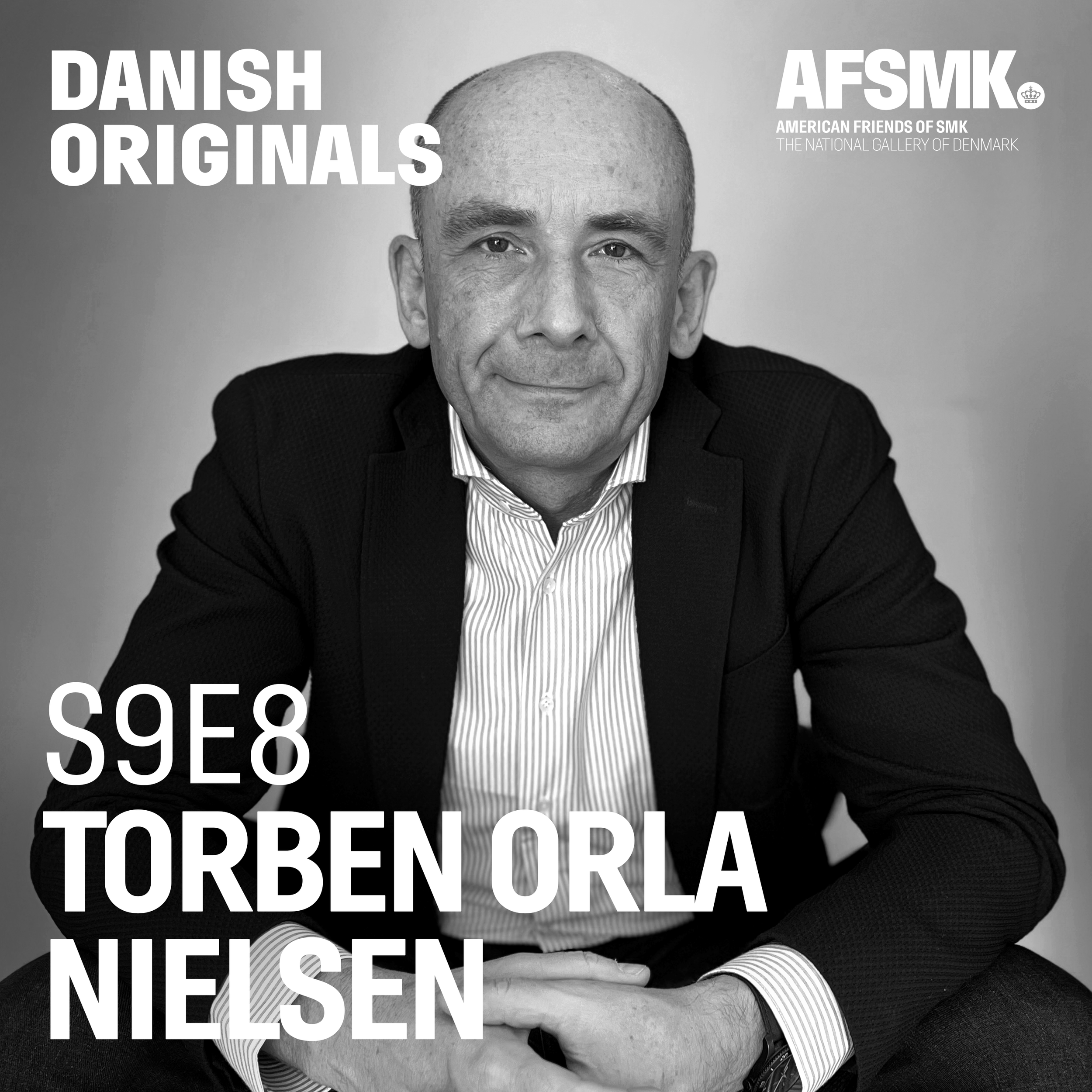
From his home in Washington DC, Ravnsnæs-born Danish counselor of science and innovation TORBEN ORLA NIELSEN explains his new role with the Danish Embassy tracking the political framework of the US research environment as it impacts Danish research. Following seven years in Boston's Innovation Centre Denmark, Torben, a diplomat, navigates the evolving US research priorities and funding in order to assist US collaborations with Danish universities and companies.
Private photograph

For today's episode, Torben Orla Nielsen chose Rialto-broen i Venedig, or The Rialto Bridge in Venice, by an unknown artist from 1670–1679 from the collection of the National Gallery of Denmark, Copenhagen.
“We talk a lot about how the US is divided, and it’s definitely also divided when it comes to trust in science. It’s very cosmopolitan, it’s very elite — which it is, research is a very international business, no doubt about that.”
“For the past 13 years, I’ve been a diplomat working in science, but I’m not part of the traditional track of diplomats that go into the Ministry of Foreign Affairs, and then post in different areas. Now an increasing share of Danish diplomacy is actually experts in specific fields, and I’m one of them.”
“Through my career, it’s something that I’m really good at, having both of these perspectives: the bigger picture, when that is needed, and also, we often hear the phrase, the devil is in the details, and also knowing when the devil is in the details and then pay attention to the details.”
Powered by RedCircle
This conversation by Christian D. Bruun occurred on October 17, 2025.
00:02
Torben Orla Nielsen
I chose the drawing The Rialto Bridge in Venice by an unknown artist, and it is from 1670 to 1679.
00:11
Torben Orla Nielsen
My father was an architect. During his studies at the Royal Academy, he went to Venice in 1956 and did some sketches. He had a big desk in his study. You can open the top, and below was a number of drawings and sketches he made over the years. But it was not something that was special to him.
00:32
Torben Orla Nielsen
Because of his upbringing, he was concerned about the future. Even though he worked at the same company for 40 years, he was always concerned whether there'll be a new project.
00:42
Torben Orla Nielsen
He raised two sons, dragged around two sons to see cathedrals in Europe, to see and experience architecture. But that uncertainty, I think, was the reason none of us pursued that career.
00:57
Torben Orla Nielsen
When he passed away, the Royal Academy issued a book and picked sketches made by architects during the last decades. And two or three that my father did on that specific trip to Venice were in the book. Beautiful small sketches. It wasn't the Rialto Bridge, but it reminded me of that.
01:27
Christian D. Bruun
My name is Christian D. Bruun. I'm the director of Danish Originals, a podcast series created in partnership with the American Friends of the National Gallery of Denmark. Our goal is to celebrate Danish creatives who have made a significant mark in the US.
01:43
Christian D. Bruun
Today, our guest is Torben Orla Nielsen, a Danish counselor for science and innovation. Welcome, Torben.
01:50
Torben Orla Nielsen
Thank you so much. Thank you for having me.
01:52
Christian D. Bruun
I'm very excited to be speaking with you, Torben. I know you hold a key position in opening a lot of doors and connecting paths for Danish and American research and innovation. To start off, I'll just describe where I am. I'm talking to you from my home office in Los Angeles. Would you share with our listeners where you are and describe the place you're in so they get a sense of the surroundings?
02:16
Torben Orla Nielsen
Sure. I am in Washington DC, which is my new home here in the US. I'm a rookie to DC but I'm not a rookie to the United States because I have, for the past seven years, been living in Boston, where I was a science attaché at the Danish Consulate and Innovation Center up there.
02:32
Torben Orla Nielsen
The plan was to move back to Copenhagen, but then the Danish Ministry for Science asked me to take up a new position at the Embassy as a counselor for science and innovation. And that was too good to refuse. So instead of directing the movers to Copenhagen, I asked them to just drive a little bit south from Boston to DC.
02:49
Torben Orla Nielsen
So I'm in my apartment. I'm close to the Potomac River. On my far left I can see the Arlington Cemetery. And a little bit more to the left, I can see the Watergate building, that was the Waterloo of another president. And then I have a beautiful sunset.
03:03
Christian D. Bruun
Well, you certainly are in very historic settings there at the center of most things in the US, I would say.
03:10
Torben Orla Nielsen
That's for sure.
03:11
Christian D. Bruun
As you mentioned, you're the Counselor for Science and Innovation with the Danish Embassy in Washington, DC. It's a new position at the Embassy, and you're the first person to occupy that position. Can you tell us what that job entails and why it was created?
03:26
Torben Orla Nielsen
Sure. If I could take one step back. I'm hired by the Danish Ministry for Higher Education and Science. So my boss is in Copenhagen, but I also have a boss here at the Embassy. As a science attaché, your role is to connect the Danish academic research environment with the one here in the US. I also assist Danish startups and Danish companies when the question is about research collaboration.
03:51
Torben Orla Nielsen
And that was what I did for seven years in Boston and before that, five years in Korea. But my new job is a little bit different here in DC. The reason why they opened this position was that there's a lot going on in the political scene in the US, and also when it comes to research, the framework for universities and research and funding and all that.
04:10
Torben Orla Nielsen
And that is my task, to follow the political framework on research in the US because that is impacting Danish research as well. Maybe not directly, there's very few US taxpayers' dollars that are flowing over the Atlantic. But when a Danish University has a collaboration with a US university and the US universities are impacted, either they lose their funding or for some other reasons they cannot participate in the research collaboration, then it impacts Danish universities.
04:43
Torben Orla Nielsen
And that's why the Ministry decided to open this new position at the Embassy. The US is the biggest trading partner for Denmark overall. The US is also the biggest research partner for Denmark overall. So it's an important destination for Danish industry but also for Danish research and academia.
05:02
Christian D. Bruun
So you're essentially a conduit for researchers in Denmark or companies in Denmark coming to the US to do collaborations on research? Or are things that happen on a private level outside of your purview?
05:17
Torben Orla Nielsen
I work for the Danish government, the Danish Ministry of Science, to pave the way and also to, you can say, maneuver the landscape of research in the US, for universities, also for companies. I do what is called political reporting. I write what is called cables. It's an old name for what it was in the old days. Now it's done by email.
05:39
Torben Orla Nielsen
I write what's going on in specific areas. There's been a lot of talk about vaccines, for instance. Mr. Kennedy, the Secretary for Health in the US, when he cut down on research in vaccines, I'll do a cable about that back to Denmark, telling this is what's going on in this field.
05:53
Torben Orla Nielsen
That could also be in the field of energy. The current administration is not a big fan of renewable energy, which is something that we are doing a lot of research in and also have a lot of business and trade in Denmark. So there are many recipients of those kinds of cables.
06:10
Christian D. Bruun
You sort of answered a little bit of my next question here. What are some of the most outstanding research and innovation areas in science, technology, and education currently in Denmark that are the most attractive to their American counterparts, and vice versa?
06:26
Torben Orla Nielsen
First of all, if you look at Danish research, both the impact and the output, it's a success story. We as a nation have various strongholds when it comes to health research. We have a strong industry in life science. Notably Novo Nordisk, Lundbeck, LEO Pharma, the old pharmaceutical companies play a role there. And their owners, the foundations, are fueling Danish research.
06:50
Torben Orla Nielsen
Also a new and upcoming number of startup companies in this field are based on research. That's why health research is an important factor. And that is specifically in Boston, where I used to be. Boston is the world capital of pharma and biotech. Every big pharma company has a research department in Boston, and for good reasons, and that goes also for Danish companies. That was the reason I was sent to Boston in the first place.
07:16
Christian D. Bruun
I see.
07:17
Torben Orla Nielsen
On top of that, there's a number of other areas where Danish research is really outstanding. Energy, which was mentioned before. Energy generation comes from renewable sources. Wind is obviously a stronghold. Also energy efficiency, how to have a whole society that actually reduces our uses of energy and our CO2 footprint. We are pretty good at that, so that's another field. The whole climate field is another area.
07:43
Torben Orla Nielsen
One area where we recently have gained a place in the academic sector is in quantum research, this field that was more or less founded by Niels Bohr. He gained his Nobel Prize back in the 1920s, I think it was '22 or something like that. And the application of quantum technologies can go on quantum computing, quantum sensing, quantum navigation, all of those new kinds of application of quantum science, which is so important. Quantum technologies also have a geopolitical and the security policy implication.
08:19
Torben Orla Nielsen
Because Denmark has a strong research base in this specific field, it means that we are in a group of countries, depending on how you look at it, ten, 12, maybe 15 countries that really have strong research environments about that. And that is specifically, here in the US, interesting. That is a race that we are in against nations that don't share our values and our way of living, and it has implications if we are not on top of that agenda.
08:45
Torben Orla Nielsen
With the help of Novo Nordisk Foundation and the Danish sovereign fund EIFO, Denmark bought a supercomputer from Nvidia and also a quantum computer, which means that both Danish academia and Danish industry can gain access to those computers. That will mean a lot for research. It will mean a lot for development also in industry science.
09:04
Christian D. Bruun
And it's made to be available for all Danish industries to use, so it's not a proprietary system?
09:09
Torben Orla Nielsen
In the case of the quantum computer, Novo Nordisk Foundation is contributing and that will be available also for our Nordic friends and Europeans.
09:18
Christian D. Bruun
Well, that is very exciting. You're definitely in a very key position in this whole new world. There's also a certain Danish DNA to sustainability and renewable energies. We all remember some of the first energy efficient light bulbs that would take about ten minutes to really come on fully and just a certain consciousness growing up in the '70s, '80s.
09:40
Torben Orla Nielsen
And in the beginning they were a little bit annoying. It took some time before they started off, and the light was a little bit off.
09:46
Christian D. Bruun
It's come a long way for sure.
09:48
Torben Orla Nielsen
It has come a long way. Now it's just everyday use and I think that's a good reminder of things. I would guess that we are probably the same age. Remember back in the '80s when we talked a lot about acid rain and what that did to forests, especially in Germany?
10:03
Torben Orla Nielsen
I remember when we were driving on holiday with my parents, you could actually see those forests, that all the leaves were gone because of this acid rain. That is actually also an improvement that we tend to forget and which we should celebrate. I know we have a bunch of other issues when it comes to climate, but that was actually one of the issues that have been addressed, at least in Western Europe.
10:26
Christian D. Bruun
It's good to see things are going in the right direction, even if it may take a couple of decades before you see the results. Those things are incredibly important. Before your current post, you were the science attaché at the Innovation Centre Denmark and the Danish Consulate in Boston starting in 2018, as you mentioned earlier. What was your key role there? And maybe you can explain a little bit what the innovation centers do.
10:52
Torben Orla Nielsen
The Innovation Centres, that is a collaboration between two ministries in Denmark, the Ministry of Science and Higher Education, and the Ministry of Foreign Affairs. Probably 20 years ago under the government of Anders Fogh Rasmussen, that government had this idea of a globalization council with participation from industry, universities, organizations, and government, and talking about how could we best position ourselves in order to make the best use of globalization.
11:20
Torben Orla Nielsen
Which is important, especially for a small country. We all believed that globalization was the new black. And we would all be happy forever after. We are wiser and we know better now. One of the many recommendations was that we need people out in the field, boots on the ground, in specific areas that can assist Danish companies and Danish researchers on an innovation and research agenda.
11:47
Torben Orla Nielsen
The Danish Foreign Service has what used to be called the Trade Council, nowadays it's called Economic Diplomacy, but basically a large organization globally on all Danish embassies that are assisting Danish companies on an export agenda. It's very successful, has done that for many years, it's still going on.
12:03
Torben Orla Nielsen
What we do at the Innovation Centre is taking a step back and assisting companies and the researchers on an innovation and research agenda. For companies before there's actually a product on the market, we assist companies to find technology partners that could be investors to invest in their companies or invest in their development.
12:22
Torben Orla Nielsen
The first one opened in Silicon Valley in 2006, and since then we have opened in Shanghai, in Munich, in Bangalore, in Seoul, that was when I joined in 2013, and in Tel Aviv. And the latest addition to this family is the one in Boston. And I was actually sent in 2018 to open the Innovation Centre in Boston.
12:42
Torben Orla Nielsen
So units placed in technology hotspots seen from a Danish perspective that assist companies, startups, researchers, and government on an innovation and research agenda. That's the overall purpose. What do we actually do? I used to say that we were the dating bureau for scientists, trying to match up Danish researchers, whether they are working at a company or at a university with their counterparts here in the US or when I was in Korea, with researchers in Korea.
13:11
Torben Orla Nielsen
Taking them in bundles, organizing scientific workshops — we did something called innovation camps, that is, we take a group of startup companies, team them up with a couple of researchers and bring them to Boston, and then we expose them to what Boston can offer in that field, which we specifically selected companies in certain fields.
13:33
Christian D. Bruun
So you provide introductions to companies, connecting people and maybe even spotting missed opportunities in these collaborations?
13:43
Torben Orla Nielsen
Exactly. Yeah. And also part of my job was to go back to Denmark — it still is — to tell what's going on in Boston because Boston is such a hub for especially life sciences or biotech and pharma. And since that sector is really the engine of the Danish economy nowadays, it was so important to be well connected with what's going on in Boston.
14:04
Torben Orla Nielsen
And that was the reason why the decision was made to open the Innovation Centre in Boston. So I go back every second month, basically, to meet with people, and to talk about what's going on.
14:14
Christian D. Bruun
The greater Boston area is a powerhouse, and of course home to many of the top science institutions in the US. They have MIT, which is the Massachusetts Institute of Technology, there's Harvard University, Boston University, Tufts University, Northeastern, I could go on.
14:31
Christian D. Bruun
And of course there's, as you just mentioned, the Innovation Centre. And then Novo Nordisk is also in Boston. So I'm just covering some of the ones that I know. Are there other companies on your radar that I'm missing here?
14:44
Torben Orla Nielsen
There are a number of smaller companies that have set up offices in Boston, and have done that recently, typically if they have some kind of collaboration. So that's one part specifically in the life science area. There is also the whole renewable energy sector and the subcontractors to that sector, also located partly in Boston, but at least on the US East Coast.
15:08
Torben Orla Nielsen
That sector is challenged for the moment because the current administration is not in favor of wind turbines, onshore and offshore. But up till the current administration took office, that was of huge importance for companies like Ørsted or Copenhagen Infrastructure Partners, and all the subcontractors that are working on the installment of offshore wind parks.
15:29
Torben Orla Nielsen
And that whole, you can say, focus on offshore wind started in Boston or in Massachusetts. Massachusetts was the first state on the East Coast that was making solicitations on having companies build offshore wind parks. And since then, it's trickled down along the East Coast of the US.
15:49
Christian D. Bruun
So even though you're in DC, you're also very much still in touch with the Boston environment.
15:56
Torben Orla Nielsen
Boston will always be in my heart. I love that city. It's a very nice city in so many ways. If you look at the many US movies of Boston, they very often picture the blue collar part, the rough edge of Boston, which definitely also is there. Look at movies like The Departed or Good Will Hunting or The Town, it's South Boston, Southie, the rough, or it used to be, now it's been converted into gentrification and pretty nice housing. Boston is crazy expensive these days. Many Americans see that part of Boston.
16:34
Torben Orla Nielsen
I went and many Danish researchers and companies went to Boston, that was the eggheads, all the Nobel prizes and all that research and innovation capacity. I think specifically Boston and Silicon Valley, those two destinations, what they are really, really good at is the ability to translate research into companies.
16:56
Torben Orla Nielsen
That's why there's such a vibrant ecosystem of startup companies and investors because they follow the investment opportunities. That's really the core, not only to do good research, but to translate that research into either a product or a new company.
17:11
Christian D. Bruun
To go back to a little bit of what you mentioned earlier — the evolving research politics here in the US, of course are now mainstream headline news these days. Can you explain to me and to the listeners what is happening and what the current administration is hoping to accomplish to the extent you can talk about that?
17:30
Torben Orla Nielsen
I don't know if I can answer the latter but I'll try to explain how I perceive what's going on. That's basically the reason for this new position in DC. Because of all the changes going on in research priorities, in research funding in the US, the Ministry of Science decided to open this new position.
17:48
Torben Orla Nielsen
If I should try to draw the picture of what has happened, I'll let the listeners decide what they want to accomplish. It falls into at least four different categories, what has been introduced of the new policies.
18:01
Torben Orla Nielsen
The first one you could call refocusing of priorities. Immediately after the new administration took office, certain research grants within specific areas were canceled. Some part of health research, especially vaccines, was hit in that phase. A lot of things related to climate research, renewable energy, and everything related to DEI, diversity, inclusion and equity, that whole agenda.
18:31
Torben Orla Nielsen
There were other areas as well, but those are probably the majority. And that was, in the beginning, driven by the DOGE department by Elon Musk. That meant that suddenly, very rapidly, funding for a number of research projects was simply canceled and gone. And that created a lot of turmoil in the research environment, obviously.
18:53
Torben Orla Nielsen
The second thing that has happened, and that happened in parallel, was the change of the business model or the economics around how you fund research. When you get a research grant, you will get an amount of money that pays for the researchers' time, lab work, their salary and all that.
19:11
Torben Orla Nielsen
But on top of that, you also have to pay rent and electricity and staff that support the research. All these costs are called overhead or indirect costs. And that's a typical percentage that you add to the research grant. The Trump administration wanted to put a cap on these indirect costs — 15%, which is by most standards, extremely low.
19:37
Torben Orla Nielsen
To give you some examples, universities like MIT, Harvard, Stanford typically have maybe between 50% and 70% in overhead. So suddenly asking them to do the same kind of research with an overhead of 15%, that's really, really difficult.
19:53
Torben Orla Nielsen
And then they also introduce a tax on their endowment. Some of these US universities have big endowments, and they have been lucky to have very low taxations on those endowments. And that's progressive taxation. But it means that some of the more wealthy universities are paying higher taxation.
20:12
Torben Orla Nielsen
That's also a change of the business model. And all of that came at the same time we had this "big beautiful bill." So there was a link between trying to finance some of the tax cuts in the "big beautiful bill" by the change of the economics in research.
20:29
Torben Orla Nielsen
The third part was, you can say, a political prioritization of specific research areas. And that's a normal thing to do for a government. We also do that in Denmark. We have political negotiation in the Parliament, deciding which areas of research should be funded on top of the funding that goes directly to Danish universities.
20:50
Torben Orla Nielsen
It's fair to say that there has been a narrow focus on certain areas such as AI, quantum, space technology, nuclear, and biotech. Those are the five that really have been pointed out by the new administration saying those are the ones we will be betting on for the future. And the jury is still out: what happens to all of the rest? We don't know the new administration's budget for the next fiscal year. So we are waiting for that.
21:18
Torben Orla Nielsen
The last one, which is more related to ideology, is this attack on specific universities. We have heard about Harvard, we heard about Columbia, Brown, and others. And that's maybe the best fit, at least seen from the outside, on the MAGA agenda, which is a contrast to the elite.
21:39
Torben Orla Nielsen
And it goes hand in hand with a lack of trust that we unfortunately see in many places, including in Europe, but we more clearly see it here in the US. There is really a division. We talk a lot about how the US is divided, and it's definitely also divided when it comes to trust in science.
21:58
Torben Orla Nielsen
So on one hand you have the Republican, or at least the MAGA part of the Republican side, where there is really a diminishing trust in science, and science is regarded as done by people that don't carry the values of the Republican party. It's very cosmopolitan, it's very elite — which it is, research is a very international business, no doubt about that.
22:28
Torben Orla Nielsen
On the other hand, you have an increased trust in science from the Democratic side, which fits well with what's going on in the Democratic party. But it creates a foundation for the current administration, at least seen from certain observers, that this attack on elite universities fits an overall agenda on a new view on how the elite should be.
22:53
Torben Orla Nielsen
And it's not a new thing. This has been going on for a number of years, this lack of trust, and you could say, the erosion of trust. It's more obvious now. JD Vance made a speech at the Conservative convention two years ago under the headline "The Universities are the Enemy," and he's basically laying out what later on has been imposed as new policy. If you look carefully, you could have foreseen what happened, but obviously we didn't, at least not with the force on how this new policy was imposed.
23:26
Christian D. Bruun
So as a diplomat, how are you able to navigate, how do you navigate this new space?
23:33
Torben Orla Nielsen
Navigate is the right word, because my job is to advise firsthand the Ministry and provide, you can say, intelligence on the research side, and then we just have to navigate this new environment. Because no matter how you look at it, the US will still be, next year and the year after, a research powerhouse. I have no doubt about that.
23:57
Torben Orla Nielsen
We can just look at the Nobel prizes. The majority is still coming from the US and there is a reason for that. The US has built up its research capacity ever since the Second World War. Technology dominance has been a policy for all American administrations since the Second World War.
24:18
Torben Orla Nielsen
And also still the current administration's policy in research. It is to be technology dominant in those areas I mentioned before — AI, quantum, nuclear, space, and biotechnology. And you can say the wealth in the US is for the most part built on industry that has been serving or building on research, one way or the other.
24:45
Torben Orla Nielsen
Most obviously in the tech area in Silicon Valley and the biotech and pharma in Boston. Those two are maybe the most prominent. But you can take other industries that are really dependent on having a strong research base and having strong universities that are educating good talent and attracting talents from all over the world.
25:07
Torben Orla Nielsen
So that talent machine, both educating them but also attracting them — obviously I know most about what's going on in Boston, but a university like MIT and Harvard, they're used to that. The top 1% of talent, maybe not all of them go to Boston, but they're at least looking at what's the opportunity for graduate students at MIT and Harvard.
25:26
Christian D. Bruun
It does sound like a very important area to keep alive and vibrant.
25:31
Torben Orla Nielsen
It is. And that's why it's very interesting for me to follow this, because as far as seen from my perspective, it's not sustainable what's going on right now. And that's why it's going to be so interesting to see the budget for the new fiscal year.
25:47
Torben Orla Nielsen
The Trump White House has already in May sent out a recommendation on where they see the budget level in all areas, including research. And that was some dramatic cuts. They suggested that NIH, that's the health research, should be cut by, I think it was 25%, the National Science foundation by 55%. Really substantial cuts.
26:06
Torben Orla Nielsen
We also saw that under the first Trump administration that the recommendation was dramatic cuts. But in the end, it is the Congress that decides the budget, it's not the White House. That negotiation ended up more or less a flat level under the first Trump administration.
26:26
Torben Orla Nielsen
I don't think we will end up in that situation under this administration, but your guess is as good as mine. And I listen to many, many, many people that have an opinion on the future funding level for public research in the US. I don't think we will see such a dramatic cut as indicated by the White House in May. But let's see, I could be wrong.
26:48
Christian D. Bruun
Interesting. And where does Denmark rank on the world stage of research in terms of patents made and research papers published, et cetera? How much do we contribute in the bigger picture?
27:01
Torben Orla Nielsen
Danish research is a success story. We have certain areas where we really are extremely excellent, and then we have a number of areas where we are really good. You can measure the quality of a scientific article in a number of ways. One of them is to see how many other researchers are citing your articles. That's at least one metric. And the top 10% of articles that are cited by other researchers, Denmark is doing really, really well.
27:28
Torben Orla Nielsen
If you look at the output, we are, relatively to our size, only Switzerland, I think, and maybe also Iceland. Iceland is also doing pretty well compared to most other countries. So Danish research is a success story. That's because we invest both from the public and the private side in research. And also because we are fortunate to have foundations that are funding Danish research in specific areas.
27:56
Christian D. Bruun
That is a good thing. Now I want to go back in time a little bit. How many years have you lived in the US?
28:03
Torben Orla Nielsen
I came October 28th, 2018.
28:06
Christian D. Bruun
Got it. And before that you were in South Korea. When did you leave Denmark?
28:11
Torben Orla Nielsen
I left Denmark July 13 for Korea. I was five years there, and then I came back and was six months in Denmark. And then I moved to Boston.
28:23
Christian D. Bruun
Let's go back to your childhood a little bit to talk about that. Where were you born in Denmark and where did you grow up? And what were your childhood and teenage years like?
28:32
Torben Orla Nielsen
I grew up north of Copenhagen in a city called Birkerød, that's a suburb of Copenhagen, a little bit outside of Birkerød in a place called Ravnsnæs. And I lived there together with my parents. I have a big brother. A happy childhood in a very safe and secure environment.
28:49
Christian D. Bruun
And you went to the University of Copenhagen where you received your master's degree in economics. What kind of education did you receive there compared to what would be comparable in the US? Has it benefited you in some ways that you have a different perspective on the world through that?
29:06
Torben Orla Nielsen
Looking back, I'm extremely glad that I chose to study economics or Cand. Polit., which is the name of the education. In the old days, the first son inherited the mansion. And the second one was sent to study something at the university that was either law or polit.
29:23
Torben Orla Nielsen
That was actually not my first choice to study polit. It was a bit of a coincidence. I had a gap year after high school. I was working at a small pharmaceutical company, which was owned by some friends of my parents. At that time, I knew I wanted to study, but I didn't know what.
29:40
Torben Orla Nielsen
The son-in-law of the owner of this small company, he was German, actually, but he had studied economics at the University of Copenhagen. And the owner, he said, why don't you talk to Andreas? He can tell you a little bit why he chose that study. And I remember we met at the lakes in Copenhagen and walked around and he just talked about that study and okay, sounds pretty interesting.
30:03
Torben Orla Nielsen
When you apply for university, you have to prioritize. I put polit as my second priority. There was a new education at the Copenhagen Business School, a mix of law and business, which I thought was super cool. So that was my first priority. But my grades from high school didn't get me into Copenhagen Business school, so I ended up with polit.
30:22
Torben Orla Nielsen
That has definitely given me a number of opportunities, opened many doors for me. I got a job in an organization that was about research. It actually framed my whole career in this area of research, commercialization, public, private, and that was why I ended up in this position.
30:41
Torben Orla Nielsen
For the past 13 years, I've been a diplomat working in science, but I'm not part of the traditional track of diplomats that goes into the Ministry of Foreign Affairs, and then post in different areas. Now an increasing share of Danish diplomacy is actually experts in specific fields, and I'm one of them.
31:00
Christian D. Bruun
When did you start your polit — when did you start studying economics?
31:06
Torben Orla Nielsen
That was in 1986, I believe it was.
31:14
Christian D. Bruun
Because I started in 1989, I believe. I did one year of Cand. Polit. as well.
31:21
Torben Orla Nielsen
Oh, really?
31:23
Christian D. Bruun
And then I switched to architecture instead. So I had a little stint with macroeconomics, etc.
31:29
Torben Orla Nielsen
Okay! That's so interesting that you jumped into architecture.
31:33
Christian D. Bruun
Yes. It's still a mystery to this day, what happened.
31:37
Torben Orla Nielsen
No. Well, a tribute to you. My father was an architect.
31:41
Christian D. Bruun
Aha!
31:41
Torben Orla Nielsen
My father, when he passed away, the priest asked us, what did you learn from your father? And that was a conversation me and my brother never had before. It was two very different things. My big brother talked about how my father taught him to sail in a small sailboat, to toughen him a bit.
32:02
Torben Orla Nielsen
When you sail close to the wind, that's where the boat is heeling the most, and that could be a little bit, if you are not used to that, that could be a little bit frightening. So that was my brother's story about what he taught.
32:12
Torben Orla Nielsen
From my part, it was something completely different. My father was, you could say, an old school architect. He was first a carpenter and then he went to Haslev and got what's called technical design, and then he could apply for the Royal Academy. It meant he had a skill as a carpenter before that. And I loved, when I was a kid, being together with my father in his workshop in the basement, seeing him working with woods.
32:36
Torben Orla Nielsen
And especially that smell of pine, when you are sawing or planning or shaving pine, that smell. But specifically his attendance to detail, that was something that I can now see I learned from him, having a broader picture on what you're doing, whether it's a chair or a door or a table, having the bigger picture in mind and then paying attention to the details.
33:03
Torben Orla Nielsen
And through my career, it's something that I'm really good at, having both of these perspectives: the bigger picture, when that is needed, and also, we often hear the phrase, the devil is in the details, and also knowing when the devil is in the details and then pay attention to the details. It's not always that the devil is in the details, but many times when things go wrong, it is, in my mind, when people haven't paid attention to the details.
33:32
Torben Orla Nielsen
And the details are also when you have two pieces of wood that really have to fit together. And that was something I learned sitting together with my father in the workshop.
33:42
Christian D. Bruun
Interesting. As someone versed in Danish and international research and innovation, one key position you had in Denmark was with the DTU, Danmarks Tekniske Universitet, in English, the Technical University of Denmark. Can you tell us what DTU is about and your work there?
34:01
Torben Orla Nielsen
What is now called DTU Science Park, it's actually a company owned by DTU. We in Denmark only have public universities and DTU, the Technical University, is obviously then also a public university. Before that I was working at the Science Park in Hørsholm, a foundation linked to the Technical University. When I came to the Science Park in Hørsholm, there was a wish from our side to be closer to the university.
34:29
Torben Orla Nielsen
We were servicing knowledge-based companies that are either spun out from universities or are very dependent on research from universities, and biotech companies in Hørsholm are a good example of that.
34:42
Torben Orla Nielsen
There was close discussion of how we could collaborate even further and those discussions ended in a merger between the Science Park in Hørsholm and the Technical University. We were converted into a company and all the shares were given to the Technical University.
34:56
Torben Orla Nielsen
And then we were serving the university, meaning that we were serving companies that were staying still at Hørsholm, and then we also took over a part of the campus in Lyngby where the Technical University is nowadays.
35:11
Torben Orla Nielsen
And my job, in the beginning, was to attract companies to the Science Park. Later on, it was business development, meaning, developing the offers that we were going to offer to the companies, and making this industry/university collaboration even smoother.
35:28
Torben Orla Nielsen
That was something that nowadays we talk a lot about. When I started there, it was less obvious, this talk about how we can commercialize research and make a company based on research. That was a discussion that was fairly new back in the late '90s when I started there.
35:46
Torben Orla Nielsen
It has been a super, super interesting journey. I would say all Danish universities have really excelled. We can still be much better, and that goes for all of Europe. That's one of the issues why we are lagging behind in Europe in a number of technology fields. We have extremely good research in Europe, but we are not good at translating that research into products and companies.
36:06
Torben Orla Nielsen
And that is something that the Americans are really good at. And that is also part of my work. I talked a lot about what we do in bringing people together. It's also to understand why Silicon Valley, and in my case, Boston, why these ecosystems are so good at not only doing good research — they still get a number of Nobel prizes — but at the same time, they can create companies in a vast number and they can make those companies scale up to be new big companies that contribute to the economy.
36:37
Torben Orla Nielsen
And it is the latter part that is what is called entrepreneurship, the translation from research to company. It is that process that we need to be better at. And right now Denmark just had the presidency of the EU and the Minister of Science and Higher Education, she's definitely on top of that agenda in the EU where we are negotiating how the EU should step up.
37:00
Christian D. Bruun
Interesting. It sounds like your time at DTU definitely prepared you for your future role or your current role. Did you think you were gonna go abroad?
37:09
Torben Orla Nielsen
No, not at all. I remember back in 2009 when I was at DTU, I was on holiday with my good friend Lene. We were in England, we were talking, both of us are single, and we have only been working in Denmark. I clearly remember that we had this discussion. Why haven't any of us pursued a career internationally? And I think that was, at least in my mind, when the seed of an international career was planted in my head.
37:37
Torben Orla Nielsen
Then it took some years. And in early 2013, I saw this ad for a science attaché at the Danish Embassy in Seoul, Korea, and I clearly remember this feeling of, that was written "Torben" all over that job ad, in my mind. And that was also how I approached the job interview. In my mind, this job was made for me, they just have to understand that.
38:01
Christian D. Bruun
It seemed to work out. So how is it, now that you've been away for a number of years, are you going to stay abroad? Are you going to return to Denmark? How is life in DC? How is it living there as an expat?
38:13
Torben Orla Nielsen
DC is actually a nice city to live in. It's a privileged place to be, in a number of ways, like Boston was. And it's also very important to remember that this is not the US. This is a bubble, and this is part of the US, and this is why I spend a lot of time traveling around the US to understand the whole, you could say, concept of this country.
38:41
Torben Orla Nielsen
If you've only been to Boston and only been to DC, or New York for that matter, then you have only been to a fraction of what the US is all about. This is definitely a convenient life, it's a nice city. Not to go into a debate about the National Guard, it's, at least where I live, a very safe city.
39:00
Torben Orla Nielsen
I know there are definitely certain areas of DC where crime is an issue. Amazing museums in all fields. I could go on about the museums. That's a whole area to explore and there's a restaurant scene that is also really good. And then this is also a funny city in the sense that most bigger cities are very lively, especially during the weekend.
39:27
Torben Orla Nielsen
DC is not, it's actually the reverse. DC is a little bit like Brussels in Europe because that is such a political environment. The vibe is that during the day, at least in the center of DC, on a weekday, it's lively. People are coming here, Congress is working, all the staffers are here.
39:46
Torben Orla Nielsen
I live on K Street and K Street stands for lobbyists what Wall Street stands for financial business. So all the major lobbyist companies are located on K Street and I'm looking down on K Street. So all these lobbyists are here during the weekday, but the Congress is not working, typically from Thursday and including the weekend.
40:08
Torben Orla Nielsen
Then the people from the House of Representatives or the Senate, they go back to their home state to talk to their constituency and all that. And you can feel that. So going around on the weekend, it's very quiet actually. And I actually like that vibe, it's very special. Going to New York on a weekend, it's another animal, really.
40:29
Christian D. Bruun
That's very true. That is very true. So, are you there for a certain number of years? Are you going to stay?
40:36
Torben Orla Nielsen
As a diplomat, there are some rules on how long you can be posted. Those are the rules that are set by your host country. In this case, the US State Department has set some rules. And I've actually been here more than usual. Seven years is a very long posting.
40:51
Torben Orla Nielsen
The US State Department and the Danish Embassy have been very helpful in making sure that I got exemptions from those rules. But it means I cannot stay as a diplomat in the US. Right now, my job and my contract ends next year. And then we'll see what happens.
41:06
Christian D. Bruun
And now that you've been away for a long time, are you interested in continuing that lifestyle or is there a pull back to go home to Denmark?
41:16
Torben Orla Nielsen
It is a super good question, and I don't know the answer. I try to push that decision in front of me, to either move home or move abroad. I love my job. It's very meaningful for me. It's very purpose-driven. I know that people are meeting and things are happening because I'm here. And that's very valuable.
41:34
Torben Orla Nielsen
In that sense I want to be in it and continue to be focused on that. But at some point, obviously, I have to think about that. Part of me sees myself moving back because of the age I have. I'm 59. What's my career? What's my end job? So I have to think about what's the last piece of my career, what's that going to look like?
41:54
Torben Orla Nielsen
So that's some of the thoughts. And then it's also getting old. Is that in the US? Or is that in Denmark or is it somewhere else? You've been living in the US for a long time, so you know about the healthcare system in this country. That's a special one. If you have a good job and good health insurance, you will get some of the best service in the world.
42:12
Torben Orla Nielsen
In Boston, some of the best hospitals are super good. If you're not in that position, not always as good. It's an extremely expensive system they have built here in the US and some will say it's a broken system. It's not my field of expertise.
42:26
Torben Orla Nielsen
I remember when I stopped working in Korea, I took a month off and was traveling in Australia. I met up with Americans in Sydney and in Melbourne, and they were the same age as me. And how much time they spent talking about their health insurance and the coverage, it opened my eyes.
42:45
Torben Orla Nielsen
In Denmark, we have discussions about waiting lists and there's a number of discussions about our healthcare system, but we have a pretty solid healthcare system and everybody gets healthcare.
42:56
Torben Orla Nielsen
That uncertainty that is rooted in so many people here in the US, the specific insurance that they have. Will it cover? And all the time that they spend debating with their insurance company on specific expenses, are they covered or are they not? All of these discussions were totally new to me, and that was before I moved to the US. That was an education.
43:17
Christian D. Bruun
You need to be very prepared for that when you live here, for sure.
43:20
Torben Orla Nielsen
I can only speak for myself, but that goes into this, you could say, internal debate on where do you want to grow old? I love living in the US, no doubt about that. I loved my time in Boston. I miss that city very much. And I also really love living here in DC. In this city, there's so many clever people. Also some strange ones, but that's another story.
43:45
Christian D. Bruun
This has been really great, Torben, thank you so much for spending time with us here on Danish Originals. And thank you for educating us a bit on research.
43:54
Torben Orla Nielsen
My pleasure.
43:59
Christian D. Bruun
For today's episode, Torben Orla Nielsen chose Rialto-broen i Venedig, or The Rialto Bridge in Venice, by an unknown artist from 1670–1679 from the collection of the National Gallery of Denmark.