
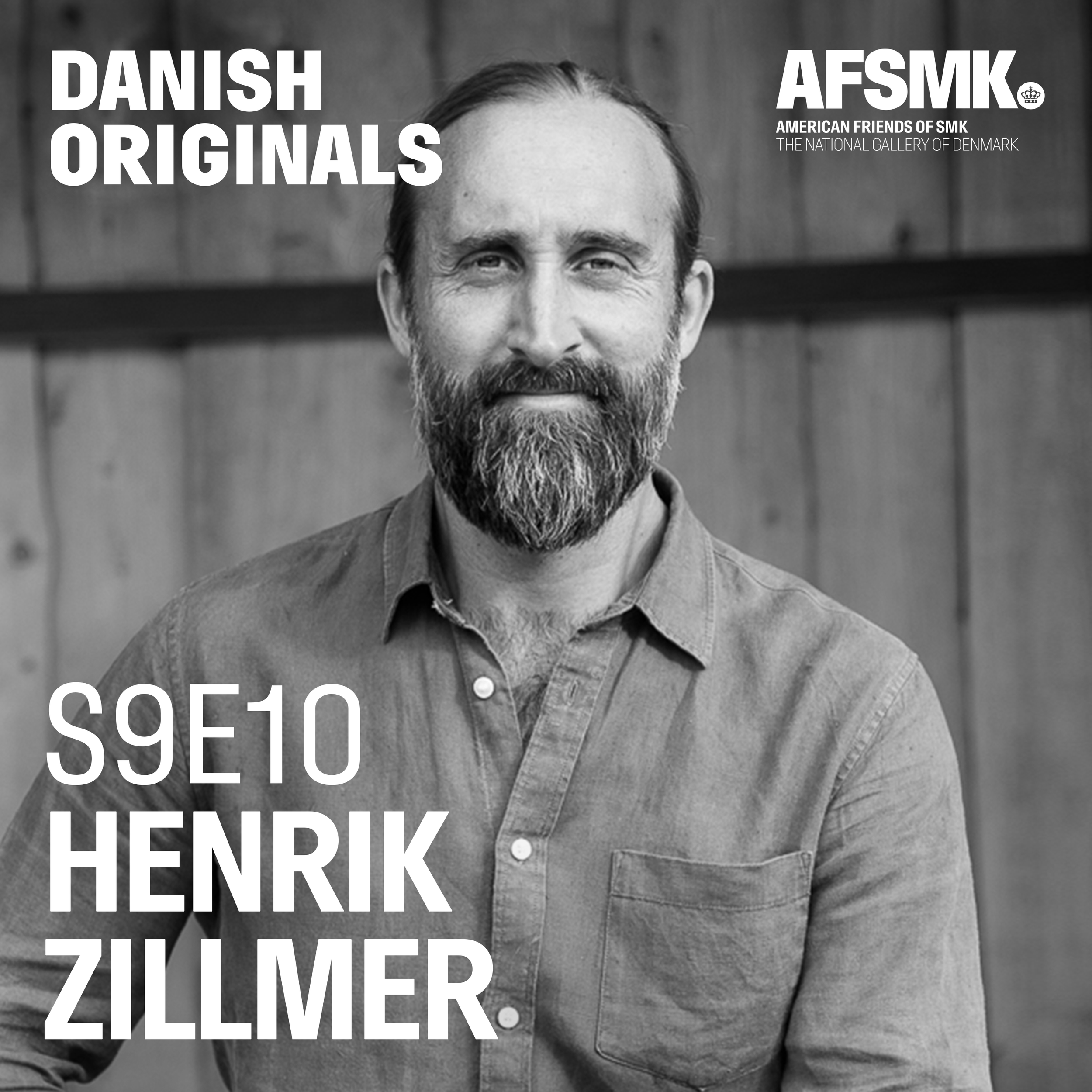
From his home in Portugal, suburban Copenhagen-born Danish serial entrepreneur HENRIK ZILLMER talks about AirHelp, one of many disruptive tech companies he founded that brought him to Silicon Valley and New York. He describes the concept of Justice-as-a-Service, his background in comedy and the military, and the cultural nuances in entrepreneurship in Europe, the US, and Asia. And he shares his newest ventures that take him away from technology into nature and the physical world.
Photographer: York Hovest

For today's episode, Henrik Zillmer chose Wilhelm Marstrand's Portræt af Otto Marstrands to døtre og deres vestindiske barnepige, Justina Antoine, i Frederiksberg Have, or Portrait of Otto Marstrand's two Daughters and their West-Indian Nanny, Justina Antoine, in the Frederiksberg Gardens near Copenhagen, from 1857 from the collection of the National Gallery of Denmark, Copenhagen.
“The irony is that you always see entrepreneurship as a straight line. In reality, it’s all these detours, left, right, center, up, down, exploring all corners. In our case, we found out after doing all the detours of all the things we thought we were gonna do, the actual core of our business was our foundation.”
“Once you do a successful thing, then there is competition, there always will be. People can be paranoid about competition, but as long as there’s someone who’s copying us, that means that we’re doing something right. So it’s actually a good sign.”
“I see that contented people just make horrible founders, because they’re just not hungry enough, they’re not willing to go that extra mile. And that is required if you want to get off the ramp and launch a company.”
Powered by RedCircle
This conversation by Asger Hussain occurred on October 22, 2025.
00:02
Henrik Zillmer
I chose the Portrait of Otto Marstrand's Two Daughters and their West Indian Nanny Justina Antoine in Frederiksberg Garden in 1856. And the painting is done by Wilhelm Marstrand.
00:13
Henrik Zillmer
This nanny was probably taken from her family of the West Indies to Denmark to be a nanny for this guy Otto Marstrand's daughters.
00:24
Henrik Zillmer
I was always fascinated with the story of Denmark and the West Indies and slavery. Denmark, as many other European countries, had colonies in the West Indies. And it shows the horror of what happened back then.
00:38
Henrik Zillmer
The contrast of an African woman taking care of two Danish girls, completely white. Probably she was one of the few in Denmark in 1856. As a colonial power, we had islands in the West Indies. But then partly because Peter von Scholten, Danish governor of the West Indies, fell in love with a local, love in a way became the first building stone of abolishing slavery.
01:02
Henrik Zillmer
I don't know if the painter had different intentions, he's family. But that was what it made me think of.
01:15
Asger Hussain
My name is Asger Hussain. I'm a film producer and guest host of Danish Originals, a podcast series created in partnership with the American Friends of the National Gallery of Denmark. Our goal is to celebrate Danish creatives who have made a significant mark in the US.
01:31
Asger Hussain
Today's guest is Henrik Zillmer, a serial entrepreneur who built one of the most disruptive travel tech companies in the world. Welcome, Henrik.
01:40
Henrik Zillmer
Thanks for inviting me.
01:42
Asger Hussain
I am genuinely thrilled to have this conversation. We've known each other for years, but we've never really talked about your journey through the lens of entrepreneurship and resilience. Let's start with where we are. I'm in my home office in Los Angeles. Where are you? Could you describe it for our listeners?
02:00
Henrik Zillmer
Well, not much different. I'm in my home office in the California of Europe called Portugal.
02:06
Asger Hussain
Very nice. How long have you been in Portugal?
02:09
Henrik Zillmer
I've been out for five years since we moved here.
02:12
Asger Hussain
You've been in many countries and we'll get to some of that. Let's start with who Henrik Zillmer is. You founded several companies and lived all over the world, with your work featured in The Wall Street Journal, The Guardian, Fast Company. Take us back to the beginning of your US journey. What brought you here and what set that in motion?
02:34
Henrik Zillmer
My fascination with America goes way back probably to my childhood watching everything on TV, as most Europeans experienced back then. I also knew, should the day come where I would consider starting a company, all roads lead to America. So I always had an interest in coming to America, and it was a dream from the beginning.
02:57
Henrik Zillmer
And I think going down that path of starting to build companies, you very quickly get more and more ties to America. And for me, it happened 15 years ago. I started my first company, AirHelp, it's called. And I was at the time thinking, oh, I'm gonna be working on this one from the beaches of Bali.
03:17
Henrik Zillmer
But very quickly, we got a lot of interest from Silicon Valley. If it's a tech company, that's where the interesting people are. I had to decide, am I gonna stay on the beach or am I gonna pursue the dream? Because then the dream is in America and then we need to go to California. So very early on that became the path of the company.
03:35
Asger Hussain
So you started, actually, abroad first. You say the beaches of Bali. Was an inception of the company somewhere else before Bali, or was it actually in Bali?
03:46
Henrik Zillmer
The company was started in Denmark. I'm Danish, I'm from Copenhagen. However, I am allergic to long winters and knew I didn't want to sit in darkness most of the day, and work from an office. I believe that good work can also be done from a beach, or at least places that are a little bit more warm and welcoming.
04:11
Henrik Zillmer
In the beginning, I was roaming around not only Bali, it was Thailand, many other places and starting this company from the beach, basically, thinking this was a lifestyle I wanted to pursue, being able to be a little bit of a free spirit. But I quickly realized that in order for this to become much bigger, we needed to settle down somewhere and get a good foundation.
04:32
Asger Hussain
The company is called AirHelp. The mission was and still is to help airline passengers claim compensation for delayed or canceled flights. What prompted that?
04:43
Henrik Zillmer
I'm from a family full of lawyers and pilots. And that's the combination you want if you're gonna go after airlines.
04:51
Asger Hussain
I bet.
04:52
Henrik Zillmer
And threaten them with legal actions if they're not paying up. So from family dinners and whatnot, these conversations led to me thinking, okay, there must be some form of service or product I can build, use technology to offer air passengers all over the world who have no idea that they're entitled to compensation and who don't want to bother spending all the time and effort trying to get it.
05:17
Henrik Zillmer
Because at the end of the day, chances back then were close to nil to get any form of compensation. It just didn't happen. So what I did back then was I said, okay, I'm gonna use my technology background, my legal references and build a machine that can automatically process all these claims so that it is possible to actually help the passenger, get money for them, but still earn some fee for that processing so that the company can exist.
05:47
Henrik Zillmer
So that was the model, you can say. Legal representation — that's not new, that's been around for thousands of years. But the automation part was new. All of a sudden, the cost of processing became so low that a $250 claim would be something you could actually have someone else process. Whereas before, no lawyer would touch anything worth $250 — simply not worth their time. And therefore the airlines knew that all these claims were gonna go unclaimed because there's nothing to service them.
06:16
Henrik Zillmer
That was a change. That was what we wanted to change. That was David's fight against Goliath because we were three guys with no funding whatsoever, just a lot of ambition and a dream. And taking up big airlines, that's a pretty hefty fight to engage in. But the good thing was that the law was on our side and eventually we had more people buy into that dream. That became the start.
06:41
Asger Hussain
And that was what was interesting too, about AirHelp. As a consumer, I've used it and I've gotten my money back. It was interesting that it was hidden in plain sight, meaning that this was not just a legal dispute, it was something that the airlines had to compensate people for. If they were delayed, airlines have to compensate.
07:01
Asger Hussain
Especially within Europe, there's regulatory things that mandate them to pay customers back. Instead, you get a $10 voucher. So you found something that not many passengers were paying attention to on their own. You brought that into the light.
07:16
Henrik Zillmer
Our biggest mission for the company these five years have been educational, to teach people, give them insight into what they are entitled to. And then we always encourage people, if you wanna do it yourself, please do it. Half of them, if not more, come back to us shortly after, with no answer whatsoever. The other half may have accepted a voucher or some miles. But we get people cash.
07:38
Henrik Zillmer
That was the educational task. In the beginning, we actually thought it was gonna be a nonprofit just for the benefit of informing every air passenger about their rights. But then we quickly realized that processing all these claims cost money. And in order to do so, we had to start charging a fee. It's been a blue ocean, still is, to some degree, to educate everyone on these rights. And still to this day, only 15% of all the people who are entitled to compensation actually get their compensation.
08:06
Henrik Zillmer
And now I'm not just talking about Europe, I'm talking about all of the US, North America, South America. We've started in many other countries that have air passenger rights. Also countries where there's just contract law, meaning that if you buy a flight ticket, the flight is canceled, you miss a couple of days on your cruise, that's an expense you had to carry. And actually the airline should pay that expense. You lost a couple of vacation days, so you didn't get the product you paid for.
08:29
Henrik Zillmer
That's just basic contract law, and that's what we're also working on in many countries today. And that opens up a lot of other doors where you can say, okay, this whole model that we've started, which we have coined Justice-as-a-Service (JaaS), that this is something you could actually apply to many different products and services and businesses where you as a consumer might be treated poorly.
08:51
Henrik Zillmer
And then do you have someone to help you, available in the palm of your hand that doesn't cost much or is a "No Win, No Fee" model, meaning that you only pay if you actually get some money back? That part is super interesting.
09:03
Henrik Zillmer
I feel that now with big data, with a lot of AI, you can now start to really democratize law so that it's accessible to you all the time, and you can have someone actually do the legal work for you, and thereby hold the companies up to their terms and conditions and consumer rights. A lot of companies don't care about them today, and they know that no one's gonna come after them.
09:26
Asger Hussain
It's very true. When you buy something, when you buy a product, when you buy this microphone that I'm speaking into, the product description is two pages, the terms and conditions are 28 pages. And if you actually try to engage with the company about anything, that's where you get the least amount of response.
09:45
Asger Hussain
So it's very interesting what you're doing. Walk our listeners through how a company like that starts from the idea to getting traction. And then, for you moving to Silicon Valley, what happens when you get there? How does a company go from point A to point B in that particular context?
10:05
Henrik Zillmer
So the whole thing started with me traveling like a maniac, back in the day, for another company I was working for. I was experiencing my own share of delays, cancellations, and horrible service. And I started claiming these claims for myself, knowing that there are rights, just to see what would happen.
10:26
Henrik Zillmer
I also figured out how to make them pay. In some cases I had to ask friends to actually put their name down so we could do a legal action and see where it would end. And I ended up getting the compensation very quickly. I was doing it for friends, I was doing it for colleagues.
10:41
Henrik Zillmer
And that made me realize that there's millions of other people out here who were in the same situation and they were not getting any help. So that was the very beginning. Back then, I also found out that there are lawyers who are doing this, but just for big group travels and stuff like that, but never just for the individual.
11:00
Henrik Zillmer
So that was what got me on the idea in the first place, not knowing if that would work or not, but decided to set aside a year, with a couple of friends that could help me do it. And we all agreed that in a year's time, if we are not making any money and we can't pay ourselves any salary and we haven't been able to raise any money for it either, then we'd call it quits.
11:22
Henrik Zillmer
But if we somehow along the way would get a breakthrough and the customers would get their money or we could raise some money, then we would push on. After six months, we applied for Y Combinator, which is one of the most prestigious incubator funds, or accelerator, I would call it, in Silicon Valley, and thereby also the world, started by Paul Graham back in 2005.
11:47
Henrik Zillmer
And only a very few companies get into this. About, I think, 20,000 companies apply now on every batch. And when we got in, there were 60 companies who got in, and today, I think it's closer to 200 or 300 companies. So they've grown quite a bit. But back then it was 60 companies. So you can imagine with all those applications and 60 companies getting in, this was the opportunity of a lifetime.
12:10
Henrik Zillmer
And the fun story here is that we were actually sitting in Bali at the time, getting the email saying, oh, we loved your application, come over to Silicon Valley and we do an in-person interview. And at that time, all the money we had left was basically to buy ourselves those flight tickets and go to Silicon Valley for that interview.
12:27
Henrik Zillmer
But we decided, it's a must, we have to try, we will never forgive ourselves if we don't. And we went over there and we had the in-person meeting prepared. And it went horribly, absolutely horrible. Because these are some of the sharpest minds of Silicon Valley, frying you, and very quickly finding all your weaknesses. So there's no point in hiding them.
12:48
Henrik Zillmer
So you actually go out there thinking that was a big waste of time. And then they tell you two things. They say, if you get an email, you're out. But if you get a phone call, you're in. And then we sat there that evening in a little bar in San Francisco waiting for something. And then eventually the email came, but in the email it said, what's your phone number? So they had actually somehow not gotten our phone number and we were sure that when we saw that email, aaah, we're out.
13:19
Henrik Zillmer
They gave us a call shortly after, saying they would love to invest and the program starts in a month. You need to get your butts to Silicon Valley. The accelerator program starts in January. In April, you're gonna present to the biggest 500 investors in the world on the tech scene. We had to pack our things, get to Silicon Valley, and then the real work began because as I said, it's an accelerator program.
13:41
Henrik Zillmer
They push you, push you, push you to really grow as fast as possible so that you have a very appealing story. On demo day, it's called — on demo day, we were able to, I would say, do a pitch that probably was top five in the class. It's still used today by Y Combinator as a best-in-class example. It was also an appealing business idea, so people found it interesting.
14:04
Henrik Zillmer
It got us about $5 million in seed funding, which in America is a seed round; in Europe, that would've been a Series A, meaning something you'd get much further down the line and probably also at a much lower valuation. Here, we could basically set our valuation, we could raise $5 million, and from some of the best investors.
14:24
Henrik Zillmer
We had the founder of Twitter, Evan Williams, come on. We had Vinod Khosla, leading the round from Khosla Ventures. We had Paul Buchheit, the founder of Gmail, and a lot of the other partners of Y Combinator invested themselves. It was really heavy hitters that were coming on board, believing in our company. And that was the American launch, you can say.
14:46
Asger Hussain
And as you progress in the company and you look back to that moment, is it still the same idea that's valid today? When I hear about AirHelp, I think one of the real amazing things about it is the simplicity of explaining it to someone. And I assume that's why you stood out too in your presentation. How much have you changed the company from back then till now, and I bet it's been 13, 15 years or so?
15:14
Henrik Zillmer
The irony is that you always see entrepreneurship as a straight line. In reality, it's all these detours, left, right, center, up, down, exploring all corners. And in many cases, which was in our case, we found out after doing all the detours of all the things we thought we were gonna do, the actual core of our business was our foundation. And that is still what we need to go out and make sure the whole world knows.
15:44
Henrik Zillmer
And that's a task that's gonna take time. And we're still fighting that fight, so to speak. But my God, we tried so many other things thinking that we needed to be much more than what we are. We actually just need to be extremely good at that one thing that we are so that no one else can do it as good as us. And that we are the go-to guys for flight disruptions and that kind of stuff.
16:07
Henrik Zillmer
So that was a long path of learning. And to this day still our strongest product, even though we have built other products. Today we sell other products and services and we do travel insurance and stuff like that, and we do it through our partners and whatnot. There's a whole B2B arm of our business as well. But the core of the business is still what you find easy to explain. We help air passengers get money from airlines if your flight's been delayed or canceled. That's it.
16:36
Asger Hussain
So 15 years in, and I want to go back to some of the early days again. What are some of the most outrageous moments you experienced in creating this? And those can be physical moments, personnel-related, investor-related. What is something that happens when you build something like this that people don't think about?
16:55
Henrik Zillmer
There's a lot. Someday I'm gonna write a book about it because I actually feel the journey has been so crazy that we need to write it down before it disappears. and I also feel that our journey has been particularly wild also because we have a crazy business model trying to get money from people who don't wanna pay it. Try starting that and then doing it from big airlines.
17:17
Henrik Zillmer
There's so many. I would say one is the first thing that got us started. We had no money for marketing, so we had to rely on PR. And my co-founder Nicholas, he was able to get one of the biggest Danish TV stations to follow us to the airport in Copenhagen. So the TV crew could get into the other side of security, the press can do that, we can't.
17:38
Henrik Zillmer
We had to buy cheap tickets to get through security, with no intention of taking the flight, but only going to a gate of a flight that was coming in three hours delayed, so that we could tell all the passengers coming off, oh, you're entitled to compensation in the airport. And the whole TV crew was following us.
17:55
Henrik Zillmer
The crazy thing was running through the airport with this TV crew, and everyone was wondering, what are these guys doing? And then coming to where you go through immigration, and they were asking us, where are you going? I couldn't remember which ticket I bought, so I said 'Berlin," and then my co-founder said, "no, London." So, pretty suspicious, but he let us through, so we got through and got to the gate.
18:16
Henrik Zillmer
They filmed the whole thing, showed it on primetime Danish television at eight o'clock in the evening saying, "Thousands of People are Missing Out on Their Compensation" and overnight, boom, it exploded in Denmark. We had 3,000 new customers just because of that.
18:30
Asger Hussain
I am sure the airlines love you for that.
18:33
Henrik Zillmer
Oh, no, they pushed the airport. The airport's biggest customers are the airlines. So the airline told the airport that if it happens again, it's gonna have serious consequences. The airport reported us to the police for unsolicited marketing on private grounds. The airport's private.
18:48
Henrik Zillmer
And we were told that if we ever do that again, the police are gonna come after us. We were threatened by that many times, and by the airlines directly, not only in Copenhagen, many other places. So that was just one thing of gorilla warfare doing what we could.
19:02
Henrik Zillmer
And then another thing, I also love that story. We wanted to sign some of the online travel agents in the beginning. At that time, Expedia was the biggest. We wanted to sign Expedia. We got to talk to the right people at Expedia, and then we said, okay, let's charm them. We invite them to Copenhagen, they come to Copenhagen, we give them a tour of Tivoli and all the beautiful areas of Copenhagen, like a little fairytale.
19:27
Henrik Zillmer
But the problem was we were still only three people. Maybe we had a couple of customer supporters at the time. A company like Expedia doesn't just make a partnership with a five-person company that's existed for a couple of years. That doesn't happen. If they invest all the time and resources, hell, they don't even know if the company's gonna exist in six months. We had to create the illusion that the company was much bigger than what it was.
19:51
Henrik Zillmer
Definitely fake it until you make it. We just believed we could do this. I asked my friend if we could borrow his office, with all his employees. And then we just put in some AirHelp merchandise and make sure that if anyone asked when the delegation from America comes, they'd know all the AirHelp lingo and can answer what they're doing.
20:12
Henrik Zillmer
So we borrowed their office. When the delegation came, they were so impressed — Wow, what a beautiful office and Danish design and much bigger than what we thought. That night we had dinner at the pirate ship on the lake inside Tivoli Gardens, and they loved it. We had such a good time. And they went back and then after that they said, okay, let's do this, get it rolling.
20:32
Henrik Zillmer
Any other small company would dream of such a partnership. We flew to Seattle afterwards to sign the deal. And once you get someone like that on board, all of a sudden all the other competitors say, oh, if these guys are doing it and they did the due diligence on them, then we can also do it. So bam! opened the door for all the other partnerships.
20:51
Henrik Zillmer
And today we have more or less a monopoly on all the travel agents in the world. They all use AirHelp, there's no one else. Even though there is competition out there. Once you do a successful thing, then there is competition, there always will be. People can be paranoid about competition, but as long as there's someone who's copying us, that means that we're doing something right.
21:10
Henrik Zillmer
So it's actually a good sign that people are starting copycats, even down to the last comma, taking our entire website. That's a good thing. We should be more worried the day that no one's copying us, because then either it's not working anymore, or we've taken the whole industry, but that doesn't really happen. There will always be competition in some form. We see it as a good sign.
21:31
Asger Hussain
That's amazing and a great outlook. And I think many companies have been through their version of what you described — the phone rings, looking extra busy, looking bigger than you really are, and really appearing to someone that you are much more than you are at the very moment. Ultimately it comes down to the execution, what you're able to do, your idea, and you were obviously able to deliver on that front.
21:57
Asger Hussain
I want to go back a little bit and start at the beginning in Denmark. Tell us a little bit about where you were born, where you grew up, and what was young Henrik like? Did you have a book of ideas running around the kindergarten playground?
22:14
Henrik Zillmer
I wish I could say that I was the entrepreneur from early on, but I think I was more the guy on the furthest back row telling jokes to everyone. So not necessarily so serious about anything besides good laughs and making other people laugh. So I think that's part of my entertainer genes that always wanted to get out, and always being comfortable in front of people, I would say.
22:39
Henrik Zillmer
So maybe that is a tie to entrepreneurship because entrepreneurs for sure go on stage or in front of other people. But back then I was just playing around having fun. Youngest out of three, suburbia, Copenhagen, safe, very idyllic, biking around. I always was a little bit curious about the world. I had a more worldly appetite, traveled a lot with my family. I wanted to get out beyond small Denmark's borders.
23:07
Henrik Zillmer
But up until that point, I was mostly interested in having fun. I tried my best at a career as a comedian for some years. I loved it, but realized also that show business is hard and can be very trivial in the sense that you're basically just performing the same thing night after night after night with a lot of transportation in between.
23:27
Henrik Zillmer
And the pay isn't good unless you're really good. And if you don't have English as your mother tongue, if you're in a small country, it's very limited. So I said, okay, maybe I can have an outlet for that in some other ways and forms.
22:39
Asger Hussain
And for a couple of years, you were in the military too. Did you crack jokes in the military?
23:44
Henrik Zillmer
Oh yeah. Military jokes as well, definitely the guy with the fun punchlines. And I did two, three years in the Army to test myself. Also, family tradition. The Danish army is not really known for necessarily going into battle and defending the country. We are active in all NATO exercises, been for many years. But you don't have the immediate threat of being attacked by anyone, at least not back then.
24:09
Henrik Zillmer
It was more to test myself, see what physically, mentally I could do. And that also gave me courage. I was 20 to 23 years old. If you're given a lot of responsibility at a very young age, and you're able to manage it, it comes easier to you afterwards. You get above your fear and you're not fear-driven. You have more belief in yourself. It definitely defined me as a person.
24:35
Henrik Zillmer
At the same time, knowing that this environment, the stiffness of the military, the very authoritative system, I didn't thrive so much in it. And I couldn't accept when things were wrong or inefficient. I knew that it was not gonna be my career path. I needed something a little bit more adventurous. Nonetheless it gave some really good skills that I've used a lot later on in life.
24:59
Henrik Zillmer
I would even say the military education I had for three years gave me more than the three years I did my bachelor and afterwards my masters. And I'd studied around the world as well during that time where I learned more about cultures there. But the books themselves, what I learned in school never really stuck, never really got me excited. School never really got hold of me because it was mostly theory, mostly taught by people who hadn't necessarily experienced or done it themselves.
25:28
Henrik Zillmer
Until I studied in America where we two met for the first time. I did an exchange semester in America in 2005, and that was actually the first time where I had four professors who were shifting from being a professor to being in private companies with C-suite positions, and then going back into schools and teaching people what they learned.
25:50
Henrik Zillmer
And that was such a big difference. I loved it because wow, you could actually have conversations about how this is applied in real life, and they could tell you what works and what doesn't. So that was a big eye-opener for me that university could actually be different than just theory that I'd mostly been experiencing.
26:09
Asger Hussain
It's quite the journey, and I think we can trace certain things back to Denmark — culture, the freedom to take your time to think about what you want to do, whether it's comedy or the military. And in each of those instances there is a little bit of room to explore who you are as a person.
26:29
Asger Hussain
You mentioned the military and you mentioned the authority there. And I think that's probably what you did when you went out with AirHelp. That was, what's the biggest authority I can find and how can I question it to the max, and then how can I break down some of those things? And it worked.
26:45
Asger Hussain
I want to ask you about school. Is that something you would be interested in, be a guest professor at NYU or somewhere in Europe and give some of that back, both the life knowledge, but also the mechanics of what you've learned?
27:01
Henrik Zillmer
I tie that back to the experience I had in New York because today, if any school asks me, I actually make an effort to go there and speak. Especially in Europe, because Europe doesn't have a lot of those people. I took my bachelor degree at Copenhagen Business School. I've been there many times talking about AirHelp and my learnings there.
27:19
Henrik Zillmer
Also here in Portugal, where I live now, I've been to the business schools here giving talks. And in Berlin, I did the same. I actually also did it in New York a couple times after we moved from Silicon Valley to New York. Those early years where you don't know much, if someone can come and inspire you and tell you how it is, that's just gold, I feel, so I want to be able to give back, and I also love doing it.
27:43
Asger Hussain
Anecdotally, having lived in Asia, Europe, the US, what are some of the differences in entrepreneurship and the way that we're taught entrepreneurship and the actual ability to do the work?
27:56
Henrik Zillmer
That's a big question.
28:57
Asger Hussain
It is.
28:58
Henrik Zillmer
I can talk about it for days. Now that I've lived in Asia for five years, in America for six years, the rest in Europe. I've really seen the differences from the different cultures and the effect it has, either encourages entrepreneurship or doesn't encourage entrepreneurship.
28:15
Henrik Zillmer
And I think European culture doesn't necessarily encourage entrepreneurship so much. There are entrepreneurs, but we have many different values where we don't necessarily want to chase fame and fortune and build an empire. We are much more content and much more modest, and also a little bit more relaxed, you can say.
28:38
Henrik Zillmer
That's also why we don't necessarily work so much. And if we don't want to work so much, entrepreneurship is just not gonna be for you because that really requires long days and high risk. And if you're already content, why rock the boat, so to speak?
28:56
Henrik Zillmer
I always say now that I'm looking at other companies and founders I want to invest in, I see that contented people just make horrible founders, because they're just not hungry enough, they're not willing to go that extra mile. And that is required if you want to get off the ramp and launch a company. European investors have that disadvantage.
29:13
Henrik Zillmer
But then, they've created some of the biggest companies in the world still. So there is an expertise and a desire to change things as well. And maybe in Scandinavia, not so much in Denmark, but in Sweden, they also have that non-hierarchal, questioning authority, being skeptical to how the system is, and then being more willing to change it. So that's what's gone for Europe.
29:35
Henrik Zillmer
For the US, that's the mother of all entrepreneurship areas in the world. If you look at venture capital, about 80% of all venture capital is allocated in the US market, US companies. And then you have Europe for 10–15%, and 5% Asia. That's the ratio of things. When people compare it, you're comparing apples to bananas, because America is just by far so much bigger.
29:59
Henrik Zillmer
The culture there is just groomed around entrepreneurship from very early on, very different to Europe. Perhaps also a little bit ego based. I need more — the best cars, the private jets, a house overlooking the ocean — and more is better. So in order to do that, I need to really work and I really need to be smart about it. And I need to create success and I need to be successful in everyone else's eyes.
30:25
Henrik Zillmer
The best people in the world go to Silicon Valley, also because there's the money element to it. If you pay the highest salary, you get the best people. And if you get the best people surrounding a small area, that is a synergy effect and you get even better. So that has a lot to do with it as well, because of the risk willingness capsule, you get the best people to start companies.
30:43
Henrik Zillmer
The mentality is also very different. And the first thing, for example, at Y Combinator, all the Europeans are told by Paul Graham, I remember, you now need to get rid of that modesty because it doesn't work here. So if you go up and you say, maybe we can do this and maybe we can do that, and are a little bit insecure about the perfection of your product, that doesn't go well in the US culture.
31:05
Henrik Zillmer
We were told, look at these US companies and startups, they go out like there's nothing that they can't do. It's just amazing, everything is fantastic. It's a little bit like looking at a US person's LinkedIn profile and a European's LinkedIn profile. One is there's no limits to what this person can do, and the other one's maybe much more modest.
31:23
Henrik Zillmer
In a world where you need to shout loud and stand out, the US model just works better. And that's just how it is, and that's for good and bad. But it promotes entrepreneurship from a culture and value perspective better. And of course, with money, it just accelerates the whole thing.
31:42
Henrik Zillmer
And then on the other end of the spectrum, you have Asia, it's just completely different. A lot fewer entrepreneurs than in Europe and in the US. It's much more of a status thing. So, the risk of you losing status or having a failure in your life if your company didn't work out, can be devastating not only for you, but also for your family.
32:03
Henrik Zillmer
We don't necessarily have that level of disappointment in Europe, even though it's also frowned upon. In the US, it's a good thing if you had a failure, it taught you what not to do, so now you would be better. You rise back up, the pioneer, much stronger.
32:17
Henrik Zillmer
In Asia, on that point, people are not really willing to take those chances, so they don't do it. And if they are doing it, these companies, these family owned, 100 year-old companies that have existed forever, they're starting all the products and new services and then they're the only investors. So, very big difference. But the US is the holy grail.
32:38
Asger Hussain
It is, and you pointed out, it's culture, it's the value system. And 'cause I look at Denmark and I look at Europe at large, and I see the skillset is there. And I think even the motivation to work hard or discipline, rather, is there, but the risk taking is not so much there. It's the what-happens-if-it-doesn't-work takes up too much space very early on. And I think that can impede any type of progress right off the bat. You become your own worst gatekeeper.
33:11
Henrik Zillmer
And it's ironic because we have the best safety net in the world. The Scandinavian social welfare model is so good that even if you fail, the worst thing that can happen to you is that you might have to spend a couple of years where you can't afford much, but you have free education, you have free healthcare.
33:28
Henrik Zillmer
In America, on the other hand, if you fail, you can end up on the street, game over, and that can take you ten years to bounce back if you even are able to, so there's much more to lose. And still we don't, in Denmark or in Europe, want to take those chances. I think it has something to do with the value and cultural base, it's maybe not about risk, but we don't necessarily want to rock the boat because life is pretty okay.
33:54
Henrik Zillmer
I have a car, kids are healthy, maybe we don't need as much to be happy. And herein lies a whole other life philosophical question. Who's right and wrong? And I'm not sure there is a right and wrong. But if you are looking at the happiest people on earth, they tend to be in Scandinavia or Northern Europe countries.
34:10
Henrik Zillmer
And here, also from a family perspective, another big difference. Family always comes first in these countries, that's number one priority. In America, work comes first, that's completely opposite. In Europe, you have to prioritize your family, it's sacred. And then work comes after.
34:27
Henrik Zillmer
That's one of the things when I come back to Denmark, I have business relations with Danish companies. You would send an email in autumn break and you'd get an out of office reply saying, I'm spending time with my kids and you should do the same, even pointing fingers back at you for not spending enough time with your kids.
34:44
Henrik Zillmer
That's the mentality and great, I love it. But to start a business or a world empire, if you will, and change the world, you need to put in the hours and then it's not always time for family.
34:56
Asger Hussain
True, and I've recognized some of that. I want to talk to you a little bit about the personal aspect of this. I've known you to chase answers, bigger answers. What's the purpose of everything that we're doing? I know at one point you really actively sought out how can I change my outlook on things or am I experiencing everything that I should be? What am I chasing here? Can you talk a little bit about that?
35:25
Henrik Zillmer
That's also a big question. I think what initially got me on that path was that you chase, in a way, success, fame, fortune. And after ten years, I could actually look at myself, maybe I actually succeeded at that. Maybe I did create a successful company that has changed a lot of things and the benefits came along with it. I could afford a lot nicer things and more adventures and all that.
35:50
Henrik Zillmer
So I climbed that mountain. Then what? I looked at all my colleagues, they would just jump onto the next venture, next project. We have to ring the bell at Nasdaq, or it has to get bigger and bigger and bigger and bigger and set new goals. And I found myself a goal oriented mindset of next, next, next, next, next. And all of a sudden, life has passed.
36:10
Henrik Zillmer
I felt a desire to figure out, okay, there must be more to this. Or at least, can I somehow optimize life fulfillment and happiness more than my goals in terms of earning this or being recognized for that or IPO with my company? And what sparked the interest?
36:30
Henrik Zillmer
Another big influence that changed my life, in a way maybe cliché now. Back in the day when I first went to Burning Man, which was a completely different experience, a completely different festival as well, I actually saw people who were down that path, went into that rabbit hole of figuring out who themselves were.
36:47
Henrik Zillmer
But also, how do they live a happier life, a fulfilled life, and not necessarily a material life. So that was an inspiration and I started my own journey. And I feel that part is also very much a big industry, I would say, in America today. Less so in Europe. But for sure there's a lot of people there that inspired me to start finding answers.
37:08
Henrik Zillmer
And I did a lot of things, from silent retreats over ten days where you're not allowed to talk to anyone, to retreats in Peru and the Amazonian forest, drinking different kinds of tea to vision quests, you name it. And the irony is that after doing all of this, I still don't know exactly what's going on.
37:29
Henrik Zillmer
But at least I know a little bit more about myself. And I think knowing more about yourself makes you able to stand out a little bit from your own mind, your own monkey mind. And if you can do that, you are much better able to also say, okay, don't react on this, react on that — pick your battles, in that sense.
37:50
Henrik Zillmer
You get more balanced in how should I navigate life? What's important, what's not important? And by doing that, your fluctuations become less, and then you become, I think, more harmonious in general. And then from that you can be a better friend, better husband, better father, and so forth. It's a lifelong journey. It's not something that ends before it actually ends.
38:12
Henrik Zillmer
But for sure, I feel now maybe starting another company again. But the way I'm doing it is gonna be different this time than the first times. And I think a lot of that is to credit learning more about myself in how to do it, in that way, be more efficient about it, not necessarily kill yourself in the process.
38:30
Asger Hussain
So no more Ayahuasca retreats for the company just yet?
38:34
Henrik Zillmer
No, and you also have to be careful about that because it might work for you, but it might not work for other people. I never recommend it, but I can point at the door if people ask me. You hear stories of people taking their whole management team to retreats like that, and that's a HR disaster right there, I would never do it. But I did once actually get my whole management team to do a breathwork session —
38:57
Asger Hussain
I've heard of those.
38:58
Henrik Zillmer
— which is not as extreme. Nonetheless, I think half my team was in tears after this because they had never really done any form of meditation, never really explored any of that, and this can be sometimes powerful. So all of a sudden, they had a very deep, deep, deep session and maybe that changed them a little bit as well.
39:18
Henrik Zillmer
So I'm happy to also merge the worlds a little bit. And if you look at the underlying reason I did all these things, if you're starting companies, you're in the corporate environment, it can be very harsh. You can close up and if you're in tough negotiations, you're firing people or hiring people, that can make you pretty hard. And if you do it your whole life, and you're a very ego-based person, you end up like Trump.
39:42
Asger Hussain
Hopefully not.
39:44
Henrik Zillmer
Hopefully not. If you can somehow take the softness and the human part of yourself and merge that, so you don't necessarily have to be CEO Henrik and home Henrik and friend Henrik, but all the Henriks can actually be the same person regardless of whatever environment you're in, that must be the end goal. Because no one wants to be a full-time actor depending on the role you need to play.
40:10
Asger Hussain
It's very insightful. I have a question. When I look at everything that you've done and I try to distill it, and I can speak to you for hours, but I think you mentioned it yourself. AirHelp was about justice, in a way, it was about getting people what they were supposed to get, what they have the right to get.
40:31
Asger Hussain
You've scaled fairness, to use an entrepreneurial language. You've built companies that advocate for fairness. We're in the middle of a technology revolution right now with AI, with automation. What's the next injustice that technology could help fix? And can you bring empathy into that process knowing everything that you've gone through up until this point?
41:00
Henrik Zillmer
It's a really good question. I'm not an expert, especially not in the future, but I can see some trends in general. And I think from what we are doing in terms of the better business bureau of using technology to make sure consumer rights are enforced, 'cause consumer rights are there for a reason, that's some of the stuff that technology can make very accessible to you.
41:25
Henrik Zillmer
If you can teach robots to do it and get better and better at doing it, it's gonna get easier for the customer and more difficult for the big corporate giants and dinosaurs to follow the technology advance. So that means it's gonna get more and more fair. On the other hand, you also have a lot of threats from AI, a lot of safety, security, fake, whatever, that can get in the way and it can distort the whole picture.
41:51
Henrik Zillmer
But I am actually an optimist. So even though a lot of people see it as potential doomsday, I actually see there's so much good that can come from it. And I think some time we will have robots helping us, doing anything, everything, and I don't think necessarily life is gonna be worse because of that. I think it can get better.
42:12
Henrik Zillmer
I think we will reach a point where we need to think about how to entertain ourselves, because everything else is already done. And we are richer than we've ever dreamt of being, poverty is gone. So I think that's the time that's approaching very quickly, a golden age, if you will, of human beings.
42:30
Henrik Zillmer
I'm very excited about it. I think it can open up a lot of doors. And what we are doing is a small, small part of it. But I do feel that empowering people, in that sense, also gives some satisfaction in that we actually need to treat each other and respect the rules. So at least the rights are there for us. So that's a good example.
42:52
Asger Hussain
Absolutely, and thank you. One last question before I let you go. What are some of the next things that you are interested in that you're working on that you can speak to right now?
43:05
Henrik Zillmer
So the pendulum swings the other way. I've been doing consumer tech for a long time. I felt I needed to actually go a little bit away from zeros and ones and code, speaking to engineers the whole day, and do something I can feel and touch. Physical stuff, even though that, today, can partly also be produced by zeros and ones. That's what I'm looking into now, going a little bit back in nature.
43:29
Henrik Zillmer
One thing is building homes, building houses that can be prefabricated, easily collected, assembled, put out in nature, and you can actually live in nature very quickly, with a little twist of Danish design. This could be a great second home for a lot of people, couples, families, if you will. So that's one project.
43:48
Henrik Zillmer
And then I'm supporting a lot of other entrepreneurs, but a lot of it's physical goods, which is new to me. I also use my company building expertise in that. But it's a different thing. It's a little bit like walking around in my garden in Portugal, where I like smelling the roses and seeing what I planted a month ago coming up.
44:05
Henrik Zillmer
It's a little different than a company where you don't necessarily always see all the good things because it's happened incrementally. Now it's in your face and you see it. And I get a lot of satisfaction from that.
44:17
Henrik Zillmer
I'm going a little bit in the other direction and building physical stuff now. I have a lot of fun with it and learn a lot too. At the end of the day, I'm always the customer of my own company, that's how it starts. If I see something that the world's missing and I could use it myself, it's a good motivator.
44:37
Asger Hussain
Amazing. Thank you Henrik, for being part of Danish Originals. This was an absolute blast. We're so happy to have you. Thank you.
44:45
Henrik Zillmer
My pleasure.
44:49
Asger Hussain
For today's episode, Henrik Zillmer chose Wilhelm Marstrand's Portræt af Otto Marstrands to døtre og deres vestindiske barnepige, Justina Antoine, i Frederiksberg Have, or Portrait of Otto Marstrand's two Daughters and their West-Indian Nanny, Justina Antoine, in the Frederiksberg Gardens near Copenhagen, from 1857 from the collection of the National Gallery of Denmark.