
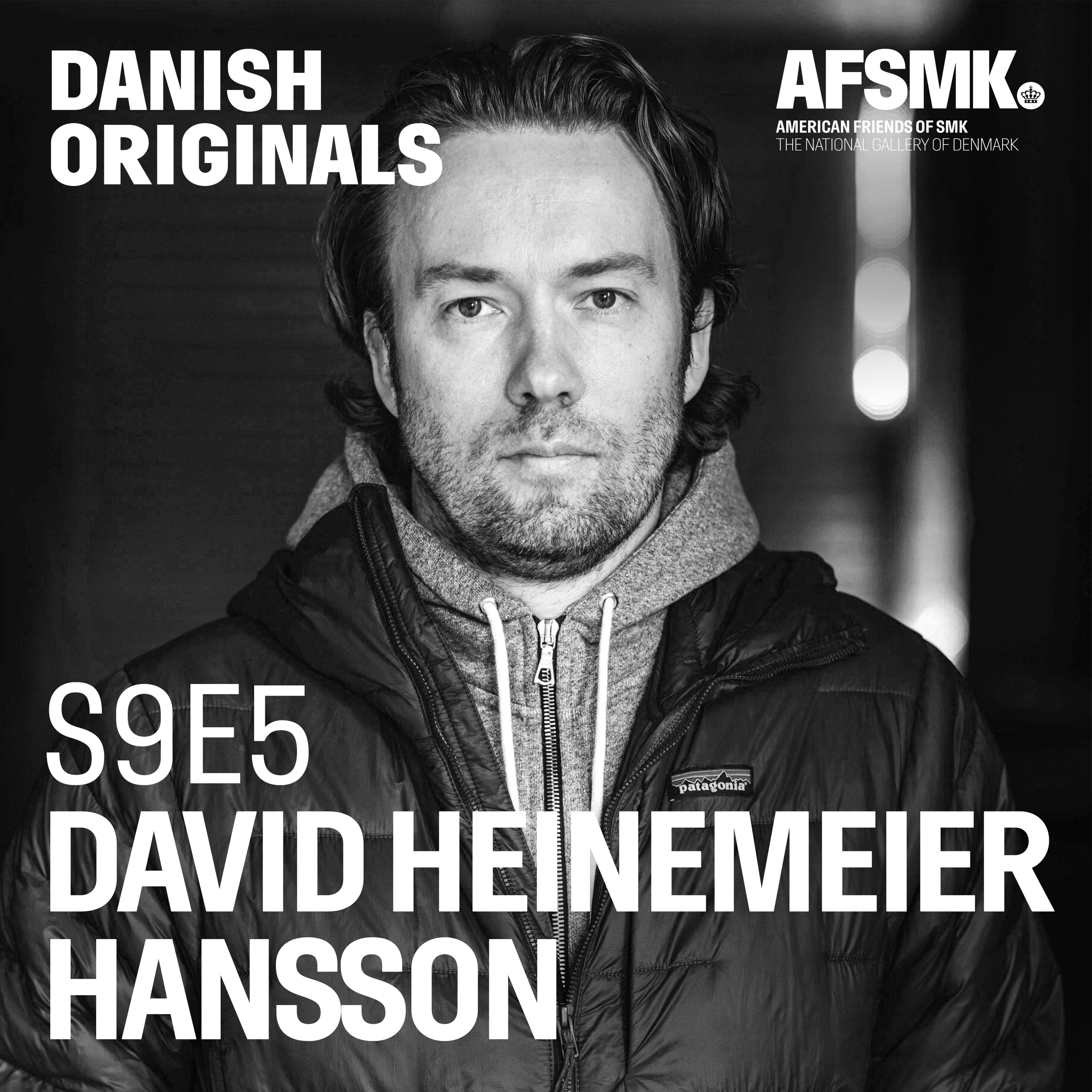
From his home office in Nordhavn, Brønshoj-born Danish tech entrepreneur, author, podcaster, investor, and racing driver DAVID HEINEMEIER HANSSON talks about his recent move back home after the fires in Los Angeles. David recalls his start of 37 Signals, his company that developed Ruby on Rails and Basecamp, and he shares his pursuit of flow, his life philosophy in Stoicism, and his thoughts on entrepreneurship, business, media, and the cultural landscapes of the US vs. Denmark.
Photographer: David Heinemeier Hansson

For today's episode, David Heinemeier Hansson chose El Greco's Mandsportræt, or Portrait of a Man, from 1570–1575 from the collection of the National Gallery of Denmark, Copenhagen.
“And if you fail the Americans generally say, I’m so glad you tried, I’m so glad you gave it a shot, get back on it, I’ll help you, I’ll help you get started again. The Danes, if you fail, we’ll have a little bit of that, why did you even try, don’t you know that most things fail, couldn’t you just get a job at a big company?”
“Know who you are, know what you want, know what your authentic goals and ambitions are. I really like programming. I really like computers. I really like the internet. I’ll make my little dent in that world. And I think that is actually something that’s a bit Danish, this idea of enough.”
“The most fulfilling part of my life when it comes to the world outside of my family, my children, my wife, is the pursuit of flow, the pursuit of total engagement with challenges and difficult problems that are just beyond my current reach and capabilities and competence. That is where I find the rush of learning, the rush of doing, and the rush of accomplishment.”
Powered by RedCircle
This conversation with Tina Jøhnk Christensen occurred on September 12, 2025.
00:04
David Heinemeier Hansson
One of the things I really love about art in general is this sense of shared history across generations. We are not just the people I knew in my lineage, we're not just my grandparents and my parents, and then me. There's a history that goes much further back and we see it in art.
00:24
David Heinemeier Hansson
I picked El Greco's Portrait of a Man to illustrate that. It looks so modern. It looks so relatable. It was right at that cusp where paintings went from the style that looked ancient, like the proportions not quite right, and then the technique just got so good right around that early Renaissance period.
00:46
David Heinemeier Hansson
It could have been done by someone who was into that style maybe just 50 years ago, but it's actually 500 years old. That's long enough that the world was intensely different at that age.
01:00
David Heinemeier Hansson
We have these artifacts and we have them so well conserved that I can enjoy them. I can be influenced by them. I can be inspired by what we were capable of back then. Love it.
01:16
Tina Jøhnk Christensen
My name is Tina Jøhnk Christensen, and I'm the host of Danish Originals, a podcast series created in partnership with the American Friends of the National Gallery of Denmark. Our goal is to celebrate Danish creatives who have made a significant mark in the US.
01:31
Tina Jøhnk Christensen
Today, our guest is David Heinemeier Hansson, a Danish technology entrepreneur, author, investor, and race car driver. Welcome David.
01:41
David Heinemeier Hansson
Thank you.
01:42
Tina Jøhnk Christensen
I'm sitting in my office in Los Angeles. Where are you, David? And it would be lovely if you would describe the location to our listeners.
01:51
David Heinemeier Hansson
I am back in Copenhagen. We moved back in the beginning of this year after the terrible fires in Malibu, Pacific Palisades, and Los Angeles hit the area quite hard. We had actually been in Copenhagen during the pandemic as well, had just moved back to the US, we were just settling back into the swing of things, and then these terrible fires hit.
02:13
David Heinemeier Hansson
Our house made it through the fires, but most of our neighborhood did not. And it was a very long cleanup, it's still not done, and we decided it was simply the best option for us, our family, our three boys to return to Copenhagen and try to get some normality back into the swing of things.
02:32
Tina Jøhnk Christensen
And the location you are in now?
02:35
David Heinemeier Hansson
I am in my home office in Copenhagen. We have an apartment in Nordhavn. It's not too far from the Copenhagen International School. A lovely area, a new area. I grew up in Copenhagen. I lived here for the first 25 years of my life before I moved to the US for about 20 years, and this area did not exist when I was in Copenhagen.
02:56
David Heinemeier Hansson
It basically sprung into life in the last ten, 15 years, and an absolute testament to the incredible city planning and design that Copenhagen is capable of these days.
03:08
Tina Jøhnk Christensen
You are the author of four books. One is Remote: Office, Not Required and the other three are It Doesn't Have To Be Crazy At Work, Rework, and Getting Real: The Smarter, Faster, Easier Way To Build A Successful Web Application. You co-wrote them with your business partner Jason Fried. What made you decide to write these books?
03:28
David Heinemeier Hansson
Jason and I have worked together for, at this point, almost 25 years, and in that time we've learned quite a lot about how to run a business, how to write software, how to work remotely, how to not go crazy at work. And we thought, these were all lessons worth sharing.
03:48
David Heinemeier Hansson
We wrote all of these books. I've written hundreds of blog posts on top of that. We enjoy doing the podcast shows that we do, and I speak at conferences as well. We're simply just passionate about sharing better ways of working, better ways of making things, and getting people inspired to reconsider the ways that they work.
04:12
Tina Jøhnk Christensen
You created Basecamp with Jason Fried around 2000. If you can explain to us what the company does in layman's terms, that would be great.
04:23
David Heinemeier Hansson
Sure. So the company's actually 37 Signals. It was started in 1999 by Jason Fried and a couple partners in the US. I joined up with Jason in 2001, which is actually a bit of a funny story. In 2001, I was working in the Danish tech industry. I saw that the dot-com boom and bust was happening, especially the bust part, that it was coming, and I applied to Copenhagen Business School.
04:47
David Heinemeier Hansson
I thought, I don't think this is gonna go over well. Let's go hide in school for a while. That same year, I connected with Jason Fried over random serendipity of a blog post. Jason was trying to learn how to program. He put a question out on it about how to do something in programming and I was simply a fan of the company.
05:08
David Heinemeier Hansson
So I wrote Jason with the answer to his question and we started talking and quickly realized that this was perhaps the beginning of something. Jason realized that it was easier to hire me than it was to learn how to program, and we started working together on client projects. Then in 2003, after working together for a couple years, we had the idea for Basecamp.
05:31
David Heinemeier Hansson
And the idea, really, was we'd been collaborating across an ocean in service of clients and we had been doing it all over email. And I think as anyone who've used email to collaborate with others will recognize, it's really easy to get started. Email is actually wonderful for breaking down those barriers across organizations.
05:53
David Heinemeier Hansson
But it does not last very long — before you don't have the right people in the thread, before folks who are joining the project later don't have access to the things you talked about earlier, before you don't have the right files, before you can't even get an overview of what are we doing. You end up in these long email threads and it's just not a pleasant way to collaborate on any material size project.
06:14
David Heinemeier Hansson
And we thought, we know how to build web applications, we should just do it for ourselves so we don't drop the ball with clients. So we have one place online where all the files are, where all the to-do lists are, where all the messages defining what we're working on are stored. And then we can just give someone access if they joined the project three weeks into it, to this one spot.
06:34
David Heinemeier Hansson
We built Basecamp and we released it the day after, I think, or the day before Facebook came into this world in 2004, and quickly realized that there were a lot of other people just like us who had been managing their projects over email and needed something better. And the business grew quite quickly.
06:54
David Heinemeier Hansson
It also grew in coordination with the Ruby on Rails toolkit that I built as part of building Basecamp, a toolkit that today has been used for about a million applications that are still online building things like Shopify and GitHub. Twitter was started on Rails, Airbnb, Gusto, and a million other applications out there.
07:18
David Heinemeier Hansson
So that was happening on the side. That was this open source project. We were just giving that away for free. And then meanwhile, we were building a commercial business software as a service, selling this Basecamp system for a monthly subscription. And I have been doing both of those things pretty much ever since. There's about 20 plus years of work and dedication in both of them.
07:40
Tina Jøhnk Christensen
What is your impression of being an entrepreneur in the US?
07:45
David Heinemeier Hansson
The US has a completely different vibe around entrepreneurship than anything I had been exposed to in Copenhagen. In Copenhagen, there were a handful of people who had big dreams and big personalities in the early internet industry, but the majority of them ended up doing exactly what I did. They moved to the US.
08:06
David Heinemeier Hansson
The US is just where these things happen. It feels like everywhere else around the world is a province of the US tech industry. So if you're into tech, if you're into programming, the center of the universe is the United States. And I felt that just very early landing in Chicago, even though Chicago is not actually a city particularly well known for software entrepreneurship.
08:32
David Heinemeier Hansson
It's not Silicon Valley, it's not New York, it's not San Francisco, it's not even LA. It's this third city in the US. And in some ways that might look like a drawback that you're not in the heart of hearts of the software industry. But I thought that in many ways it was an advantage to us because we did not follow the traditional path for software startups.
08:53
David Heinemeier Hansson
We did not raise venture capital. We did not try to become as big as possible as quickly as possible. We built a very nice business, but quite slowly and bootstrapped. Nonetheless, the atmosphere in the US in regards to entrepreneurship is just so different.
09:12
David Heinemeier Hansson
The whole culture around starting your own business, taking risks, and maybe you fail. And if you fail the Americans generally say, I'm so glad you tried, I'm so glad you gave it a shot, get back on it, I'll help you, I'll help you get started again. And then if you succeed, they're cheering, that's amazing, I'm so happy for you, oh, you got all this success!
09:37
David Heinemeier Hansson
Now, I'll give a caricature here of what the Danes are like. And it's not all Danes, but there are cultural differences that are noticeable enough that you can make caricatures about it. The Danes, if you fail, we'll have a little bit of that, why did you even try, don't you know that most things fail, couldn't you just get a job at a big company? Wouldn't that be easier? Why are you spending all your time on this?
10:01
David Heinemeier Hansson
And then if it works, if you're actually successful against all the odds, there's very much a cultural atmosphere of suspicion. There's not a sense of pride, I find, amongst many Danes when Danes do succeed, which I'm sure you've talked about with other guests, but Janteloven, this whole notion, don't think you're better than anyone else, don't stick your neck out too far. All of these things are very real.
10:31
David Heinemeier Hansson
Now, some of them also have positive aspects, and this is the conundrum that the Danes are never gonna be Americans. And some of the Jante Law principles, they're actually productive to have the kind of society that the Danes enjoy, where everyone is quite equal. We're one of the most equal societies in the world when it comes to income and also in terms of social status, and no one wants to stand out. So it feels like it's just one big middle class.
10:59
David Heinemeier Hansson
Even if that's not actually true and there is real wealth and there is real poverty, but it's masked and we like it that way. And I do think that there are positive social aspects of that. But I also think that if you are an entrepreneur who does like to dream big, who does want a risky thing, you will find a more welcoming audience in the United States than you will in Denmark.
11:25
Tina Jøhnk Christensen
You did eventually move to Silicon Valley, in the Bay area of San Francisco —
11:30
David Heinemeier Hansson
I did move to California. I moved to Southern California, which is one of the most gorgeous places on earth. I ended up moving to Malibu, just north of Los Angeles, around 2009 is when we started coming there, but I never made it all the way to San Francisco. I visited many times. I have good friends. I have a lot of admiration for what they've accomplished up there, but it was never exactly my scene.
11:54
Tina Jøhnk Christensen
What made you make the move? What made you decide that California was better than Chicago? I have to say Chicago has some chilly winds in the winter. Even in the spring, it's a very cold city.
12:06
David Heinemeier Hansson
That was really a key part of it. I felt I'd already suffered 25 years with Copenhagen winters, and now I'd made it another four or five years with Chicago winters. 30 years is enough. Now I wanted some sun in January. And I had this notion that since we were already working remotely, even in Chicago, where we had an office, I wouldn't go most days. I'd go into the office maybe once or twice every two weeks.
12:38
David Heinemeier Hansson
So I wasn't bound to a particular place. And since I wasn't bound to a particular place, I thought, do you know what? California sounds nice. We've done well enough at this point that I could afford a nice place out there. I could live in a spot where the winters weren't freezing my hands or my nose off, and I thought that was worth giving a try.
13:03
David Heinemeier Hansson
And after I'd done that, I realized, yeah, I really liked Southern California and ended up essentially staying and bouncing back and forth between Southern California and Spain, of all places, which is the place in Europe that is most similar to Southern California. So that's how we spent probably the next ten, 11 years, my wife and I together, bouncing back and forth between the US and Spain, but always with a center in Malibu, California.
13:32
Tina Jøhnk Christensen
Was there anything that surprised you about working with Silicon Valley where a lot of the technology companies like Google, Meta, Microsoft, Apple, and Amazon are based?
13:44
David Heinemeier Hansson
All my interactions with those big tech companies have been of two natures. On the one hand, I am incredibly impressed with the scale and size that these companies have been able to achieve. They're not just big in the US, they're big in the world. They dominate the internet, and the internet dominates the world.
14:03
David Heinemeier Hansson
So it's incredible the ambition that the founders of these companies exhibited and put into these companies and were able to grow them really quickly. But at the same time, they were not the kind of companies I wanted to work for. They were very often not the companies I even wanted to work with.
14:22
David Heinemeier Hansson
I've found that the big tech companies in the US have this tendency to realize that they are incredibly big and incredibly powerful. And it is a human temptation when you have all the power in the world to let that corrupt you a bit and to perhaps not be as nice as you could be. We've had plenty of fights with both Google and Apple over the years.
14:46
David Heinemeier Hansson
Particularly Apple. We made a new service in 2020, HEY.com, an email service, and we thought we were gonna take on Gmail. We thought we were gonna take on Google, but it turned out that the first battle we had to wage was against Apple because getting our new application into the app store turned out to be very difficult, and that Apple was intent on trying to take 30% of our revenue. And if we weren't gonna hand it over, they were gonna crush us.
15:18
David Heinemeier Hansson
So I've had these run-ins with big tech companies, and I've had this eternal skepticism that the beauty of the internet to me was all about decentralization, was all about having a million companies out there being able to access customers directly without the middleman, without having to ask anyone for permission. And some of the internet is still like that. More of the internet used to be like that.
15:45
David Heinemeier Hansson
Today, a lot of the internet is dominated by the Apples, the Googles, the Microsofts, and the Amazons of the world. And then you end up back in this situation, as it was prior to the internet, that suddenly you have gatekeepers. And those gatekeepers want their pound of flesh. And at the very least, they want you to ask them for permission before you publish anything. And that's not why I got into business. That's not why I fell in love with the internet.
16:10
David Heinemeier Hansson
That's not what I want to do. I wanna make great software, sell it directly to customers without having to get any other relation going than that direct one with the customer. If I can convince someone to buy Basecamp or to buy HEY, that should just be a transaction between the two of us. I don't need any third party in the middle of that, taking 30% or however much they want to take.
16:37
David Heinemeier Hansson
That just feels like an indignity, and it feels very much counter to that American capitalist spirit, that we don't want markets to get captured, we want free markets and we want free competition. And the US is the beacon for that in the world, but has also struggled with monopolies over the years, not just in technology.
16:58
David Heinemeier Hansson
Prior to that it was in oil, and prior to that it was in banking and it was in telecommunications. The US has dealt with a lot of monopolies over the years, but right now it is a bit in the grips of a new set of monopolists on the tech platforms. We're making some progress. The US sometimes takes a while to get going on it, but it's addressing it and I think there are alternatives springing up. So I'm more hopeful on that account than I've been in many years.
17:26
Tina Jøhnk Christensen
Speaking of Amazon, which was founded by Jeff Bezos, you actually welcomed him as an investor. How did you get introduced to him and why did you allow him into your business?
17:38
David Heinemeier Hansson
When our business was starting to take off in 2004, 2005, Basecamp was growing quite quickly and we were launching additional applications. We had just launched something called Backpack and we were working on a Campfire tool that was basically Slack ten years before Slack became a thing. We were gaining some attention in the industry.
18:02
David Heinemeier Hansson
And suddenly, someone from Jeff's team reached out and just said, are you interested in the conversation? And our first instinct was, no, we're not interested in the conversation. We've already been invited by a bunch of venture capitalists to conversations about how they wanted to invest in our company to blow it up real big.
18:22
David Heinemeier Hansson
And we had no interest in any of those things. We were growing quite quickly enough on our own, thank you very much. We were bootstrapped, so we did not have anyone to answer to. Why would we want someone else to be part of that equation? So the very first interaction was a polite, no thank you.
18:39
David Heinemeier Hansson
They reached out again and said, do you know what, he'd really like to meet. Just a conversation, what could go wrong with that? Both Jason and I had tremendous respect at that point already for what Jeff had built with Amazon. Amazon was in many ways the polar opposite of the kind of business that we were building.
18:57
David Heinemeier Hansson
It was growing incredibly quickly. It was losing an astounding amount of money as it was building out its infrastructure and its base, but it was also accomplishing something spectacular. Amazon was reshaping not just e-commerce, but commerce in general, how people were buying things and where they were getting it from.
19:17
David Heinemeier Hansson
So we thought, that's worth a conversation. Jeff has earned a conversation, even if we're not interested in his money. And that conversation then quite quickly revealed that Jeff was not like other investors. He was interested in us at the time simply because he had a curiosity to learn from others, to be part of something unique, and that his horizon on the financial side, which is very different.
19:45
David Heinemeier Hansson
Most venture capitalists need their money back in five to seven years. So as soon as you sign on the dotted line, you start a time bomb. And if you're able to dismantle that time bomb in time by growing your company so big that it can go public or it can get sold, you can have a good time. Most people do not manage to disarm the time bomb before it goes off, and then it blows up their company.
20:08
David Heinemeier Hansson
And we had seen that, both Jason and I, in the dot-com bust, these fantastical creations of companies, many of them vapid, many of them full of hot air, just blow up in 2001. Amazon itself almost blew up in 2001 when the stock traded all the way down to almost nothing. And we thought, no interest in that.
20:32
David Heinemeier Hansson
But Jeff was simply saying, can I be a part of this? Can I be along for the ride? Not on the traditional venture capital terms. We're not gonna have an end date. If you guys wanna stick around for the next 10, 20, 30 years, that's great with me. And Jason and I looked at each other and said, there's something here.
20:53
David Heinemeier Hansson
And there's something here because that's a compelling vision in and of itself because we'd actually like to hear what he has to say and get some counsel from him, but also just on a sheer economic sense of it. Because at that time, the company was growing rapidly, but from a very small base and we hadn't made any money.
21:09
David Heinemeier Hansson
We hadn't taken anything off the table. And suddenly someone shows up and says, what if I write you a check for several million dollars and you get to keep that money? You don't have to put it into the company. Because that was the way the deal was structured, it wasn't actually an investment.
21:24
David Heinemeier Hansson
It was a purchase of shares from Jason and me, not money that went into the company because the company didn't need any money. We were growing just fine without it. So Jeff bought a minority stake from Jason and I, got no control, got no timeline, just got a seat on the bus going wherever we were going.
21:43
David Heinemeier Hansson
And Jason and I got a couple million dollars each in our bank account, and therefore, the confidence to say no to everyone else, to say no to all the venture capitalists who may come tempt us in a weak moment with a big check, and therefore the freedom to pursue the vision we had for the company and to build something that was still ours and something quite unique. And that's what we did.
22:09
Tina Jøhnk Christensen
Let's talk about wealth a little bit. You say that it is better to be moderately rich and not too rich. I completely get that more is not necessarily better. But it doesn't sound very American.
22:23
David Heinemeier Hansson
I do think that most Americans have a philosophy that more is better and bigger is better. I'm not an American. I am an American immigrant from Denmark and was shaped by Danish culture to some degree, not completely. And I have many points of contention with Danish culture as well. But I do think it taught me something about happiness, actually.
22:50
David Heinemeier Hansson
By American standards you'd say I grew up poor. I grew up working class. Even just a class consciousness and awareness was absent from my upbringing. I grew up in a suburb of Copenhagen in Brønshøj and all my friends, it felt like we were all the same class, even though in retrospect we were totally not.
23:10
David Heinemeier Hansson
I had to earn my own money from a quite young age. I didn't just get things. And I think it left an impression that you can live like that and still be perfectly content, better than perfectly content, to have a great childhood, and that could be good. It also, of course, did give me an ambition to try to better myself.
23:28
David Heinemeier Hansson
I also realized quite quickly that getting outside the orbit of having to worry about rent and groceries, or even going to a nice restaurant, you don't have to be fabulously wealthy. There's a lot of things that many people think they wish they had, but if they actually had it, they'd grow really discontent with it very quickly.
23:49
David Heinemeier Hansson
Now, it's also not a choice. It's not like I had a billion dollars and said, you know what, I'm not gonna take it. So there's also just something of falling in love with your own situation that I think is very healthy. A principle I've tried to embrace my entire life is "amor fati," love your faith, love the outcome.
24:06
David Heinemeier Hansson
Now try to work for a better outcome, try to put in your best, but accept what you get once you put in your best. Once you have tried everything to better yourself. Because walking around being miserable about all the things you don't have, or all the things you couldn't reach is simply not a good way to live.
24:24
David Heinemeier Hansson
And that is true regardless of where you are on the wealth scale or the accomplishment scale or the skill scale. I'm not a gambler. I don't actually like risk in the same way I think a lot of entrepreneurial types in the United States like risk, who do like to put it all on the line. Much of the contemporary idols we have in that genre define that.
24:50
David Heinemeier Hansson
Elon Musk has about a million anecdotes about how he was almost broke, how Tesla was gonna run outta money in three months, and then miraculously he pulled it off. It's also not the only template. It's not the only model. You can build businesses in many different ways.
25:07
David Heinemeier Hansson
Know who you are, know what you want, know what your authentic goals and ambitions are. And mine are a lot more modest. I really like programming. I really like computers. I really like the internet. I'll make my little dent in that world. I don't need as much grandeur. I am content with that part of it.
25:29
David Heinemeier Hansson
And I think that is actually something that's a bit Danish, this idea of enough. And I just arrived at that stage where I do have enough. There's still more ideas I wanna pursue. I don't need more zeros on the bank account.
25:47
David Heinemeier Hansson
And that's just this glorious middle place where I find that I take much of my inspiration from these larger than life American characters and pair that with this Danish down to earth sensibility and then try to mix it in somewhat equal measures and end up with a cocktail that's somewhere halfway in between.
26:09
Tina Jøhnk Christensen
What have you found to be the most fulfilling in life, and what is your life philosophy, so to speak?
26:16
David Heinemeier Hansson
The most fulfilling part of my life when it comes to the world outside of my family, my children, my wife, is the pursuit of flow, the pursuit of total engagement with challenges and difficult problems that are just beyond my current reach and capabilities and competence. That is where I find the rush of learning, the rush of doing, and the rush of accomplishment.
26:47
David Heinemeier Hansson
And I find that sometimes that does happen with cars. Not only do I thoroughly enjoy cars on the street, I really enjoy cars on a racetrack. I have raced at the 24 Hours of Le Mans, 12 times. I spend a lot of my time pursuing that hobby and that hobby provides an incredibly consistent portal into the state of flow.
27:11
David Heinemeier Hansson
I also just love sitting in front of a computer, cracking a hard programming problem, or simply just enjoying writing either code, I write a lot of code, or prose, I also write a lot of prose, I write a lot of blog posts. I write a lot of articles. I've written a handful of books. I love both of those things.
27:31
David Heinemeier Hansson
I also realize that, especially in America, but throughout history, entrepreneurs go bankrupt all the time. They manage to squander whatever wealth that they have accumulated and they have to start over. And I've lived my life with the negative visualization always close at hand, that things could go terribly wrong, and I would have to start over.
27:55
David Heinemeier Hansson
And the only thing I would have to start over with would be my talents, my brain, my capacity, and my ambition. So I wanna be in a position where those factors could get things going again, even from scratch, even from game over. I think that just gives you a different outlook on life. Where is the real value?
28:18
David Heinemeier Hansson
I really like the Coco Chanel quote that the best things in life are free. The second best things in life are very expensive. Realizing the difference between those things is really quite important, and I think especially in an American context where a lot of people do manage to confuse the best things in life — finding a partner, in my case, my wife Jamie, who totally transformed my outlook on actually what constituted those best things in life.
28:53
David Heinemeier Hansson
I didn't know if I wanted to have a family or be a father. At least it was a very foreign concept at the time that we met, but fall in love with the right person and suddenly all your plans go out the window. And isn't that great that that's possible? And at the same time, starting a family, becoming a father of three children, you suddenly realize that all these things that you thought were also important are suddenly not all that important.
29:24
David Heinemeier Hansson
And there's suddenly a new thing that's way more important than all of those things. It really helps separate the most important things from the second most important things. And then the beautiful thing, of course, is in my case, I didn't have to choose, I needed to discern between those two categories.
29:42
David Heinemeier Hansson
So I paid the most time to the most important things, but I could also enjoy the second most important things, even when they were expensive. And that really does lead into the question, what's the philosophy of life? And I have multiple answers to that. The primary answer is that I discovered Stoicism as a philosophy of life.
30:05
David Heinemeier Hansson
In my late 20s, I think is, when I read A Guide to the Good Life for the first time, and I immediately found recognition with how my brain was already configured with how I was already thinking about life, with how I was already trying to divide the things that I control from the things I don't control, and focusing all my energies on the things I do control and not worrying so much about all the things I don't control.
30:28
David Heinemeier Hansson
Using the Stoic technique of negative visualization, of imagining what would happen if we went bankrupt, what would happen if my reputation got destroyed, what would happen if a terrible accident should befall me, and preparing myself psychologically for all those outcomes. Because I knew even before reading Stoicism that, you know what, it's not all sunshine and butterflies.
30:52
David Heinemeier Hansson
If you make it long enough into this life, you will face hardship, you will face setbacks, and if you are not prepared for those things, they could be exceedingly difficult. If you prepare yourself a bit, and a lot of it is just mentally, it can be a little lighter, it can be a little easier to make it through, and it doesn't have to crush you, it doesn't have to destroy you.
31:12
David Heinemeier Hansson
Now, other people will find their operating system in religion or other sources, but for me, Stoicism was really just a key. Then the other key of it was some of those modern implementations of it, or modern dialects of it. Viktor Frankl, his book Man's Search For Meaning that he wrote after spending time in a concentration camp during World War II and realizing that the people who made it out alive, they all had a why.
31:41
David Heinemeier Hansson
They had a why for why they needed to make it out. And the people who perished were often folks who lost the why, who lost the meaning. And he then expanded that into a whole branch of psychotherapy called logotherapy, the search for meaning, which really resonated with me that it's not just about doing things.
32:02
David Heinemeier Hansson
It's not just about being good at things. It has to amount to something larger. It has to serve a deeper purpose. And I need to be on the lookout for that purpose. And if I lose that purpose, the rest of it is gonna stop mattering. So I can't lose sight of why we're doing the things we're doing.
32:21
David Heinemeier Hansson
And I think this is a quite common modern affliction that you just go through the motions, you have some job and you show up from nine to five. And over the years you lose connection with why did you even get into this business in the first place? Why did you become a programmer? What was it about computers that attracted you in the first place and you get reduced to this cog that's just moving this wheel around and you can't see yourself in the larger picture?
32:51
David Heinemeier Hansson
David Græber wrote this wonderful book Bullshit Jobs, based on a survey he did, I think in the UK, where he asked people essentially, does your job matter? If you did not go in tomorrow, would the world be any worse off? Would your job not existing change anything? And a staggering, I think 35%, answered, I don't think my job matters at all.
33:16
David Heinemeier Hansson
So I do think we have a pandemic of basically missing logos in our world, in our society. And I've just been intent from the get go that I would not let that travesty befall me. If I lost sight of my logos, I'd either rediscover it, or find a new one.
33:39
Tina Jøhnk Christensen
Alright. What was life in Malibu like? It was very much affected by the fires in January. Maybe describe both things, the beauty of California and the danger of California with earthquakes and fires and mudslides and extreme weather.
33:56
David Heinemeier Hansson
I do think those are actually often two sides of the same coin, that if you chase the peak beauty, it has a bit of a dark side, it does have a bit of a drawback, and Malibu is one of the most beautiful places on earth. So the tradeoff is, it's also an area that can be struck by fires, that can be struck by earthquakes, that can be struck by mudslides.
34:22
David Heinemeier Hansson
There was even a tsunami warning this year. There are a lot of calamities that are constantly preying on poor Malibu, but the beauty makes it worth it, at least for a lot of people, a lot of the times, and in a lot of situations. But there's also another side of Malibu, which is deliciously boring.
34:42
David Heinemeier Hansson
I think Malibu has this image in the public consciousness as being the place for the rich and famous, and maybe they're imagining movie stars all over and movie stars doing movie star things. And maybe that also exists in Malibu. I didn't see very much of it.
34:58
David Heinemeier Hansson
I just saw a kind of sleepy town of 8,000 people just north of Los Angeles where people mostly just minded their own business and lived a little bit far from each other because we live up in the hills and you're not necessarily right next to and on top of people. I really like that.
35:19
David Heinemeier Hansson
I'm an introvert, I love nature, I love a beautiful view. All of those factors, Malibu satisfies in spades, but it's not a scene. It's not where you go to be seen, or at least maybe, I don't know where those places are. I never found them in over ten years in Malibu, but it's just a beautiful, calming place to live, and to some extent to escape from the world at large.
35:47
David Heinemeier Hansson
You get to live on this beautiful spot that seems almost desolate. There are many places from my house where I just see a handful of houses and then I see the ocean and then I see a bunch of trees. I can't always see Los Angeles, this great metropolis that's right next door, yet you have access to it.
36:06
David Heinemeier Hansson
I am, I don't know, 40 minutes from LAX when I need to engage with the rest of the world and travel somewhere. So it's at once both quite isolated yet connected. It's just an absolutely magical place to be. It's a beautiful place and it's a sunny place and there have been times where you can think, is that actually healthy?
36:31
David Heinemeier Hansson
Is it actually healthy for humans to live in 75 degree Fahrenheit, sunny 320 days out of the year? And I'm still not settled on that question. I actually do think seasons bring some natural churn to life that's healthy, and Malibu missing it explains some things about some of the people there and some of the attitudes there that I like in small doses.
36:59
David Heinemeier Hansson
And then I also like the realism of the rest of the world that do have seasons and do have to prepare for winter and other aspects of a sense of time passing. Sometimes it can feel like Malibu lives in just this one time zone, this time capsule. And nothing ever really changes until you have a fire, until you have a mudslide, until you have some calamity hitting it.
37:25
David Heinemeier Hansson
And then that calamity did hit this year. In all the time we've lived in Malibu, we've been used to the warnings of fires. In 2017, there was a really bad fire that hit western Malibu. We had friends that lost their houses. We evacuated, but it didn't hit us personally.
37:44
David Heinemeier Hansson
This fire in 2025 did hit us personally. Our canyon was on fire. There's walls of flame coming up through our house, which we had left in due enough time, but we were evacuated and two thirds of our neighbors lost their houses. We didn't. Very thankful for that, but it was difficult and I think a reminder that nature bites in Malibu.
38:12
Tina Jøhnk Christensen
Definitely. We spoke about cars before. You discovered racing when you were back in Chicago. How did you happen to discover it and what was this thrill of racing for you?
38:26
David Heinemeier Hansson
So the funny thing is I did not get my driver's license until I was 25, the year I moved to the United States. In, I think, January or February of that year was when I got my driver's license and I got it specifically because I wanted to travel to the United States and elsewhere. And I knew I needed a driver's license to get around because in Copenhagen you don't need a car.
38:48
David Heinemeier Hansson
I didn't have a car growing up. We didn't have a car growing up. I got around the city on the bus, I got around on bike, I got around on my roller blades, and I never really had an interest in regular cars. I didn't really care about the Toyotas and the whatever common commuter cars I would see around my streets.
39:10
David Heinemeier Hansson
But I did always like top gear, for example. I did always like the beautiful design of an Italian machine, like a Ferrari or Lamborghini. I like the history, I like the sound, I like the design, I like the flair. I liked a lot of these things. But when you live in Copenhagen and grew up like I did, that seemed a foreign world, if not a foreign galaxy.
39:35
David Heinemeier Hansson
At least it's something not within your reach, and it wasn't within my reach. So it was not something I was pursuing. Even the driver's license, as I said, I didn't even get it until I was 25. But then when I got to Chicago, I started meeting people, and two years after moving there, I met some friends who were into racing and they took me down to the local Chicago track.
39:57
David Heinemeier Hansson
There's a track about an hour away from the city in Joliet called the Audubon Country Club, and a friend of mine took me down there and we drove race cars for a day. Real race cars. The ones that kind of look like miniature Formula 1 cars, not as fancy, kind of old, not super safe designs from the late '80s, early '90s, but with a manual gearbox. You're sitting exposed to the wind, you can see the wheels. And it was completely intoxicating.
40:29
David Heinemeier Hansson
I'd done some track day stuff where you take your own car to a racetrack and that was fun, but sitting in a real race car and driving a real race car, that was when I got that complete rush of flow, where for a couple of hours, my brain was as blank as a Buddhist monk.
40:50
David Heinemeier Hansson
I felt I had somehow reached nirvana and complete stillness in my head in a way I was never capable of doing just sitting on a pillow, smelling some incense, and listening to some gongs or whatever you do when you are serious about meditation.
41:07
David Heinemeier Hansson
I found my meditation in race cars, which funnily enough are very loud machines. They're not very calm places. You're constantly screeching. You're constantly actually in an elevated state, in a stressful state because you need that cortisol to activate all your senses to their most heightened ability.
41:28
David Heinemeier Hansson
There's a little bit of fight or flight there. You need to make the next corner, as I said, otherwise things can go sour real quick. So I fell in love with that feeling, and after I'd experienced it, I simply couldn't get enough and I spent basically every weekend for the next four years going to that racetrack whenever it was open, and just driving as much as I could every session to the max.
41:55
David Heinemeier Hansson
I could not get enough of it. After a couple of years of doing that, practicing, learning how to drive a race car, I got interested in taking it further. And when I was taking it further, one mission came to mind real quick. And it was that my racing idol was another Dane.
42:17
David Heinemeier Hansson
It was Tom Kristensen who has won the 24 Hours of Le Mans more times than any other. Nine times. Literally earned the moniker, Mr. Le Mans. And I watched him win this race over and over again into the 2000s. So when I was getting into racing, he was still racing and he just showed — do you know what some Dane from, not even Copenhagen, just was able to accomplish this at the highest levels of motorsport?
42:47
David Heinemeier Hansson
That's deeply inspiring and it's something I somehow could see myself in. I think this happens a lot with countries all over the world that whenever one of their countrymen or countrywomen accomplishes something so spectacular, it just breeds this whole sense of I wanna do it too.
43:07
David Heinemeier Hansson
We now have a Tour De France winner that's Danish, Vingegaard. And I know that even before him, Bjarne Riis really inspired a lot of Danes to get on the bike. We're already crazy about the bikes, but using the bike in a competitive fashion was something that turned a lot of Danes into cyclists from the example of those two Tour de France winners, and I think Christensen did the same thing for Danish race car drivers.
43:36
David Heinemeier Hansson
There is an astounding, almost preposterous number of Danish race car drivers at this point. I think this year at Le Mans, we were 15 Danish drivers out of a field of — what, we are three drivers per car — 180 drivers, something like that. So 8% of the grid is Danish. That's crazy when you think of just how small of a country we are.
44:00
David Heinemeier Hansson
But Tom paved that way and he paved the way for me and he paved the way in terms of ambition, first and foremost. So I got started with that mission, started racing competitively in 2009. And in 2012, I was on the grid of the 24 Hours of Le Mans for the first time.
44:20
Tina Jøhnk Christensen
And Le Mans is a race that allows amateurs to race. It doesn't mean that they're not good. It means they're not making a living from it.
44:28
David Heinemeier Hansson
That's what's magic. That's what's really magic and why I found such an attraction to race cars. If I was really into basketball, there's no amount I could practice and then go, I'd like to be part of the NBA Finals, that'd be really fun. Can you put me on the Chicago Bulls? That's just not gonna happen.
44:46
David Heinemeier Hansson
The people who are on those teams are thoroughbred professionals who have dedicated their entire lives to that. In part because it's very expensive, sports car racing in particular needs gentleman drivers, as they're called. And the sport has always had that.
45:04
David Heinemeier Hansson
It has always been full of passionate amateurs, usually the kind who've made their wealth in some other industry and some other domain, and then decide to spend an alarming chunk of it on driving around in circles. And Le Mans has a great history of doing just that right from the start.
45:24
David Heinemeier Hansson
And therefore I got to be part of the same race as Tom Kristensen. I drove I think three times. I think he retired in '14, so maybe we shared the track three times at the 24 Hours of Le Mans, which is incredible. Tom, one of the best Le Mans drivers that history has ever known, and I got to spend time on the racetrack next to him and be passed by him. Just absolutely incredible and only possible because racing is this curious sport where amateurs and professionals rub shoulders and wheels.
45:59
Tina Jøhnk Christensen
Cool. And you did win it too, we have to add.
46:03
David Heinemeier Hansson
I did in my class, in the amateur class with Aston Martin in 2014, absolutely a highlight of my career. And also again, so very unique. Almost in no other sport is this possible. Maybe in sailing, I'm not even sure. But in race cars, amateurs like me, cannot just participate but can actually get so good that we can fight for the class wins.
46:28
Tina Jøhnk Christensen
Let's go back in time a little bit where it all started. You're from Copenhagen, you mentioned Brønshøj, and since you were a little boy, you were fascinated with computers and got your first one at the age of six or something crazy like that. For your generation, it was, at least. Talk about your childhood home. What was your childhood room like?
46:49
David Heinemeier Hansson
Yeah. I grew up in Brønshøj, as you said, not too far from Brønshøj Trov, which is the main square in that area. And it was really a great place to grow up as a kid in the '80s. It's actually that childhood experience that was partly responsible for why we decided to move back to Copenhagen. The freedom I enjoyed as a boy in the '80s is almost entirely gone from the American childhood experience.
47:23
David Heinemeier Hansson
This notion that I could stay out as long as I wanted, as long as I got home, not even before it was dark, even just slightly after it was dark, that was fine. My parents didn't know where I was the majority of the time. I could roam not only Brønshøj, but the city of Copenhagen on my own. From age eight or nine probably is when I started taking the bus into the center of town and just doing my own stuff.
47:53
David Heinemeier Hansson
That was an incredible freedom. And I think it really just left an enormous mark on my personality as someone who could just do my own stuff, not ask anyone for permission about anything, not ask, oh, I'm going over to a friend's house, or whatever. Maybe I'd call my parents and tell them that we're here, and many days I wouldn't. I'd just come home and it'd be fine.
48:18
David Heinemeier Hansson
That childhood experience is just not common, if not almost rare in the United States today, certainly not present in any of the major cities. You're not seeing eight year olds walking around downtown Los Angeles or New York or San Francisco. Most of them are being fared around in cars by their parents intermediating all their play dates, all their relations, and otherwise they're spending time perhaps in their room alone.
48:45
David Heinemeier Hansson
Now, I also spent a lot of time in my room alone in Brønshøj. I had a tiny room in our rækkehus, in our row house, and I spent a lot of that time in that room on the computer. And my first computer was an Amstrad 464 that my dad, who made a living repairing TVs and Hi-Fi equipment, traded with someone. I think he probably traded him for some speakers or something else like that.
49:13
David Heinemeier Hansson
And I got a computer at age six and just fell in love with video games first and foremost. Computers to me was the entry to video games, that was really what I cared about. And I spent almost all the time I had leftover when I wasn't playing with friends and we weren't just running around outside doing physical activities, I'd spend it on the computer.
49:35
David Heinemeier Hansson
And I had a lot of computers over those years. I fell in love with a lot of them. I ended up being so fascinated with video games that by the time I was 14, 15, I started writing about video games. As soon as the internet was a thing, I started publishing video game reviews on Danish websites. I was coordinating a whole group of people. We were building these websites together and just my world revolved around video games for a very long time.
50:03
David Heinemeier Hansson
It was right up until my early 20s, actually, when that interest pivoted into programming. And I discovered that there was something I liked to do even more with computers than play video games, which was to make my own programs, to do programming.
50:20
Tina Jøhnk Christensen
You went to Copenhagen Business School. Was it important to your future career that you went to this school?
50:28
David Heinemeier Hansson
Yes and no. I don't think I learned that much that I specifically applied as in certain skills, either in business or in programming. I have a joint degree. The program used to be called HA. Dat, which is basically half computer science, not even computer science, more informatics or information design. And then the other half was just basic business administration.
50:56
David Heinemeier Hansson
But I do think it gave me a real appreciation for just learning things that you don't always want to learn, but you should know and you can put to use. I do think that was very helpful and I had a great time doing it. I think it also taught me just that you can question things. A lot of the projects that I worked at, I started with, let's just question the premise. We get this assignment and I want to critique the assignment itself.
51:27
David Heinemeier Hansson
Sometimes that worked really well with certain professors who very much liked that the students were pushing back, and other times it didn't work at all and they were greatly annoyed when I just wouldn't do what they asked me to do. But I think it was a really good time, I'm very glad I did it.
51:43
David Heinemeier Hansson
I'd say that I've also come to appreciate the fact that life is quite long and spending three years at a higher school of education, it's just a drop in the bucket and you invariably will pick up some life skills and some important influences and meet some people you really should meet outside of your immediate sphere of influence or community. And that was really helpful.
52:12
David Heinemeier Hansson
In the United States the experience is perhaps a little more intensive. There are a lot of entrepreneurs who have almost a religious affection to their alma mater, who donate fantastical sums to Harvard or MIT. I did not have that kind of relationship to Copenhagen Business School.
52:32
David Heinemeier Hansson
And maybe it's because that experience in Copenhagen for a lot of students is quite different. You don't live on campus. You may live in a dormitory. I didn't. I have my own apartment because I had worked in the internet industry for a couple of years and saved up some money and bought my own place and I just went to school. So the relationship wasn't quite as deep, perhaps as it is for a lot of people in the US. But you're still meaningful. I'm very glad I did it.
52:57
Tina Jøhnk Christensen
From a business perspective, how has the return to Denmark been for you? You mentioned before that there's a huge difference between being a businessman in the US and being one in Denmark.
53:10
David Heinemeier Hansson
Yes. I think the thing for me is I get to observe it a little bit from the outside because my work situation here is not one of starting a new company inside the Danish system, inside the Danish culture. And I will say I've gotten a little bit discouraged or perhaps disappointed that some of the things we talked about with the cultural perspective is as ingrained as it is.
53:36
David Heinemeier Hansson
I had hoped that after being out for 20 years, we would've moved in a better direction and I don't actually see as much movement as I'd hoped for. That's not to say that there aren't businesses being started in Copenhagen, just not nearly as many as I would hope for.
53:52
David Heinemeier Hansson
It's not to say that there's no ambition at all for the ones that do run businesses to wanna grow bigger or have an impact in some ways, but not nearly as much as I hoped for. So I think we are in a little bit of a precarious situation in Denmark that so much of the welfare state is built on top of the pillars of companies that were founded a hundred years ago, in some cases more.
54:14
David Heinemeier Hansson
We have Mærsk, we have Novo, we have Lego, we have a handful of these tent pole companies that are producing the majority of the national income, and we should be eternally grateful for having them. But I also think we should be planting new seeds in the Danish soil with a far greater vigor than we are today.
54:41
David Heinemeier Hansson
There is far too much complacency that the big companies that we have will always be around. I don't think that's going to be true. The history of commerce is one of continuous creative destruction. And we need to continuously invest in the next generation of companies. And I don't see Denmark being serious about that, partly because the statistics tell us that they're not.
55:07
David Heinemeier Hansson
I saw a terrible statistic saying that I think it was in the last 30 years, or maybe it was the last 40 years, that only three companies in Denmark, I believe, had managed to grow over 1,000 people in the last 30 or 40 years. One of them was Netcompany, a technology consulting company. One of them was Fitness World, I believe, and I forget what the third one was.
55:31
David Heinemeier Hansson
That's not a very impressive record, and I think that's not just a Danish problem, it's a European problem. When you compare the largest companies in the world, especially the ones over a billion dollars or more in market capitalization that were created in the last 40 years — there's this famous bubble chart where you see the American side of it and you see all these bubbles and how large they are and how big the companies are.
55:53
David Heinemeier Hansson
And then you see the European chart and you almost need to zoom in to even notice that it's there because it almost looks invisible. Nvidia, one of the highest flying companies in the US, the makers of these AI chips, when I saw the news article a few weeks ago, Nvidia, one American company, has a larger market capitalization than the entire European stock markets, all of them combined.
56:21
David Heinemeier Hansson
That's not great. That's not great for Europe, that's not great for Denmark. We need to be careful. And what's so funny about that, especially from a Danish perspective, is that the Danish economy has basically never been better. We've never had more money, we've never had lower debt. It's very hard to convince people at the height of their welfare success that there are warning signals on the dashboards.
56:48
David Heinemeier Hansson
There are little red lamps and they're blinking and they're telling us that we need more entrepreneurship, we need more companies started. We need better conditions economically, politically, and culturally for entrepreneurship in Denmark. And I don't know if we're getting there nearly as fast as we need to, and maybe the good times are gonna last forever.
57:11
David Heinemeier Hansson
Maybe Novo and Mærsk and Lego and the rest of them are just gonna sail through and for another hundred years, they're gonna pay for everything. Wouldn't that be wonderful? If I was a betting person and I'm not really, but if I was an investing person and I am that, I would not invest on that premise.
57:29
David Heinemeier Hansson
I don't think that's solid enough. You need a portfolio. You need some small companies coming up. You need some mid-size companies, and what we have in Denmark is such a concentration of just a handful of companies pulling the whole load. It's not healthy.
57:46
Tina Jøhnk Christensen
My final question to you. David, I could go on, listening to you for a long time, but we have to end it somewhere. You are a young man, you have a blossoming career, what do you still want to achieve, things you want to accomplish before you retire and move to Majorca?
57:46
David Heinemeier Hansson
I've come to realize that for creative people or even ambitious people, retirement is a mirage. And in fact, to some extent, for some of them, a literal death sentence. I hope to stay active and engaged for another, I don't know, 30 years, 35. I'm 45 years old, so I'm not a spring chicken anymore.
58:26
David Heinemeier Hansson
In addition to amor fati, another foreign term I love is memento mori, remember death. Remember this is not permanent. Remember that in terms of spending your time appropriately, spending it on the stuff that matters, but also realizing that one day it will be over.
58:48
David Heinemeier Hansson
I do still have the vigor of pursuing ideas. Just today I had a wonderful conversation with one of our programmers and got insanely fired up about a software idea I cannot wait to sink my teeth into. Computers, in particular, is really my passion and making them better and making them faster, making them more enjoyable and more accessible and a million other things. And I think there's plenty there for me to fill the rest of my days with that.
59:20
Tina Jøhnk Christensen
Thank you so much for being part of Danish Originals, David, we really appreciate you being with us.
59:27
David Heinemeier Hansson
Thank you so much for having me.
59:29
Tina Jøhnk Christensen
Thank you.
59:33
Tina Jøhnk Christensen
For today's episode, David Heinemeier Hansson chose El Greco's Mandsportræt, or Portrait of a Man, from 1570–1575 from the collection of the National Gallery of Denmark.